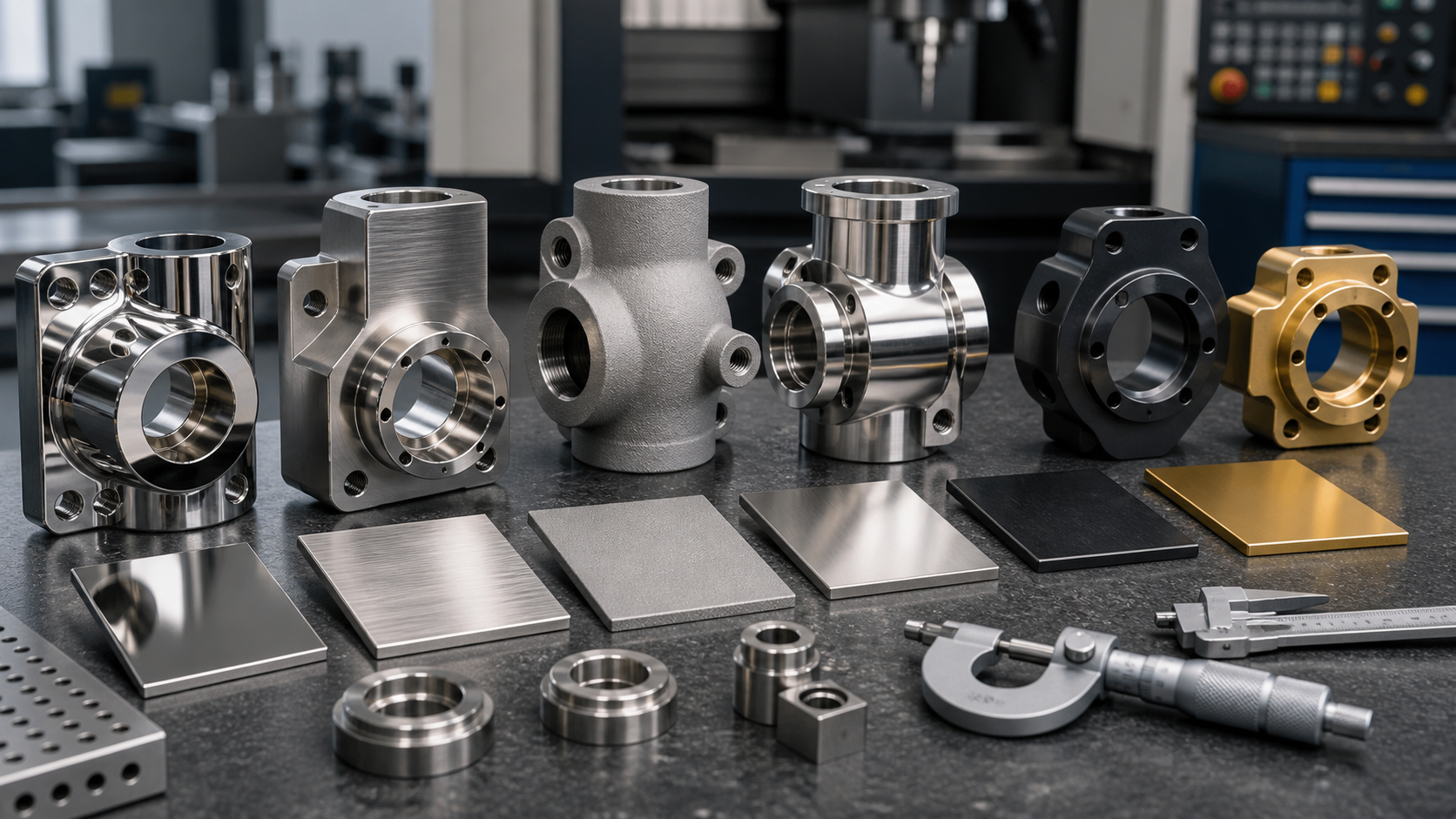
Surface finishing of stainless steel parts is not a final cosmetic step — it is part of the CNC machining service. Many projects require rework after dimensions have already passed inspection, not because the machining center lacks precision, but because tool marks, バリ, cleaning residue, 不動態化, electropolishing, and final dimensional changes were not considered together during process planning. For medical, food machinery, fluid valve bodies, appearance parts, 組み立てられたコンポーネント, surface finishing directly affects corrosion risk, cleaning validation, 組み立てクリアランス, バッチの一貫性.
In JADE-CNC project reviews, surface requirements are confirmed together with material grade, 取り代, fixturing method, and inspection items. The purpose is simple: do not wait until the part has been machined to discover that “this Ra value cannot be achieved,” “this hole opening enlarged after electropolishing,” または “the critical surface needs re-masking after blasting.”
First, Define What Problem the Surface Finish Solves
Customers typically describe requirements as “a bit brighter,” “must not rust,” “must pass food audit,” または “no tool marks on the surface.” In engineering terms, these descriptions need to be broken down into manufacturable and inspectable requirements: appearance grade, roughness range, corrosion resistance requirements, whether the part is used in medical or food-contact applications, whether post-weld treatment is needed, which dimensions are functional dimensions, and which areas must not have material removed.
Common Issue | 機械加工 & Finishing Judgment | Common Risk |
Tool marks or chatter on surface | Confirm whether finish machining, 研削, or polishing is needed — do not rely solely on post-processing to cover it up | Polishing cannot reliably repair deep chatter marks; batch appearance will be inconsistent |
Part prone to rusting | Verify material, machining contamination, クリーニング, 不動態化, or electropolishing route | Iron chip contamination and weld heat-affected zones can cause rust spots even on 304/316 |
Tight dimensions | Distinguish pre-treatment and post-treatment dimensions on the drawing | 電解研磨, 爆破, and PVD pre-treatment can all alter edges and hole openings |
Medical or food applications | Confirm passivation, electropolishing, clean packaging, and documentation requirements | Appearance-only treatment cannot replace cleanliness and traceability management |
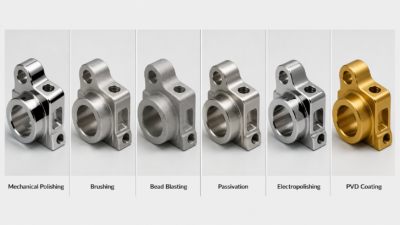
There are six commonly used stainless steel surface finishing processes: mechanical polishing, ブラッシング, ビーズブラスト, 不動態化, electropolishing, and PVD coating. Each has a different principle, effect, 料金, and suitable application. This guide explains all six processes in detail, provides selection guidance and practical considerations, and helps you choose the right process before placing an order.
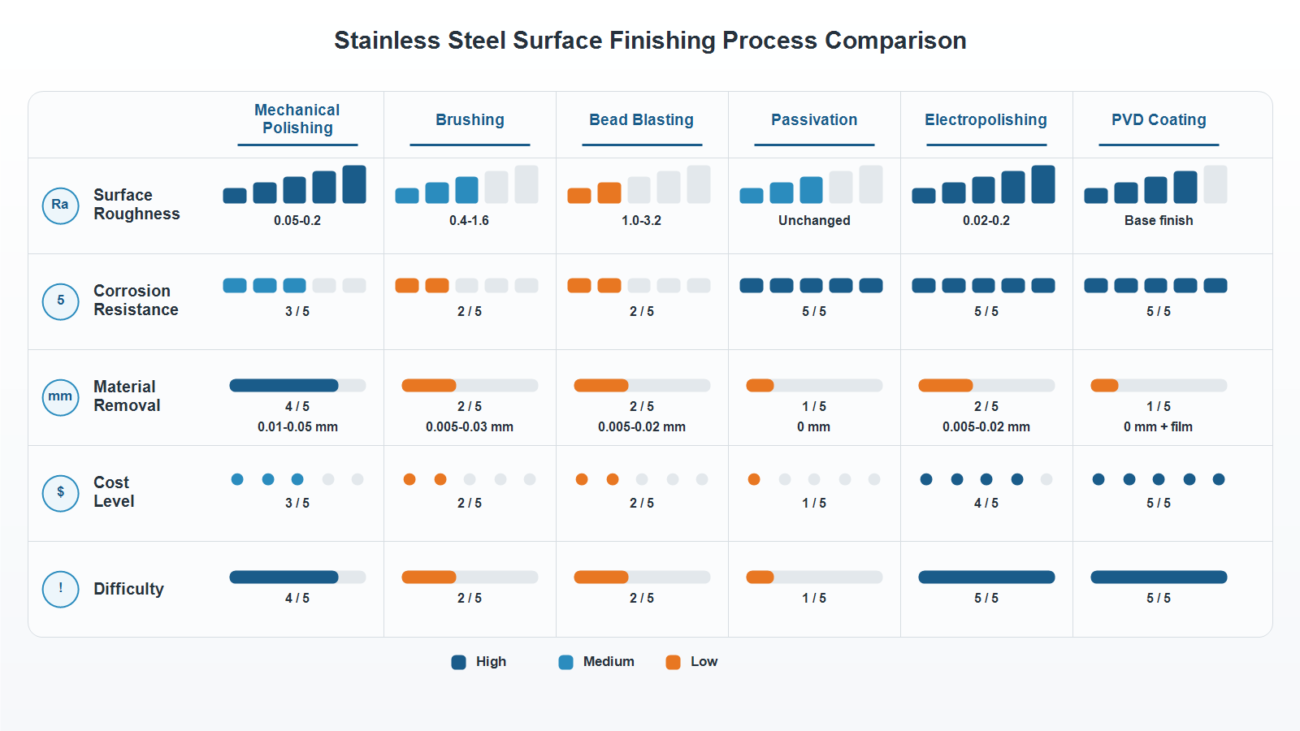
Six Processes at a Glance: Compare the Differences in One Table
Start with an overview table that puts the core parameters of all six processes side by side to give a clear starting point before the process details.
プロセス | Principle | Surface Effect | Corrosion Improvement | Material Removal | Relative Cost |
Mechanical Polishing | Mechanical friction removes surface irregularities | Mirror/satin finish, bright | 中くらい (removes defect layer) | 0.01–0.05mm | Low–Medium |
ブラッシング | Belt/brush creates directional texture | Straight/random grain, matte | 低い | 0.005–0.02mm | 低い |
ビーズブラスト | High-pressure abrasive impact on surface | Uniform matte, rough | 低い | 0.005–0.01mm | 低い |
不動態化 | Chemical treatment supports passive film formation | Appearance essentially unchanged | 高い (chemical conversion) | Virtually none | 低い |
電解研磨 | Electrochemical dissolution removes surface peaks | Ultra-smooth mirror, high gloss | 高い (removal + 不動態化) | 0.01–0.03mm | Medium–High |
PVD Coating | Physical vapor deposition of ceramic coating | Gold/black/gunmetal etc. | 高い (coating protection) | Coating 1–3μm | 高い |
Six Processes Explained in Detail
Mechanical Polishing
Mechanical polishing is the most traditional and widely used surface finishing method. Grinding wheels, abrasive belts, and cloth wheels progressively remove tool marks and surface irregularities through mechanical friction, ultimately achieving a mirror or satin finish. Polishing grades range from rough polishing (Ra 1.6μm) to fine polishing (Ra 0.2μm) to mirror finish (Ra 0.05μm) — the higher the grade, the higher the labor cost.
The advantage of mechanical polishing is its versatility — many stainless steel parts can be polished, and costs are relatively controllable. The disadvantages are that complex cavities and deep hole interiors cannot be reached, hand polishing has poor consistency, and quality fluctuates noticeably in large batches. さらに, polishing removes a small amount of material (0.01–0.05mm), so high-precision parts require polishing allowance.
In practice, mechanical polishing is commonly used for appearance parts, 装飾部品, and food equipment contact surfaces. しかし, for medical and high-cleanliness parts, mechanical polishing alone may not be enough — it is typically combined with electropolishing or passivation.
ブラッシング
Brushing uses abrasive belts or brushing machines to create directional textures on the surface. Common patterns include straight grain (hairline) and random grain (snowflake). Brushed surfaces have a matte texture, uniform grain, and a refined feel. They are more scratch-resistant than mirror finishes, and minor scratches are less visible.
Brushing is low-cost and efficient, suitable for large flat panels and simple curved surfaces. しかし, the brush grain has directionality, so the grain direction must be coordinated with the part geometry during design. welded parts and complex curved surfaces are difficult to brush, and the grain can become discontinuous. Brushed surface roughness is typically Ra 0.4–1.6μm, with limited corrosion improvement — passivation is recommended in corrosive environments.
Consumer electronics enclosures, architectural decorative panels, and kitchenware panels are the most common applications for brushing. Both 304 そして 316 are suitable for brushing, with minimal difference in results.
ビーズブラスト
Bead blasting uses compressed air to propel glass beads, ceramic beads, or aluminum oxide at high speed onto the part surface, creating a uniform matte rough surface through impact. Blasted surfaces are non-directional with an even texture, reducing the visibility of light machining marks and minor surface variation. It is one of the lowest-cost surface finishing methods.
The key parameters are abrasive type and grit size. Glass bead blasting produces a fine, soft surface; ceramic beads are harder with a coarser texture; aluminum oxide produces the roughest surface but with strong adhesion, suitable as a base for subsequent painting or bonding. Material removal is minimal (0.005–0.01mm), with negligible dimensional impact, but thin-walled parts require attention to deformation from blasting pressure.
Blasting is commonly used for internal mechanical parts, 備品, equipment enclosures, and as a base treatment for subsequent painting or bonding. Blasted surfaces have high roughness and tend to accumulate contaminants, making them unsuitable for food or medical contact surfaces unless followed by electropolishing or passivation.
不動態化
Passivation is a chemical treatment that immerses stainless steel parts in nitric acid or citric acid solution, removing free iron and contaminants from the surface and promoting the formation of a dense chromium oxide passive film. This passive film is the fundamental reason stainless steel is “stainless” — when surface chromium is damaged or contaminated during machining, passivation restores corrosion resistance.
Passivation does not change appearance or dimensions, is low-cost, and is often worth evaluating for stainless steel CNC parts — especially welded parts or parts with corrosion exposure. Passivated parts show better corrosion resistance, but the passive film is very thin (nanoscale) and can be damaged by mechanical friction. したがって, passivation is typically the final process, or used in combination with other finishing methods.
Passivation is commonly specified for medical, food, 海洋, and corrosion-sensitive stainless steel parts, but the final requirement should come from the drawing, 標準, or service environment. Citric acid passivation is more environmentally friendly and suitable for the food and medical industries, while nitric acid passivation offers more stable results and is more widely used in industrial applications.
電解研磨
Electropolishing can be understood as “reverse electroplating” — the part serves as the anode in an electrolyte solution, and when current is applied, microscopic surface peaks are preferentially dissolved, achieving an ultra-smooth mirror finish. Unlike mechanical polishing, electropolishing is chemical dissolution — it produces no mechanical stress or deformation, and can uniformly treat complex cavities, deep holes, and fine gaps.
The practical advantages of electropolishing include: surface roughness can reach Ra 0.1–0.4μm, smoother than mechanical polishing; it simultaneously removes free iron and contaminants, providing a passivation effect; it is burr-free and stress-free, with better corrosion resistance than passivation alone. The trade-offs are higher cost and typical material removal of 0.01–0.03mm (requiring allowance calculation for high-precision parts), and varying results by stainless steel grade — 316/316L generally produces better results than 304.
Electropolishing is often used for high-cleanliness fluid components, food and beverage pipe interiors, semiconductor equipment, and selected medical components where the specification requires it. For welded parts, ensure the weld is smooth before electropolishing, otherwise over-polishing or under-polishing may occur at the weld.
Medical stainless steel parts and food machinery stainless steel parts do not always require electropolishing. The real basis for judgment is the drawing, specifications, contact medium, cleaning method, and audit requirements. For more medical scenarios, refer to Medical Stainless Steel Part Machining; for food machinery structures, refer to 食品機械ステンレス加工.
PVD Coating
PVD (Physical Vapor Deposition) ionizes metals such as titanium or chromium in a vacuum environment and deposits them onto the part surface, forming a 1–3μm thick ceramic coating. Common colors include gold (TiN), 黒 (DLC), gunmetal (TiCN), and blue. PVD coatings can provide high hardness, 耐摩耗性, controlled color, and additional surface protection when the substrate and pre-treatment are suitable.
PVD coating has high cost and strict pre-treatment requirements — the surface must be smooth and uniform before coating, typically requiring mechanical polishing or brushing first, otherwise underlying defects will show through the coating. The coating thickness is only 1–3μm and does not affect dimensional accuracy, but masking and fixture design for complex parts can affect coating uniformity, with potentially thinner coatings in inner holes and deep grooves.
PVD is commonly used for high-end decorative parts, watch cases, 切削工具, mold components, and applications requiring both wear resistance and decoration. Both 304 そして 316 can be suitable for PVD coating when cleaning, activation, マスキング, and fixture design are controlled.

Image slot 2: Six-process parameter comparison (can be designed as infographic)
Process Combinations: When One Process Is Not Enough
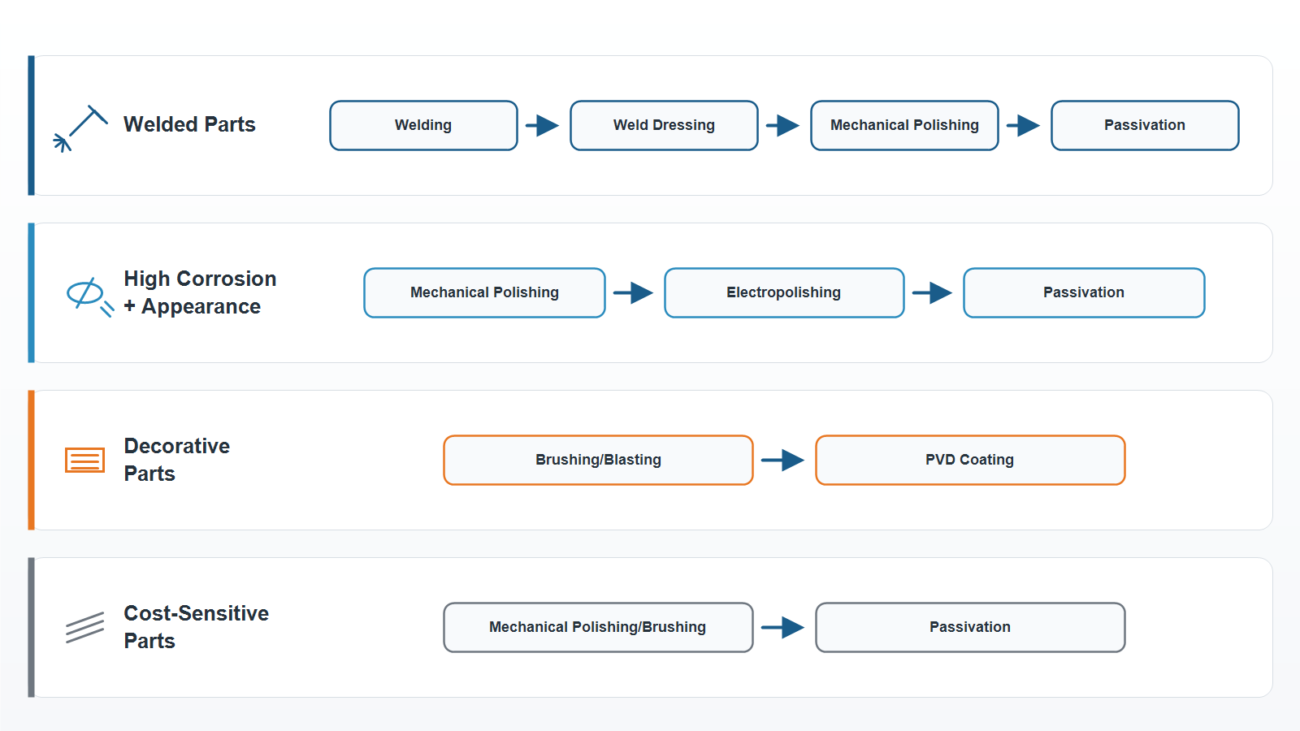
In production, one finishing process often cannot meet every functional, 化粧品, and corrosion requirement. Here are the most common combination approaches.
The standard flow for welded parts is: Welding → Weld dressing → Mechanical polishing → Passivation. Welding destroys the stainless steel passive film, and oxidation discoloration appears near the weld — the affected area normally needs weld dressing or cleaning first, followed by passivation when corrosion resistance is required. For food and medical industry welded pipes, electropolishing may also be specified to ensure the interior is smooth and free of dead corners.
For parts requiring high corrosion resistance plus high appearance quality, the combination “Mechanical polishing → Electropolishing → Passivation” is commonly used. Mechanical polishing removes major tool marks and defects, electropolishing achieves an ultra-smooth surface, and passivation provides final protection. This combination costs more, but it can be appropriate for medical, 海洋, and corrosion-sensitive equipment when the specification supports it.
Decorative parts commonly use “Brushing/Blasting → PVD coating”. The base layer is brushed or blasted to create texture, and PVD deposits a coating on top of the texture — preserving the texture while adding color and wear resistance. Note that the quality of the base treatment before PVD directly determines the final appearance.
For cost-sensitive general parts, “Mechanical polishing/Brushing → Passivation” is sufficient. Appearance meets requirements, passivation restores corrosion resistance, and cost is minimized.

Image slot 3: Common process combination flow chart (4 typical combination paths)
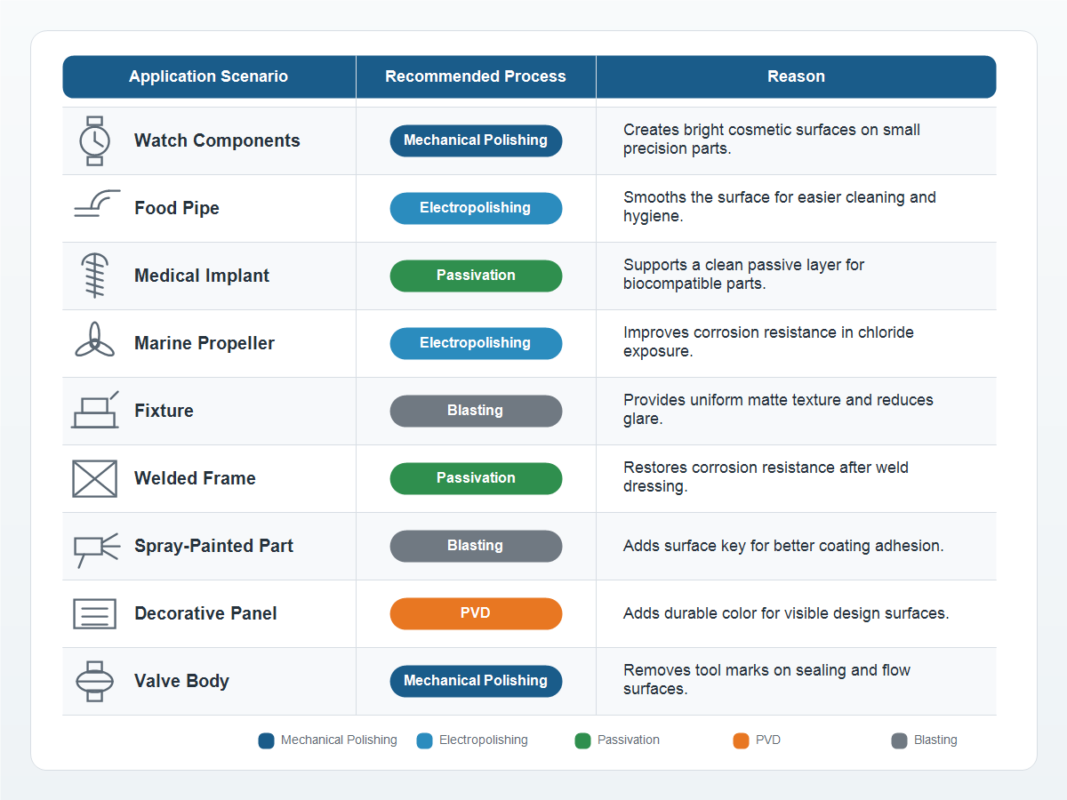
セレクションガイド: Choose the Process by Application
Each of the six processes has its suitable applications. 迷ったときは, use the following guidance.
応用 | Recommended Process | 理由 |
General appearance/decorative parts | Mechanical polishing or Brushing | 低コスト, appearance meets requirements |
High-end decorative parts/watches/tools | PVDコーティング (polished/brushed base) | 耐摩耗性 + カラーコントロール + consistent appearance |
Food equipment contact surfaces | Mechanical polishing + 不動態化 | スムーズ + 耐食性, food-grade |
Food pipe interiors/high cleanliness | 電解研磨 + 不動態化 | Ultra-smooth, no dead corners, easy to clean |
Medical implants/surgical instruments | 電解研磨 + 不動態化 | Cleanable + 耐食性 + burr-controlled |
Marine equipment/chemical parts | Passivation or Electropolishing | Corrosion resistance priority, appearance secondary |
Internal mechanical parts/fixtures | ビーズブラスト | 最低コスト, conceals tool marks |
Welded structural parts | Weld dressing + 不動態化 | Restores weld zone corrosion resistance |
Parts requiring subsequent painting/bonding | ビーズブラスト | Rough surface increases adhesion |

Image slot 4: Application-recommended process reference table
How JADE-CNC Handles Surface Finishing
JADE-CNC can manage five-axis machining, turn-mill machining, バリ取り, クリーニング, 不動態化, electropolishing, PVD, final dimensional inspection, and packaging requirements within a single manufacturing plan. For overseas customers, this one-stop approach reduces the problems of hand-offs between multiple shops and unclear responsibility boundaries, while also improving control over lead time, batch consistency, そしてスクラップのリスク.
結論
Surface finishing selection should be judged together with part function, 材料, 加工痕, cleaning requirements, dimensional risk, and final inspection method. Send your 3D/2D drawings, 材質グレード, target roughness, 外見要件, contact medium, 限界寸法, and annual volume. JADE-CNC can help evaluate the appropriate CNC machining and surface finishing route.
Related Stainless Steel Articles
- ステンレス鋼CNC機械加工: 完全な問題解決ガイド
- Medical Stainless Steel Part Machining: 316L Material, Process and Compliance Requirements
- 食品機械ステンレス加工: 衛生グレードの素材, 溶接と表面仕上げ
- Stainless Steel Welding for CNC Machined Parts: TIG, Laser Welding and Distortion Control
- Stainless Steel CNC Machining Problems & ソリューション: Built-Up Edge, Tool Wear, Broken Drills & Chatter
目次

レオ・リャン, Founder Best Partner with R&D
JADE-CNC 創設者 LEO, 20年以上の業界専門知識をもたらした人物, レオは見習いとしてキャリアをスタートし、表面処理と CNC 加工のスキルを実践しています。.

Let's Build the Future, 一緒に
Whether you need prototypes, custom components, or low-volume production, JADE-CNC is ready to support your next manufacturing project.
Share your CAD files or drawings with us, and our engineering team will provide a practical machining solution tailored to your requirements.
Let's work together to create reliable, high-quality parts for the future.
FAQ in Stainless Steel surface finishing
Electropolishing typically removes 0.01–0.03mm of material, depending on current density, 時間, and stainless steel grade. For parts with general tolerances, the impact is often manageable, but it should still be confirmed against the drawing. しかし, for high-precision mating surfaces (tolerance ±0.01mm), removal must be calculated in advance, or electropolishing should only be applied to non-mating surfaces. During process planning, JADE-CNC distinguishes mating and non-mating surfaces based on drawing annotations, and apply masking protection to mating surfaces.
Passivation restores the chromium oxide passive film on the surface, significantly improving corrosion resistance, but it is not “absolutely rust-proof.” Passivated 304 will still pit in chloride environments (seawater, 塩水噴霧) — this is an inherent material limitation that passivation cannot solve. In corrosive environments, 316/316L should be selected, combined with passivation or electropolishing. さらに, the passive film is vulnerable to mechanical friction, so surface scratching should be avoided during handling and installation.
PVD coating adhesion depends on pre-treatment quality. 油, oxidation, or uneven polishing on the base surface will cause the coating to peel easily. Proper PVD processes include pre-coating ultrasonic cleaning and plasma etching, and adhesion can be verified by cross-cut test (ISO 2409). PVD coatings can provide strong wear resistance in suitable applications, but they may crack under hard impact or bending deformation — because the coating is ceramic in nature and less ductile than the metal substrate.
It can be done, but it is not usually the most efficient route. Blasted surfaces have high roughness, and electropolishing requires longer time to achieve a smooth finish, increasing material removal and cost. If electropolishing is ultimately required, it is often better to plan the machined surface and deburring route for electropolishing from the start. Blasting is more suitable as a final treatment, or as pre-treatment for painting/bonding.
Not always. Passivation is typically worth evaluating when the part has corrosion risk, medical or food contact requirements, weld heat-affected zones, or iron contamination risk. The final decision should be based on the drawing, 標準, or service environment.
There is a small amount of material removal, and hole openings, sharp edges, and thin-wall areas are more sensitive. 精密部品用, pre- and post-treatment dimensional requirements should be clarified at the quotation and process planning stage.
Not as a simple substitute. Blasting is better suited for unifying appearance, while polishing is better for reducing tool marks and improving local roughness. The two also differ in dimensional impact and cleaning risk.