素材関連

Stainless Steel CNC Machining Cost & Quotation Guide: 10 Cost Factors and Supplier Comparison

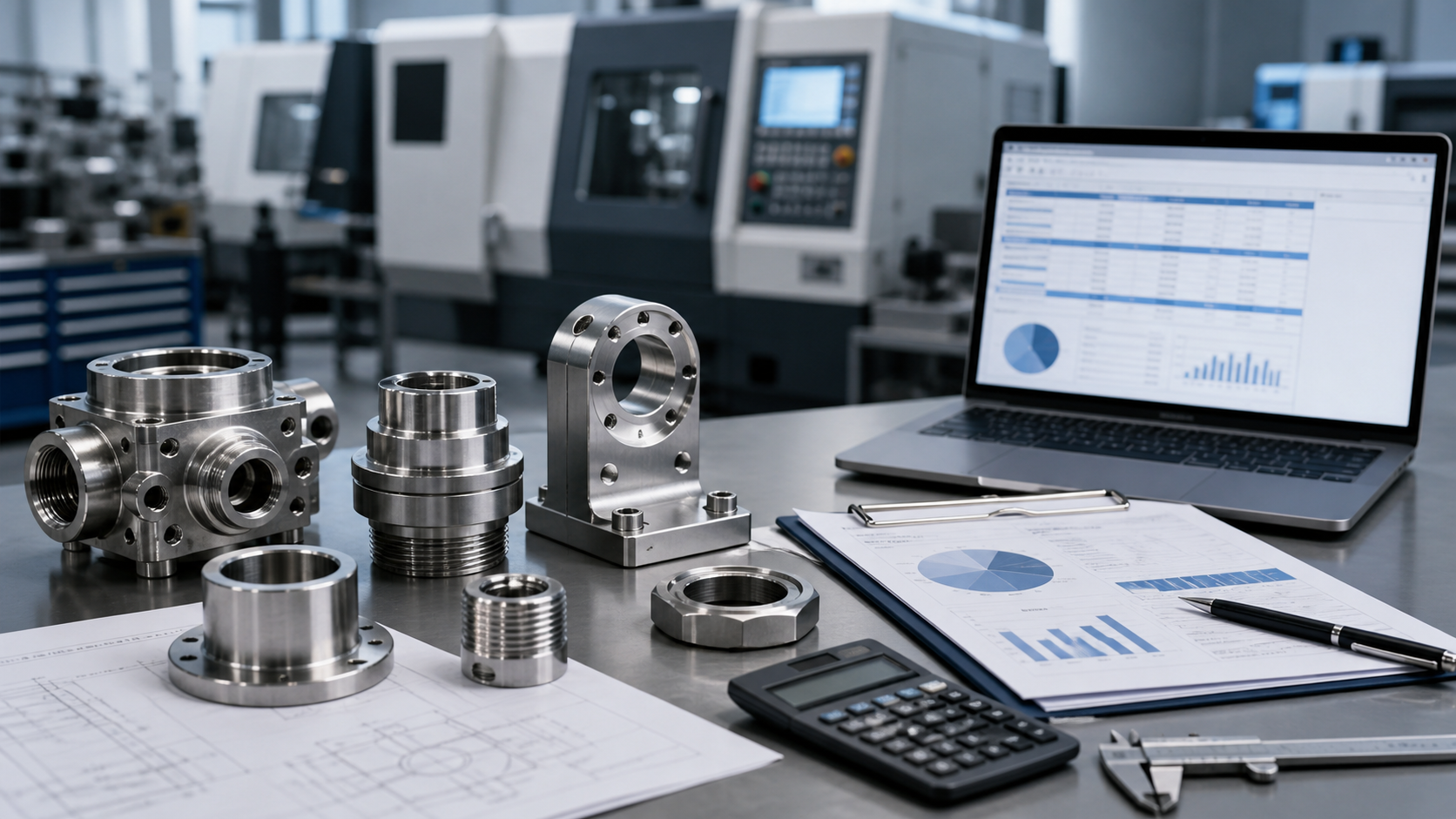
Stainless steel CNC machined parts reviewed with quotation documents, cost charts, calculator, and inspection tools in a CNC machine shop

Why Can the Same Drawing Get Quotes That Differ by 100%?

Many engineering and procurement teams have seen this: the same stainless steel part drawing sent to three machining shops comes back with prices that can differ by a factor of two. Is the low quote missing scope? Is the high quote carrying unnecessary cost? 実際には, quote differences follow clear cost logic — understanding it helps you judge which quote is complete, realistic, and suitable for the project.

Quote Differences Usually Come from Total Manufacturing Cost

For the same stainless steel part, quotes differing by 20% に 50% are not uncommon. A lower price may come from faster machining cycles, or it may come from omitting post-processing, 検査 documentation, or risk contingency. When comparing quotes, do not compare unit price alone — confirm whether the quote scope includes material certificates, critical dimension inspection, 表面仕上げ, packaging requirements, and responsibility for non-conformance handling.

コスト要因

Why It Affects the Quote

Cost Reduction Direction

Material Grade

304, 316, 316L, 303, 17-4PH differ in price and machinability

Do not over-specify higher grades; select based on corrosion, 強さ, およびコンプライアンス要件

Geometric Complexity

Deep cavities, 薄い壁, long overhangs, and small internal corners increase machining time

Relax non-functional internal corners, add machinable chamfers and clamping surfaces

許容範囲 & 粗さ

Overly tight tolerances increase finish machining, 研削, そして検査

Distinguish functional dimensions from general dimensions

Tool Wear

Stainless steel stickiness and work hardening increase tooling cost

Optimize cutting parameters, 冷却, and tool paths

Post-Processing

不動態化, electropolishing, PVD, and blasting all add process and inspection steps

Specify required areas clearly on drawings; avoid over-processing entire parts

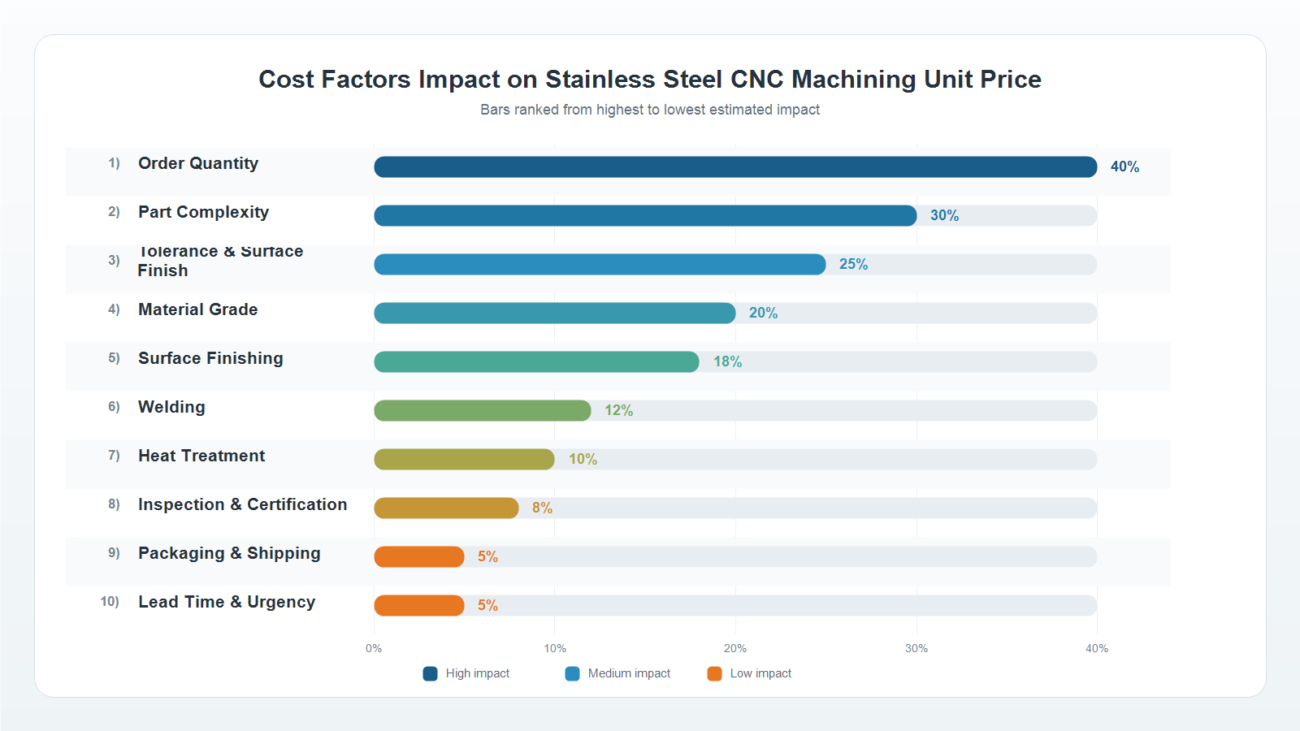
In stainless steel CNC machining, 材質グレード, part complexity, 公差要件, order quantity, 表面仕上げ, 溶接, 検査, 梱包, and lead time all affect the final quote. For a broader understanding of stainless steel machining, refer to the Stainless Steel CNC Machining Guide.

Stainless Steel Machining Cost Structure Breakdown

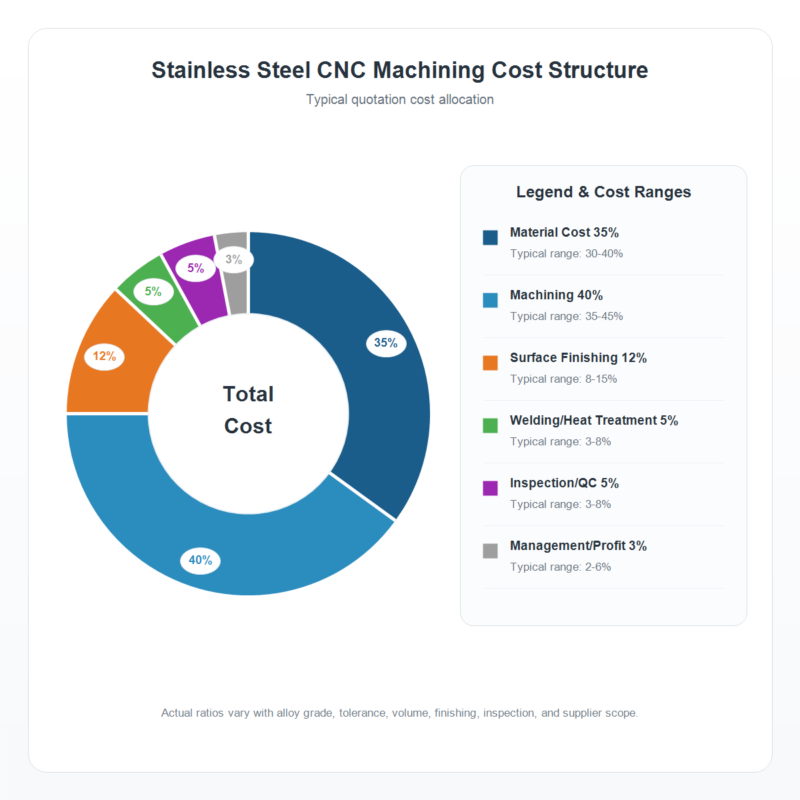
A stainless steel machining quote is built from several cost layers. For typical 304/316 precision machined parts, material cost usually accounts for 30%–40%, 機械加工 (including equipment depreciation and labor) 35%–45%, surface finishing and post-processing 10%–15%, inspection and QC 5%–10%, and management and profit 5%–10%.

These proportions shift with part characteristics. For complex five-axis parts, machining can exceed 60% while material drops to 20%. For high-volume simple parts, material can exceed 50% while machining drops to 30%. Understanding this structure helps identify where a quote is high and where cost can be reduced without adding quality risk.

Cost Item

Range

注意事項

Material Cost

30%–40%

316 costs 50%–80% more than 304; bar/plate/forging differ significantly

機械加工

35%–45%

Includes equipment depreciation, 労働, tooling consumption, 冷却剤

表面仕上げ

10%–15%

Electropolishing/PVD cost 2–5x more than standard polishing

Welding/Heat Treatment

5%–15%

Welded parts need post-weld treatment; heat treatment adds cycle time

Inspection/QC

5%–10%

Full CMM inspection costs more than sampling; salt spray testing extra

Management/Profit

5%–10%

Includes packaging, shipping, overhead

Donut chart showing stainless steel CNC machining cost breakdown across material, 機械加工, 表面仕上げ, 溶接, 検査, and management

Image slot 1: Stainless steel machining cost structure donut chart (6 segments)

10 Core Cost Factors

Material Grade and Form

Material is the foundation of any quote. 316 stainless steel bar often costs more than 304; 316L is slightly above 316; 17-4PH and duplex steel are more expensive. Material form also affects price — bar stock is most common with transparent pricing, plate requires nesting calculations for utilization, forgings need tooling costs, and castings have minimum order quantities. さらに, material standard (GB/ASTM/EN) and whether a material test report (MTR) is provided affect price — a complete quote should state whether MTR documentation is included.

For material selection, refer to 304 対 316 vs 316L Stainless Steel

Part Complexity and Machining Time

Complexity directly determines machining time. Simple bushing parts may take minutes each, while complex five-axis housings can take hours. Assess complexity across several dimensions: whether five-axis simultaneous machining is needed, whether there are deep holes and cavities, whether wall thickness is under 2mm, whether multiple angled operations are required. Each step up in complexity can double machining cost. Experienced CNC teams can estimate machining time more accurately from complete 3D models and drawings.

For related issues, refer to Stainless Steel CNC Machining Problems & ソリューション

Tolerance and Surface Roughness Requirements

Tighter tolerances mean higher costs. General tolerances (±0.05mm) are achievable with standard CNC; precision tolerances (±0.01mm) require precision grinding and temperature-controlled shops, increasing cost by 30%–50%. Surface roughness follows the same logic — Ra 1.6μm is achievable with standard milling, Ra 0.4μm requires finish grinding, Ra 0.05μm needs mirror polishing or electropolishing. Every unnecessarily tight tolerance or high finish requirement on the drawing adds cost.

Order Quantity

Order quantity is one of the biggest factors affecting unit price. For prototypes of 1–5 pieces, プログラミング, 設定, and first-article inspection costs are spread over very few pieces, making unit price highest. で 100+ 個, these fixed costs are amortized and unit price can drop to 40%–60% of prototype pricing. で 1000+ 個, process routes can be optimized and dedicated fixturing used, reducing unit price further. しかし, very large quantities may extend lead time, requiring a balance.

Surface Finishing Requirements

The cost impact of surface finishing is often underestimated. Standard mechanical polishing and brushing are relatively low cost. Electropolishing requires specialized equipment and electrolyte, costing 2–3x more than standard polishing. PVD coating requires vacuum deposition equipment and pre-treatment, with even higher cost and minimum coating area requirements. Passivation is low-cost but requires chemicals and environmental handling; blasting is cheapest but usually more suitable for non-appearance or functional internal parts. When multiple finishes are combined, costs stack.

For surface finishing selection, refer to Stainless Steel Surface Finishing Guide

Welding and Post-Weld Treatment

The cost of welded stainless steel parts goes beyond the welding operation itself. 316L welding requires ER316L filler wire, post-weld passivation, and for critical parts, solution treatment or weld inspection (penetrant testing/radiography). Welding distortion control requires dedicated fixturing, and distortion after welding requires straightening. These costs are easy to miss in simplified quotes and can cause budget pressure during production.

Heat Treatment Requirements

Precipitation-hardening stainless steels like 17-4PH require solution treatment + age hardening, adding 2–3 operations and 3–5 days to the cycle. Post-weld solution treatment for 304/316 welded parts requires large heat treatment furnaces, which may not accommodate large parts. Heat treatment not only adds direct cost but also extends lead time, affecting overall project schedule.

Inspection and Certification Requirements

Standard parts may only require dimensional sampling, which is relatively low cost. Medical and food industry parts may require CMM inspection, surface roughness measurement, material verification, and documented records, which increases cost. If special tests are needed — salt spray testing, ferrite testing, cleanliness testing — each carries additional fees. Projects requiring medical-grade documentation or certified quality systems usually carry higher management and documentation costs.

Packaging and Shipping

Precision parts require rust-preventive packaging (VCI paper/rust-preventive oil) and shock-resistant packaging (foam/wooden crates). Export parts require fumigated or heat-treated wooden crates. Large and heavy parts have higher shipping cost proportions, and international shipping requires customs clearance and insurance. These fees are sometimes listed separately in quotes, sometimes included in unit price — confirm whether packaging and shipping are included when comparing.

Lead Time and Urgency

Standard lead times (2–4 weeks) are priced at standard rates. Rush orders (delivery within 1 week) require queue-jumping and overtime, with rush fees typically 1.3–1.5x standard. The tighter the deadline, the less room there is for process optimization, which usually increases cost. さらに, supplier capacity utilization affects quotes — capacity, order timing, and material availability can all affect the final quote.

Horizontal bar chart ranking ten factors that impact stainless steel CNC machining cost, led by order quantity, part complexity, および公差要件

Image slot 2: 10 cost factors impact ranking bar chart (by unit price impact percentage)

5 Practical Cost Optimization Directions

Understanding cost factors enables reasonable cost optimization without sacrificing quality. The following are cost reduction directions that JADE-CNC has found effective in production projects.

Material optimization is often the most direct cost reduction method. Where the environment permits, substituting 304 for 316 can reduce material cost when the service environment allows it; for non-welded parts, using 316 instead of 316L may reduce cost when welding, 腐食, and specification requirements allow it. しかし, material downgrading must be based on service environment assessment — marine, 医学, and regulated environments need careful material review.

Tolerance optimization is often overlooked. Marking every dimension at ±0.01mm on a drawing drives up machining cost significantly. 実際には, only mating surfaces need tight tolerances; relaxing non-mating surfaces to a more suitable tolerance can reduce cost without affecting function. During process review, we help customers distinguish critical dimensions from general dimensions.

Batch consolidation also reduces cost. Combining multiple small-batch orders into production, or sharing material and fixturing across similar parts, significantly reduces unit cost. Long-term programs can also use safety stock or blanket-order planning to reduce repeated setup and purchasing cost.

Surface finishing simplification is effective too. Polishing appearance surfaces while blasting or leaving non-appearance surfaces untreated costs much less than electropolishing everything. Passivation often provides a good cost-to-performance balance for corrosion resistance in suitable environments; electropolishing is not always necessary.

Process integration is one advantage of a one-stop manufacturing partner. Completing machining, 溶接, 表面仕上げ, and inspection through one managed route can reduce hand-offs, communication cost, and unclear responsibility between multiple shops. JADE-CNC provides one-stop service from machining to surface finishing, with cost, リードタイム, and quality risks reviewed together before production.

Supplier Types Compared for Stainless Steel CNC Machining Quotes

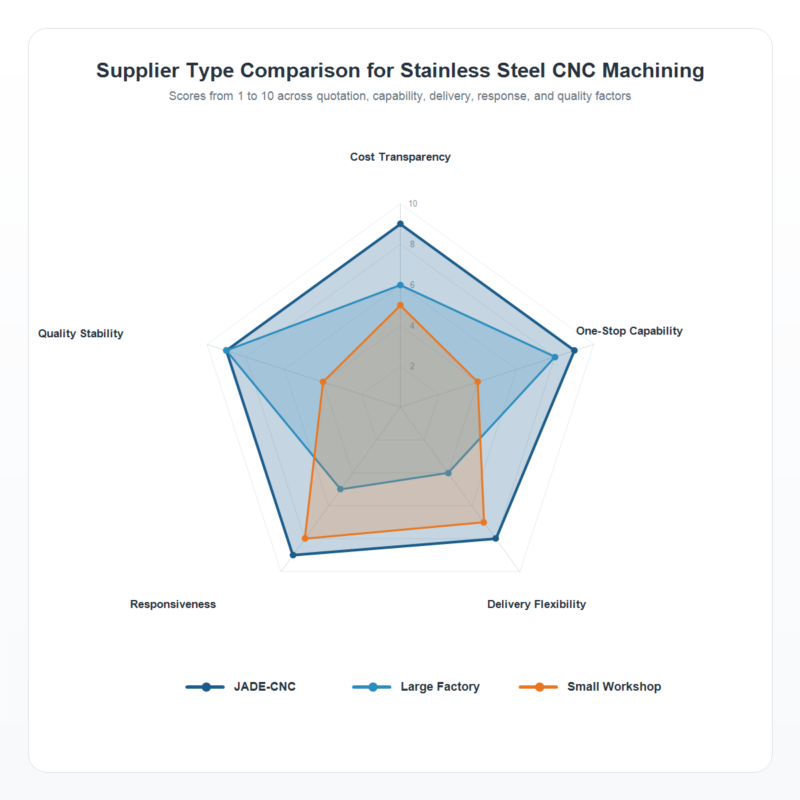
Supplier selection should not be based on unit price alone. 料金, delivery, technical communication, responsiveness, and quality stability all matter. The following compares JADE-CNC with industry leading competitors across five dimensions.

Dimension

ジェイド-CNC

Large Leading Factory

Small Machine Shop

Quote Transparency

itemized quotes, 10 cost items traceable

Lump-sum quotes, limited detail

Estimated quotes, high variance

One-Stop Capability

機械加工 + 溶接 + 仕上げ + 検査

Some processes outsourced

Single process focus

Delivery Flexibility

All order sizes, rush orders accommodated

Large orders prioritized, small orders wait

Fast for small orders, limited capacity for large

Cooperation

Proactive optimization suggestions in process review

Machines to print, limited proactive input

Cooperative but limited technical capability

Responsiveness

24-hour response, dedicated contact

Long process, 3–5 day response

Fast response but inconsistent quality

Quality Stability

ISO 9001, full-process QC

Robust system but inflexible

High quality variance

Overall Cost

10%–15% lower than large factories

高い (management overhead allocation)

Low unit price but high rework cost

Radar chart comparing JADE-CNC, large factories, and small workshops across cost transparency, one-stop capability, delivery flexibility, responsiveness, and quality stability

Image slot 3: Supplier five-dimension comparison radar chart (One-stop CNC partner vs large factory vs small machine shop)

Large leading factories have the advantage of robust systems and large capacity, but high management costs, long scheduling for small orders, slower communication processes, and typically higher quotes. Small machine shops offer low unit prices and fast response, but limited technical capability and quality stability — complex and high-requirement parts are prone to problems, and rework costs end up higher.

JADE-CNC is positioned for projects that need engineering support, flexible order quantities, and stable execution — with a quality system and appropriate equipment (five-axis, turn-mill machining, ISO 9001), while maintaining responsiveness, 柔軟性, and speed. During process reviews, JADE-CNC helps customers identify cost drivers and manufacturability risks before machining to print. Small batches, volume orders, and urgent projects can be reviewed against current capacity, with dedicated contacts to reduce communication gaps.

JADE-CNC Quotation Process

JADE-CNC uses a structured quotation process to improve speed and accuracy. For many projects, JADE-CNC can respond within 24 hours after receiving complete drawings, including material selection recommendations, プロセスルート, surface finishing plan, リードタイム, and itemized quote. For complex parts, we conduct a process review first, identifying design points on the drawing that may increase cost, providing optimization suggestions, and issuing a formal quote after customer confirmation.

Quote itemization includes material cost, machining cost, surface finishing cost, inspection cost, and packaging/shipping cost — each item can be reviewed and traced. Volume quotes provide tiered pricing (10/50/100/500 個) to help customers select based on demand. After prototype confirmation, volume pricing can be reviewed and planned against material availability and order schedule.

About JADE-CNC

JADE-CNC specializes in precision stainless steel part machining, with five-axis simultaneous, turn-mill machining, and precision grinding equipment, ISO 9001 認証, and one-stop service from machining and welding to surface finishing and inspection. Its quotes are structured and traceable, and process reviews help customers identify cost reduction opportunities, lead-time risks, そして quality-control requirements before production.

Send your 3D/2D drawings, 材質グレード, 量, 公差, 表面仕上げ, 検査要件, and target lead time for an itemized quote, manufacturability review, and lead-time assessment.

Related Stainless Steel Articles

ステンレス鋼CNC機械加工: 完全な問題解決ガイド

304 対 316 vs 316L Stainless Steel: Which One Should You Choose for CNC Machining?

Stainless Steel CNC Machining Problems & ソリューション: Built-Up Edge, Tool Wear, Broken Drills & Chatter

Stainless Steel Surface Finishing Guide: 研磨, ブラッシング, ブラスト, 不動態化, 電解研磨 & PVD

目次

JADE-CNC CNC加工ワークショップの工場フロア

レオ・リャン, Founder Best Partner with R&D

JADE-CNC 創設者 LEO, 20年以上の業界専門知識をもたらした人物, レオは見習いとしてキャリアをスタートし、表面処理と CNC 加工のスキルを実践しています。.

ブログ元
Teamwork image representing JADE-CNC manufacturing service commitment

Let's Build the Future, 一緒に

Whether you need prototypes, custom components, or low-volume production, JADE-CNC is ready to support your next manufacturing project.

Share your CAD files or drawings with us, and our engineering team will provide a practical machining solution tailored to your requirements.

Let's work together to create reliable, high-quality parts for the future.

よくある質問

Stainless steel usually creates higher cutting resistance, faster tool wear, more heat-control difficulty, and greater risk of work hardening than aluminum. Tight tolerances, deep holes, 不動態化, electropolishing, 溶接, and inspection documentation can further increase cost.

Start with material selection, 耐性のレビュー, manufacturable radii, suitable surface finishing, batch planning, and a clear inspection scope. Cost reduction should remove unnecessary process burden, not remove controls that protect fit, 耐食性, or delivery reliability.

Send 3D and 2D drawings, 材質グレード, 量, key tolerances, 表面仕上げ, 熱処理, welding requirements, inspection documents, 梱包のニーズ, and target lead time. Complete RFQ information helps reduce quote assumptions and risk buffers.

Differences often come from machining strategy, equipment fit, tooling assumptions, 検査範囲, finishing route, documentation, lead-time pressure, and risk allowance. A lower quote is not always incomplete, but the quote scope should be checked carefully.

返信を残す

あなたのメールアドレスは公開されません. 必須フィールドにマークが付いています *