Food Machinery Stainless Steel Machining: Hygiene Requirements Come First
The biggest difference between food machinery stainless steel parts and standard industrial parts is hygiene and cleanability. Food contact surfaces should avoid dead corners, residue accumulation, ひび割れ, rough welds, and hard-to-clean gaps because these areas can retain product residue and cleaning chemicals. FDA-related food-contact requirements, 3-A Sanitary Standards, and EHEDG guidance are often used as references for material safety, 表面仕上げ, cleanable geometry, and weld treatment. Non-conforming details can lead to audit findings, rework, or delayed equipment release.
This article explains the special requirements for food machinery stainless steel machining across five areas: 材料の選択, sanitary design, welding process, 表面仕上げ, and audit documentation. For general stainless steel machining knowledge, refer to ステンレス鋼CNC機械加工: 完全な問題解決ガイド.
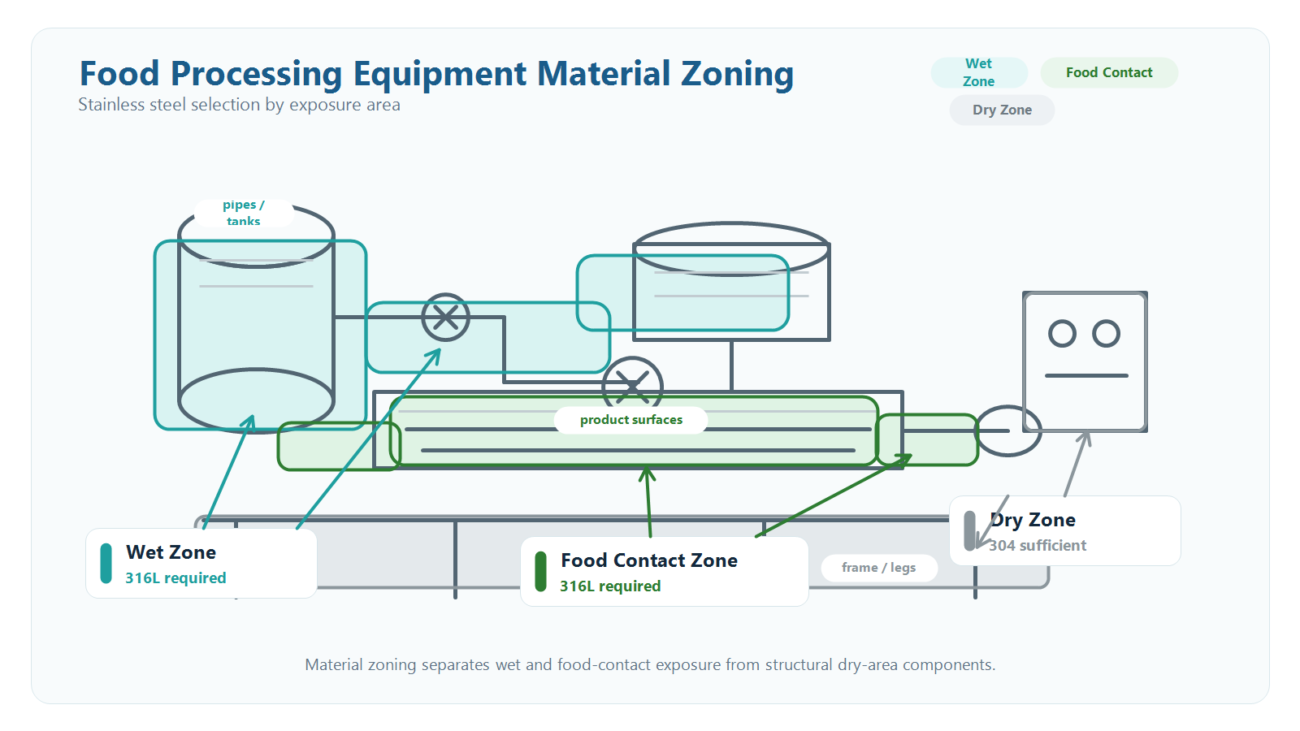
Material Selection for Food Machinery: 304 for Dry Zones, 316L for Wet Zones
Different zones of food machinery have different material requirements. Dry zones, such as enclosures and frames without product or washdown contact, often use 304 because it has good availability, 料金, と機械加工性. Wet zones that contact water, food, cleaning agents, or disinfectants often need 316L because chloride-containing cleaners can increase pitting risk in 304. 316L contains molybdenum for improved chloride corrosion resistance and has lower intergranular corrosion risk after welding.
Using 304 in wet zones may reduce initial material cost, but rust staining, pitting, or field replacement can create a larger loss later. For food machinery wet zones and welded contact parts, 316L should be reviewed early during material selection and quotation.
304 is commonly used for many food equipment structural parts, offering good cost and availability. 316 or 316L is more suitable for stronger corrosive media, chlorine-containing cleaning environments, or more stringent contact conditions. Material selection should not be based on grade name alone; it should consider contact medium, cleaning agents, 温度, 溶接, and surface finishing. For detailed material comparison, refer to 304 対 316 vs 316L Stainless Steel.
Zone | Recommended Material | 理由 |
Dry zone (enclosure/frame) | 304 | No water or food contact; 304 is sufficient |
Wet zone (water/cleaner contact) | 316L | Chloride environment; 304 prone to pitting |
Food contact surface | 316L | Sanitary-grade requirement; 耐食性 + easy to clean |
Welded pipes/tanks | 316L | No intergranular corrosion after welding |

Image slot 1: Food machinery material zoning selection diagram
Sanitary Design for Food Machinery Parts: No Dead Corners, Easy to Clean
The core of food machinery design is no dead corners and easy cleaning. Internal corners should use radius transitions where the design allows. Sharp internal corners are difficult to clean and can accumulate residue, while external corners should still be deburred for safe handling and cleaning.
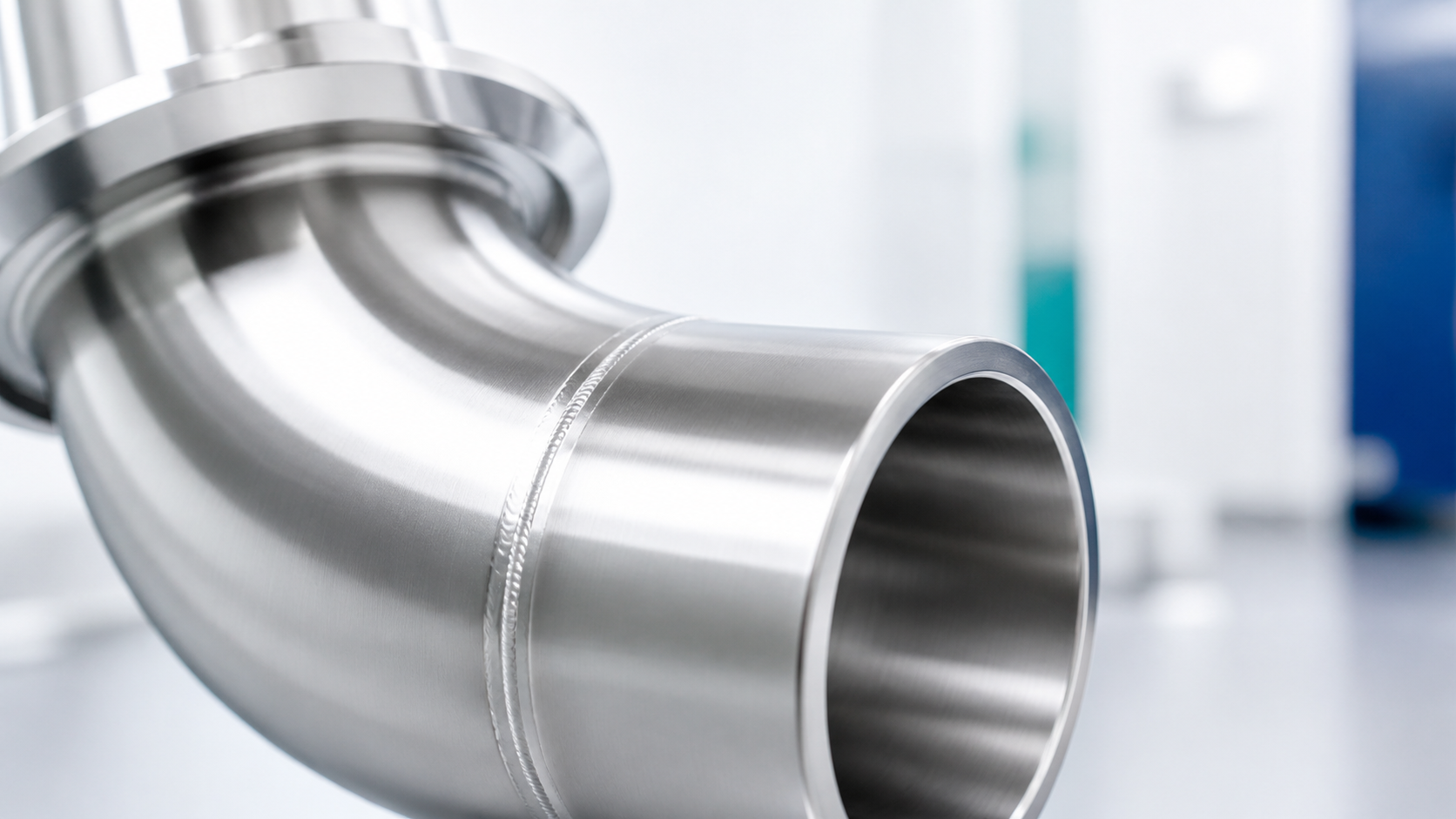
Welds are a key focus of sanitary design. Welds on food contact surfaces should be ground or finished flush with the base material where the specification requires it, with no sharp weld crown that can create a cleaning dead corner. Pipe welding often uses orbital welding, and the inner weld surface may be electropolished or mechanically polished to support a smooth, cleanable interior.
Threaded connections should be avoided on food contact surfaces when possible because thread gaps can become hygiene dead corners. When threads are necessary, seal welding or dedicated sanitary connections such as ISO 2852 clamp connections may be used. Equipment surfaces should avoid unnecessary blind holes and recesses; through holes, drainable features, and sloped surfaces improve cleanability and drainage.
Welding Process for Food Machinery: Orbital Welding, Internal Flattening and Passivation
For food machinery pipe and tank welding, orbital TIG welding is often selected for tube and pipe joints because automatic parameter control improves weld consistency compared with manual welding. Typical pipe diameters from 19mm to 219mm can use orbital welding, while larger pipes may use manual TIG welding with qualified welders and controlled welding procedures.
Internal weld flattening may be required for food pipes when the internal weld reinforcement or oxidation affects cleanability. After welding, the inner wall can have weld reinforcement and discoloration that should be processed with suitable internal finishing equipment, followed by electropolishing or passivation according to the specification. External welds may also need to be ground smooth to match the surface finish of the base material.
For post-weld treatment, 316L welded parts commonly need cleaning and passivation after welding. のために 304 welded parts used near wet zones, electropolishing and passivation may be reviewed if corrosion resistance or cleanability is a concern. Passivation may use citric acid where suitable, followed by rinsing with purified water to reduce chemical residue.
Risks in food machinery welded parts typically concentrate on the weld backside, heat-affected zone, weld crown, and insufficiently ground areas. For more on stainless steel welding, refer to Stainless Steel Welding for CNC Machined Parts.
Surface Finishing for Food Contact Stainless Steel Parts
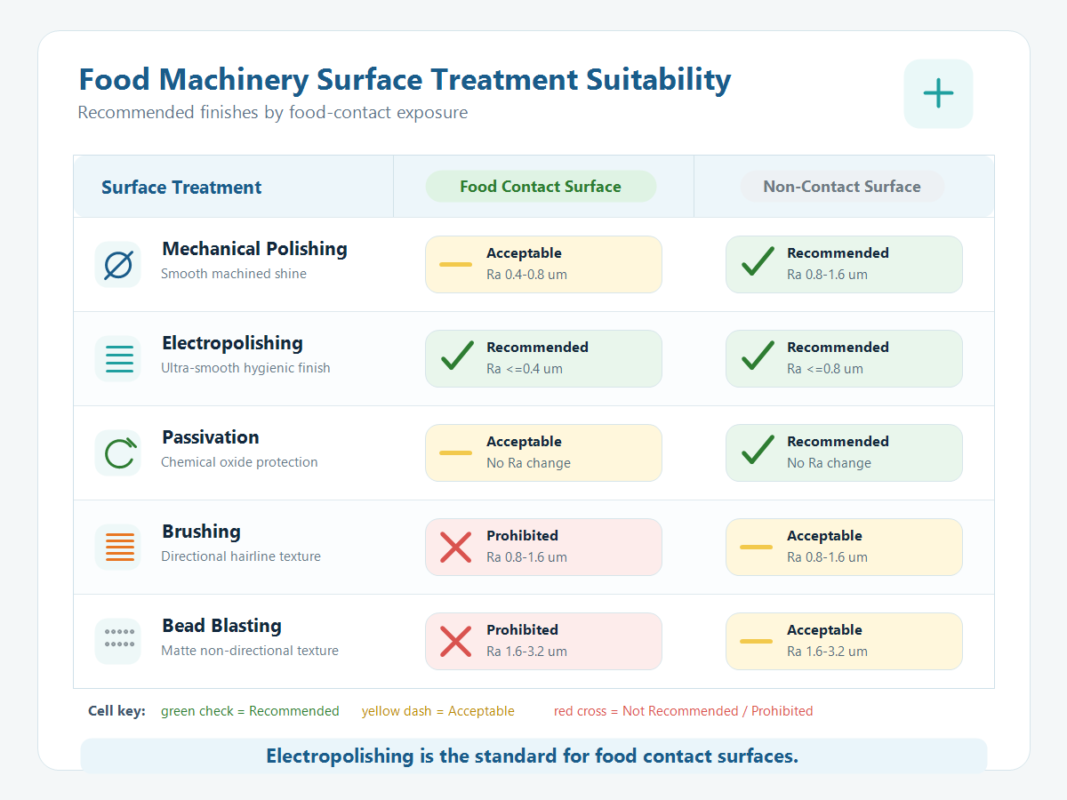
Food contact surfaces often target Ra 0.8um or below, with higher-end requirements reaching Ra 0.4um depending on the equipment and cleaning method. Standard mechanical polishing can achieve Ra 0.8um, but uncontrolled polishing grooves may trap product residue and become difficult to clean. Electropolishing can achieve a smoother, groove-reduced surface and improve corrosion resistance, so it is often selected for food contact surfaces where cleanability is critical.
Electropolishing usually costs more than mechanical polishing, but for food contact surfaces the improved cleanability and corrosion resistance may justify the cost. Non-food contact surfaces, such as dry-zone enclosures, can often use standard mechanical polishing or brushing to control cost.
Bead blasting in food machinery is usually limited to non-contact surfaces because blasted surfaces are rougher and can retain residue. PVD coating can be used for appearance decorative parts, but it should be reviewed carefully before use on food contact surfaces because coating damage or delamination can create contamination risk.

Image slot 2: Food machinery surface finishing selection table
Audit Documentation and Sanitary Standards: FDA, 3-A and EHEDG
Food machinery exported to the United States, ヨーロッパ, or sanitary dairy and beverage applications may need to follow customer specifications based on FDA-related food-contact rules, 3-A Sanitary Standards, EHEDG hygienic design guidance, or other applicable standards. FDA food-contact rules focus on material safety and conditions of use; 3-A and EHEDG place stronger emphasis on cleanable design, welded joints, 表面仕上げ, and equipment hygiene. The exact requirement should be confirmed from the project specification and destination market.
JADE-CNC can provide material certificates, welding records, surface roughness reports, and passivation or electropolishing records to support customer FDA, 3-あ, EHEDG, or internal hygiene audits. Welding procedure specifications (WPS/PQR) and welder qualifications can also be reviewed when the project requires them.
Common Food Machinery Stainless Steel Machining Problems and Solutions
A common problem in food machinery is rusting at welds. The cause is often using 304 in wet zones, incomplete weld cleaning, or insufficient passivation after welding. JADE-CNC’s approach is to review 316L for wet-zone and food-contact welded parts, control post-weld cleaning and passivation, and apply penetrant testing for critical welds when required.
Another problem is depressions at welds after electropolishing. The cause is uneven weld grinding, which can lead to current concentration at depressions during electropolishing and over-removal. JADE-CNC grinds welds flush with the base material where required and controls current and time during electropolishing.
Hygiene audit failures are often caused by cleaning dead corners. During process review, JADE-CNC checks drawings for sharp internal corners, 止まり穴, thread gaps, non-drainable recesses, and other hygiene risks, then provides manufacturability suggestions before production. This reduces the risk of finding non-conformance only after machining, 溶接, and finishing have already been completed.
About JADE-CNC
JADE-CNC specializes in precision stainless steel part machining, with five-axis machining, turn-mill compound machining, precision grinding equipment, ISO 9001 認証, and one-stop service from machining and welding to surface finishing and inspection. Incoming material can be verified by spectrometer, with self-inspection plus dedicated inspection at key process stages, helping control lead time, 品質, バッチの一貫性.
Send your drawing, CAD model, 材質グレード, food-contact zone, weld location, surface roughness requirement, cleaning method, documentation requirement, and batch quantity for process assessment and quotation, typically within 24 時間.
Related Stainless Steel Articles
– 304 対 316 vs 316L Stainless Steel: Which One Should You Choose for CNC Machining?
– Stainless Steel Surface Finishing Guide: 研磨, ブラッシング, ブラスト, 不動態化, 電解研磨 & PVD
– Stainless Steel Welding for CNC Machined Parts: TIG, Laser Welding and Distortion Control
– Medical Stainless Steel Part Machining: 316L Material, Process and Compliance Requirements
– Stainless Steel CNC Machining Problems & ソリューション: Built-Up Edge, Tool Wear, Broken Drills & Chatter
目次

レオ・リャン, Founder Best Partner with R&D
JADE-CNC 創設者 LEO, 20年以上の業界専門知識をもたらした人物, レオは見習いとしてキャリアをスタートし、表面処理と CNC 加工のスキルを実践しています。.

Let's Build the Future, 一緒に
Whether you need prototypes, custom components, or low-volume production, JADE-CNC is ready to support your next manufacturing project.
Share your CAD files or drawings with us, and our engineering team will provide a practical machining solution tailored to your requirements.
Let's work together to create reliable, high-quality parts for the future.
よくある質問
304 is often acceptable for dry-zone frames, カバー, 括弧, and non-contact structures. For wet zones, food contact surfaces, chloride-containing cleaners, or welded contact parts, 316 or 316L is usually reviewed because corrosion and cleaning risk are higher.
316L should be considered when the part contacts food, water, steam, cleaning chemicals, disinfectants, or acidic/chloride environments, or when welded joints need better corrosion resistance after finishing. The final choice should follow the drawing, sanitation requirement, サービス環境.
Not always, but food contact welds often need flush grinding, internal finishing, 不動態化, or electropolishing when cleanability, 粗さ, or sanitary inspection requires it. Weld treatment should be planned before machining because it affects geometry, 表面仕上げ, そして検査.
Send the drawing, 3Dモデル, 材質グレード, food-contact and non-contact zones, 溶接箇所, target roughness, passivation or electropolishing requirement, inspection records needed, cleaning method, sample quantity, そして生産量. These details help JADE-CNC plan material, 機械加工, 溶接, 仕上げ, and documentation correctly.