


17-4PH Stainless Steel: Machining and Heat Treatment Decisions for High-Strength Parts
When 304 or 316 stainless steel does not provide enough strength, engineers often evaluate 17-4PH, also known as 630 stainless steel. 17-4PH is a precipitation-hardening stainless steel. Through solution treatment and aging, it can deliver high strength while maintaining useful corrosion resistance and machinability. It is often used in aerospace, medical instruments, high-end mechanical parts, and high-load connection components.
Machining 17-4PH is more complex than machining 304 or 316 because the heat treatment route affects the final dimensions, hardness, strength, and batch consistency. The key decisions are when to perform solution treatment, when to perform aging, and whether final machining should be done before or after heat treatment. Common parts include precision shafts, locking components, valve spools, robotic gripper structures, aerospace-related brackets, and high-load connectors.
This article focuses on heat treatment sequence, machining allowance, aging distortion, finish machining, and inspection timing for 17-4PH stainless steel CNC machining. For the wider stainless steel machining route, material selection, machining problems, and finishing decisions, see the stainless steel CNC machining guide.
17-4PH Material Properties: Balancing Strength, Hardness and Corrosion Resistance
17-4PH is a Cr-Ni-Cu precipitation-hardening stainless steel. Copper is the main precipitation-hardening element. After solution treatment, the material is relatively soft and easier to rough machine or semi-finish. After aging, precipitation strengthening increases hardness and strength. Because each condition has different hardness, strength, corrosion behavior, and machinability, the process should not be planned like ordinary austenitic stainless steel.
The corrosion resistance of 17-4PH is usually close to 304 and lower than 316, so it is not a good first choice for seawater or strong chloride environments. Its main value is high strength with manageable dimensional control, making it useful for load-bearing, locking, positioning, and wear-related structures. Welding is possible, but weld performance and the heat-treated condition should be confirmed before production.
Condition | Hardness HRC | Tensile Strength MPa | Notes |
Solution treated, Condition A | <=30 | >=930 | Softer condition, machinable |
H900, aged at 480C | 40-44 | >=1310 | Highest strength, corrosion resistance may decrease |
H1025, aged at 550C | 35-40 | >=1070 | Balanced strength and corrosion resistance |
H1150, aged at 620C | 28-33 | >=860 | Higher toughness and better corrosion resistance |
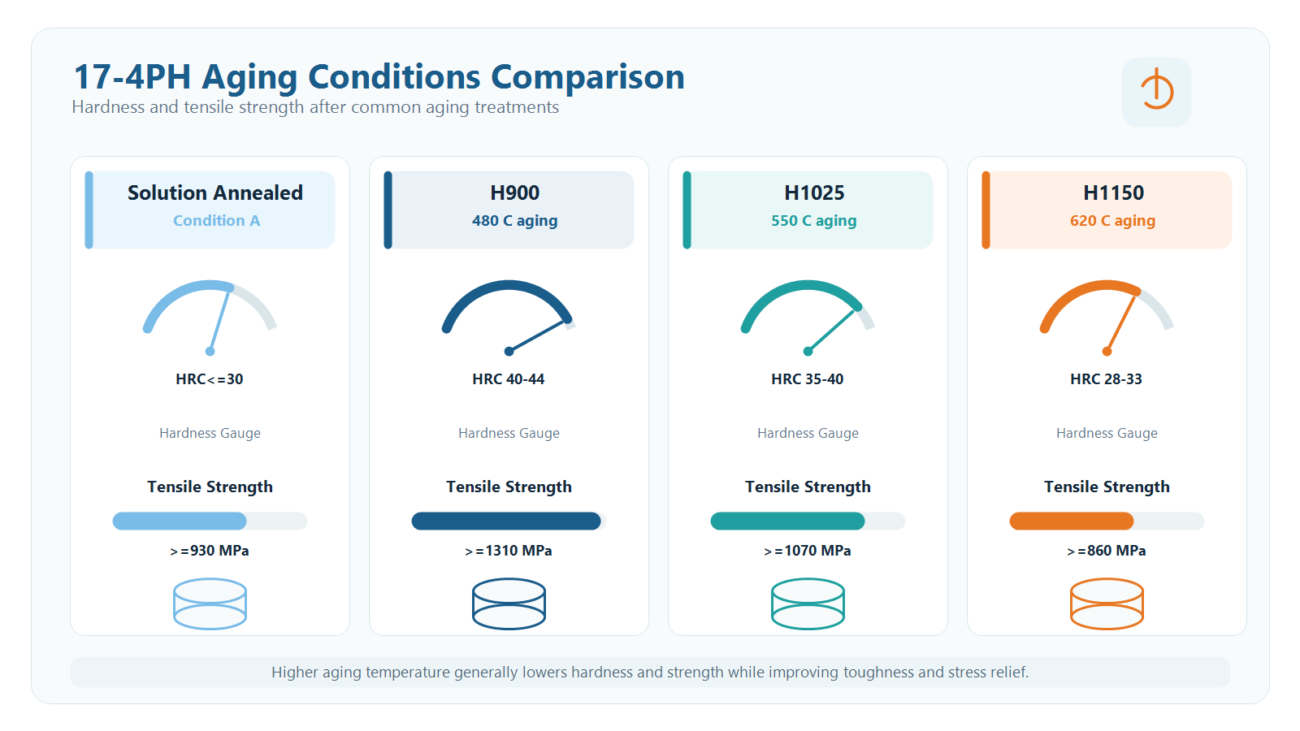
Image slot 1: 17-4PH performance comparison by aging condition.
Heat Treatment Route: Solution Treatment, Aging and Finish Machining Sequence
A common 17-4PH process route is rough machining, solution treatment, semi-finishing, aging, and finish machining. Rough machining is usually done in a softer condition because machinability is better and enough stock can be left for heat treatment and final finishing. After aging, the material becomes harder, so the remaining work is usually grinding, light milling, finish turning, or local correction rather than heavy stock removal.
Another route is rough machining, solution treatment plus aging, and then finish machining. This route reduces one handling step, but the aged material is harder, the finish allowance must be smaller, and tool wear risk is higher. It is more suitable for simple geometries, small finishing allowance, and stable tolerance requirements.
The key point is that final critical dimensions are usually completed after aging. Aging may cause slight dimensional movement. A range such as 0.05-0.15 mm should be treated as a typical planning reference for certain structures, not as a guaranteed value. JADE-CNC normally checks key dimensions after aging, then adjusts finish allowance, fixturing, and machining parameters based on measured movement.
CNC Machining Strategy: Different Conditions Need Different Cutting Plans
In the solution-treated condition, 17-4PH machines somewhat like 304, but it still has some toughness and work-hardening tendency. TiAlN-coated carbide tools are often used, and Vc 80-120 m/min can be used as an initial turning reference. Depth of cut should avoid rubbing on a hardened surface layer. Rough machining allowance depends on part size, wall thickness, heat treatment condition, and tolerance requirements.
In the aged condition, 17-4PH has higher hardness, stronger cutting load, and more tool wear. Milling may use carbide, cermet, or PCBN tools where justified. Cutting speed is usually reduced, and stable feed, small depth of cut, and sufficient cooling become more important. Drilling may use cobalt HSS or carbide drills; deep holes and small holes need pecking and chip evacuation control. Tapping should be planned with the right tap type, tapping oil, and controlled pilot-hole size.
Grinding is an important finishing method for aged 17-4PH. Cylindrical grinding, surface grinding, and jig grinding can be used to correct critical dimensions. Wheel selection and cooling strategy must avoid grinding burn. If temper color or burn appears, surface hardness, corrosion resistance, and fatigue performance may be affected, so grinding heat should be part of process review for critical surfaces.
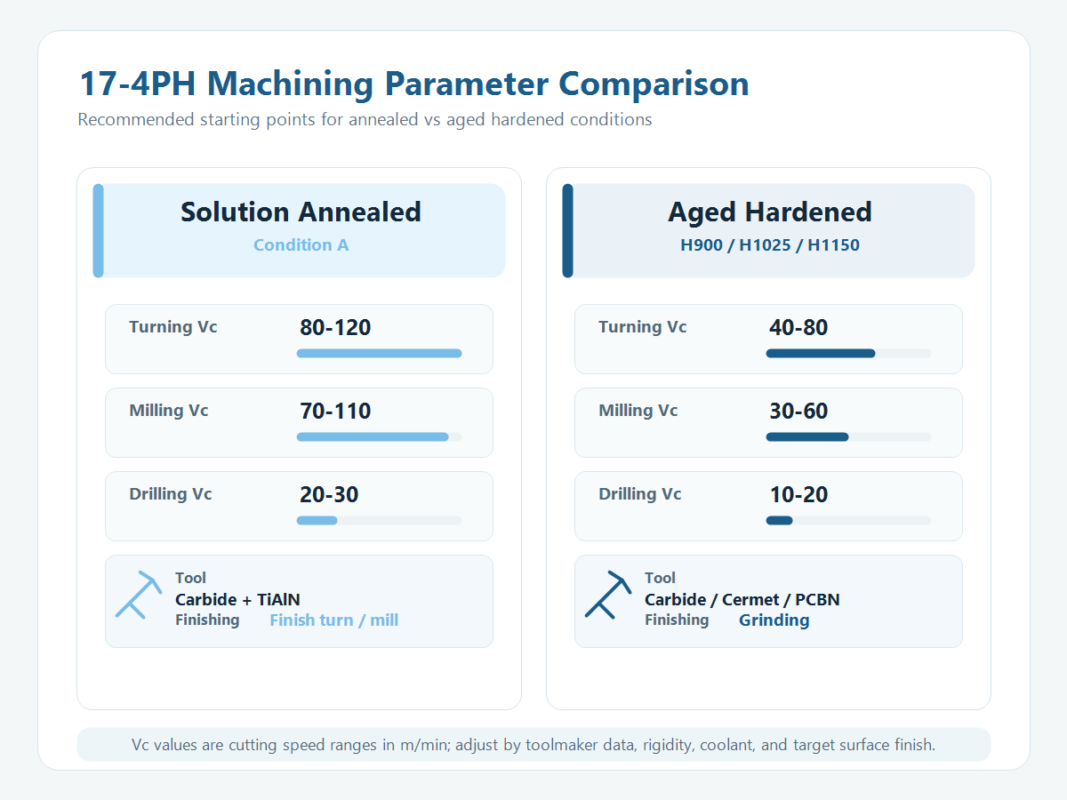
Image slot 2: machining parameter comparison for 17-4PH in different conditions.
Distortion Control: Heat Treatment Allowance, Fixturing and Inspection Timing
17-4PH heat treatment distortion often needs more attention than 304 or 316 because precipitation hardening causes structural and dimensional changes. Thin walls, long shafts, complex cavities, eccentric features, and uneven wall thickness can lead to bending, warping, or local dimensional shift. Distortion control depends on machining allowance before heat treatment, heat-treatment support, fixturing, and inspection timing after aging.
Long shafts may be evaluated for vertical hanging or supported heat treatment to reduce bending from self-weight. Thin plates and thin-wall parts may use dedicated fixtures or support methods to reduce warping. Complex parts are often semi-finished after solution treatment and finish machined after aging, using final machining to correct aging movement. Aging movement of 0.05-0.15 mm and finish allowance of 0.2-0.3 mm can be used as early planning references, but final allowance should be confirmed from part geometry, heat-treatment batch behavior, and tolerance requirements.
If distortion exceeds the available finish allowance, the team may need to evaluate straightening, re-heat treatment, local correction, or remake risk. Aged 17-4PH is harder and more difficult to straighten, so the better approach is to control geometry while the part is still in solution-treated or semi-finished condition. Process planning should therefore include the straightening position, inspection point, and final machining allowance.
Common Machining Problems and Tool Control
Compared with 304 or 316, 17-4PH can generate higher cutting load in certain conditions, and tool wear becomes more obvious after heat treatment. Small internal corners, deep grooves, thin walls, high surface-finish requirements, and interrupted cuts all increase risk. Tool choice, cutting data, coolant, chip evacuation, and workholding rigidity should be reviewed together. For adjacent stainless machining issues, see Stainless Steel CNC Machining Problems & Solutions.
Applications and Selection Guidance
17-4PH is suitable when a part needs high strength and moderate corrosion resistance: aerospace structural components, high-strength medical tools or components, premium mechanical parts, gears, shafts, valves, locking parts, and oil-and-gas-related components. If the service environment includes seawater, strong chloride exposure, or aggressive corrosion media, 316, duplex stainless steel, or another corrosion-resistant alloy should be reviewed instead of looking only at strength. If high strength is not required, 304 or 316 is usually more economical and easier to machine.
The aging condition is also a selection decision. H900 is often used where high strength is the priority, but toughness and corrosion resistance should be reviewed. H1025 is commonly used when strength, toughness, and corrosion resistance need balance. H1150 provides better toughness and is useful for impact loading or toughness-sensitive parts. JADE-CNC evaluates the machining route based on load, environment, dimensional accuracy, heat-treated condition, and inspection requirements.
About JADE-CNC
JADE-CNC focuses on precision stainless steel part machining, with five-axis machining, turn-mill compound machining, precision grinding equipment, ISO 9001 certification, and one-stop service from CNC machining, welding, heat-treatment coordination, surface finishing, to inspection. Incoming material can be verified by spectrometer, and key processes combine self-inspection with dedicated inspection to help control lead time, quality, and batch consistency.
Send your drawing, 3D model, 17-4PH material condition, target aging condition, heat-treatment requirement, critical dimensions, tolerances, surface treatment, and batch quantity for process assessment and quotation, typically within 24 hours.
Related Stainless Steel Articles
– 304 vs 316 vs 316L Stainless Steel: Which One Should You Choose for CNC Machining?
– Stainless Steel Welding for CNC Machined Parts: TIG, Laser Welding and Distortion Control
– Stainless Steel CNC Machining Cost & Quotation Guide: 10 Cost Factors and Supplier Comparison

Leo Liang, Founder Best Partner with R&D
JADE-CNC’s Founder LEO, who brings over two decades of industry expertise, Leo started his career as an apprentice and practice his skills in surface treatment and CNC machining.