


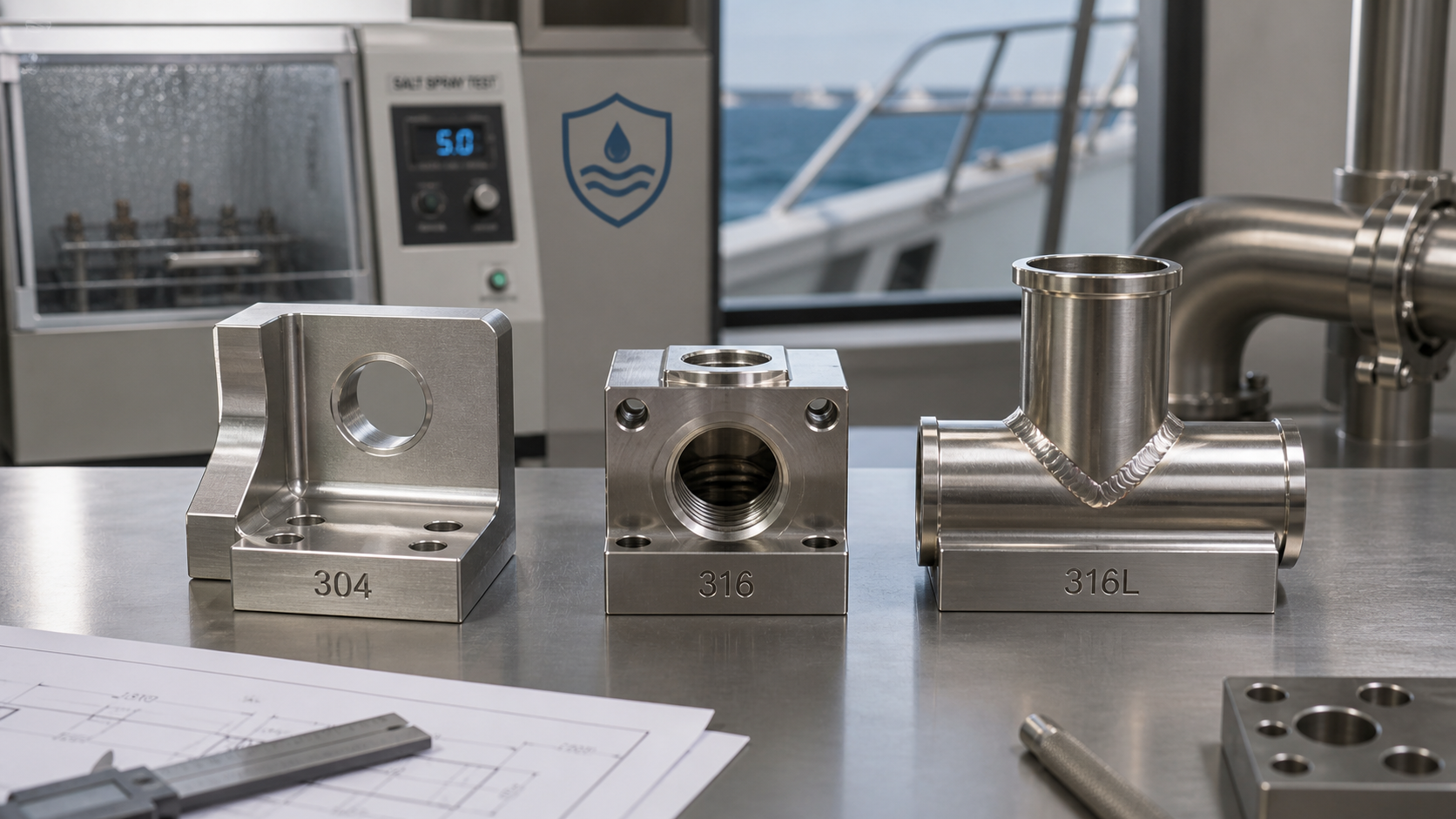
A practical stainless steel material selection guide for 304, 316, and 316L CNC machining, covering corrosion resistance, welding, cost, applications, procurement, and inspection.
What Happens When Choose Wrong Stainless Steel for projects?
304, 316, and 316L look nearly identical in hand, and in many cases only material verification can confirm the difference. Yet they differ significantly in price, corrosion resistance, weldability, and machining behavior. If a drawing or RFQ only says “stainless steel” without specifying the grade, the supplier may quote 304 while the application actually requires 316 or 316L. That creates avoidable rework, schedule risk, and commercial disagreement.
An even more common scenario: a customer downgrades from 316 to 304 to save cost, installs the part in a coastal environment, and sees rust within six months. Choosing the wrong material is never a “minor performance difference” issue. Using 304 instead of 316 in a marine environment leads to pitting within three months, and the cost of a full batch return can exceed 10 times the material savings. Conversely, using 316 for ordinary indoor structural parts adds 60% to material cost with no real benefit. This article breaks down the differences between these three grades so you can make the right decision before placing an order.
For the broader machining route, tolerances, finishing, inspection, and supplier-selection context, use the stainless steel CNC machining guide as the cluster hub before finalizing grade selection. This 304 vs 316 stainless steel comparison should be read as a material-selection decision, not only a price comparison.
304 vs 316 vs 316L :Difference in general saying
If machinability is the main concern rather than corrosion resistance, compare these grades with 303 free-machining stainless steel. If the part needs much higher strength, review 17-4PH stainless steel machining.
Before reading detailed data sheets, separate the three grades by their primary selection driver: general-purpose use, corrosion resistance, or welded corrosion performance.
304 is the general-purpose choice: cost-effective, widely available, and suitable for many indoor or mildly exposed parts. It is commonly used for kitchen equipment, stair railings, brackets, covers, and standard equipment enclosures, but it is not the right choice for salt water or aggressive chemical exposure.
316 is the corrosion-resistant choice. Its molybdenum content improves resistance to chloride attack, salt spray, and many chemical environments. It costs more and is less machinable than 304, but it is often justified for marine hardware, coastal equipment, chemical plant components, and selected medical parts.
316L is the low-carbon welding choice. Its composition is close to 316, but the lower carbon limit reduces the risk of intergranular corrosion in the heat-affected zone after welding. If the part will be welded and cannot be solution annealed afterward, 316L is usually the safer specification. Welded piping and sanitary assemblies in food and pharmaceutical equipment commonly use 316L.
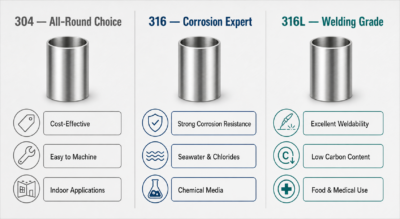
Remember this: use 304 for ordinary environments, 316 for corrosive environments, and 316L when welding is involved. Now let us look at the specific data.
Chemical Composition and Mechanical Properties
All three grades are austenitic stainless steels. The key differences come down to three elements: nickel, molybdenum, and carbon. Higher nickel improves toughness and corrosion resistance; molybdenum is the key to chloride corrosion resistance; lower carbon directly reduces the risk of intergranular corrosion after welding. The table below lists the critical parameters for easy comparison.
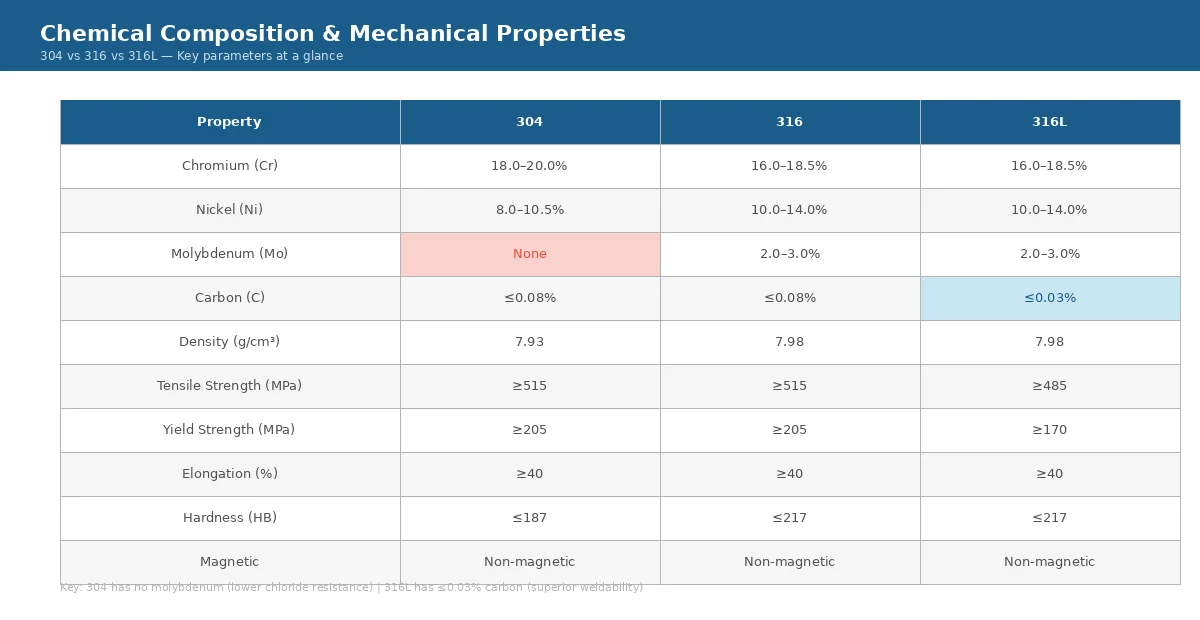
As the table shows, the only compositional difference between 316 and 316L is carbon content — 316 allows up to 0.08%, while 316L caps at 0.03%. The lower carbon slightly reduces 316L’s tensile and yield strength, but significantly improves weldability and intergranular corrosion resistance. 304 contains no molybdenum, which is the fundamental reason its corrosion resistance falls short of the 316 family.
Global Grade Designation Equivalents
With composition understood, there is another common pitfall in common: different countries use different naming systems for the same material. American 304,Japanese SUS304, and European 1.4301 which are referring to the same material. Failing to confirm these equivalents can lead to communication errors — or even the wrong material being delivered.
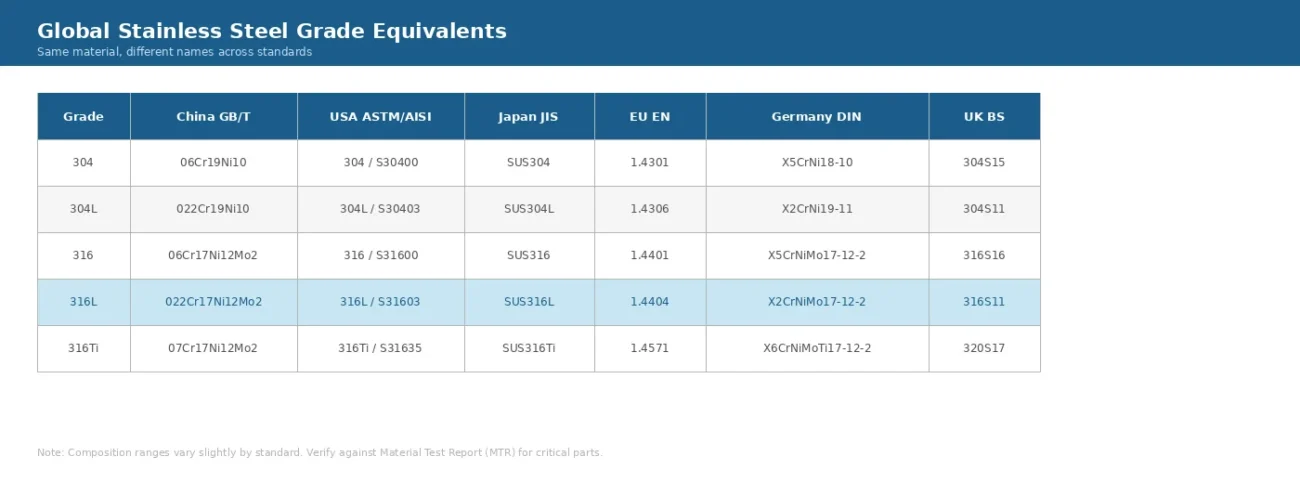
Composition ranges vary slightly across standards, so for critical parts, never rely on grade equivalence alone — always verify against the actual chemical composition and mechanical properties on the Material Test Report (MTR). Grade equivalents help with quick identification, but the certificate is what matters for acceptance.
Corrosion Resistance: The Primary Selection Criterion
Now that grades and composition are clear, let us look at the most critical property: corrosion resistance. Most material selection errors stem from misjudging the corrosiveness of the service environment. 304 is perfectly adequate in ordinary environments but fails when chloride ions are present. 316, with its molybdenum addition, takes chloride resistance to a higher level. 316L goes a step further with superior post-weld corrosion resistance.
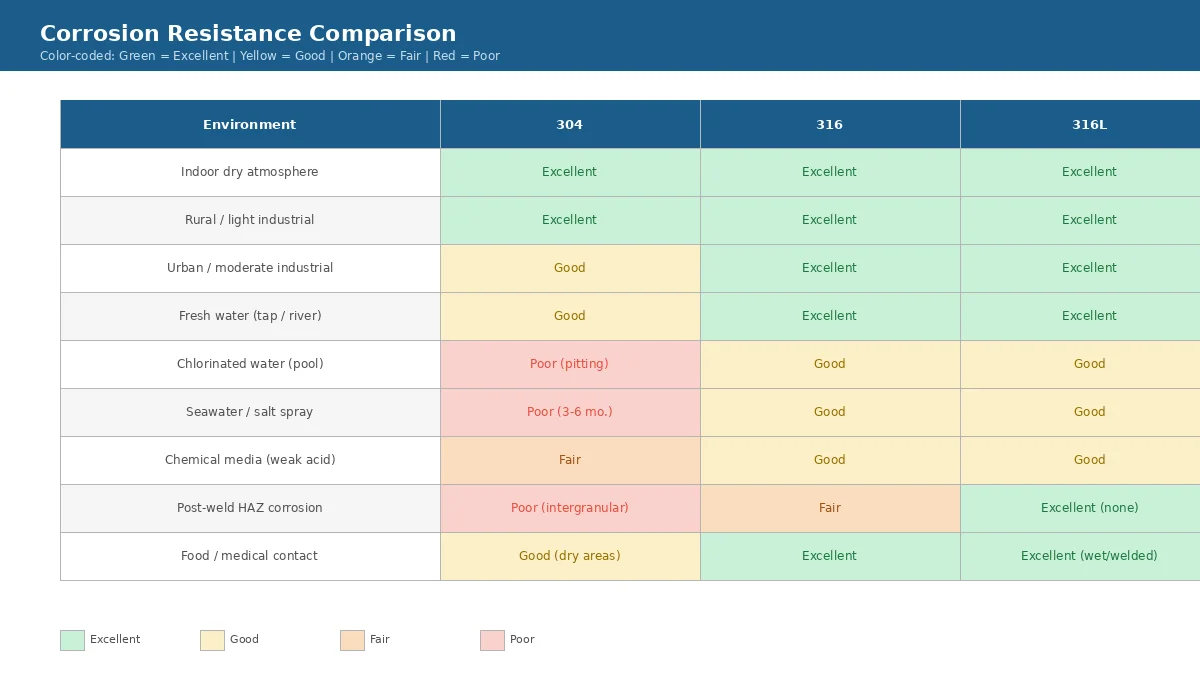
Two things stand out in this table. First, in chloride environments (seawater, salt spray, chlorinated water), 304 is simply out of the question. Second, for post-weld heat-affected zone corrosion resistance, 316L is the only grade rated “Excellent.” If your part meets both conditions — chloride exposure and welding — the choice is straightforward: 316L.
Weldability: The Core Reason 316L Exists
Welding is where the three grades differ most dramatically, and it is the core reason the 316L grade exists. During stainless steel welding, the heat-affected zone reaches 500–800°C. At this temperature, carbon combines with chromium to form chromium carbides that precipitate at the grain boundaries, depleting chromium in those areas and causing “intergranular corrosion” — a rust band alongside the weld seam.
Both 304 and 316 have carbon content up to 0.08%, so carbide precipitation can still occur during welding. There are two solutions: post-weld solution annealing to re-dissolve the carbides, or using a low-carbon material to minimize carbide formation from the start. 316L takes the second approach — with carbon capped at 0.03%, intergranular corrosion after welding is essentially eliminated.
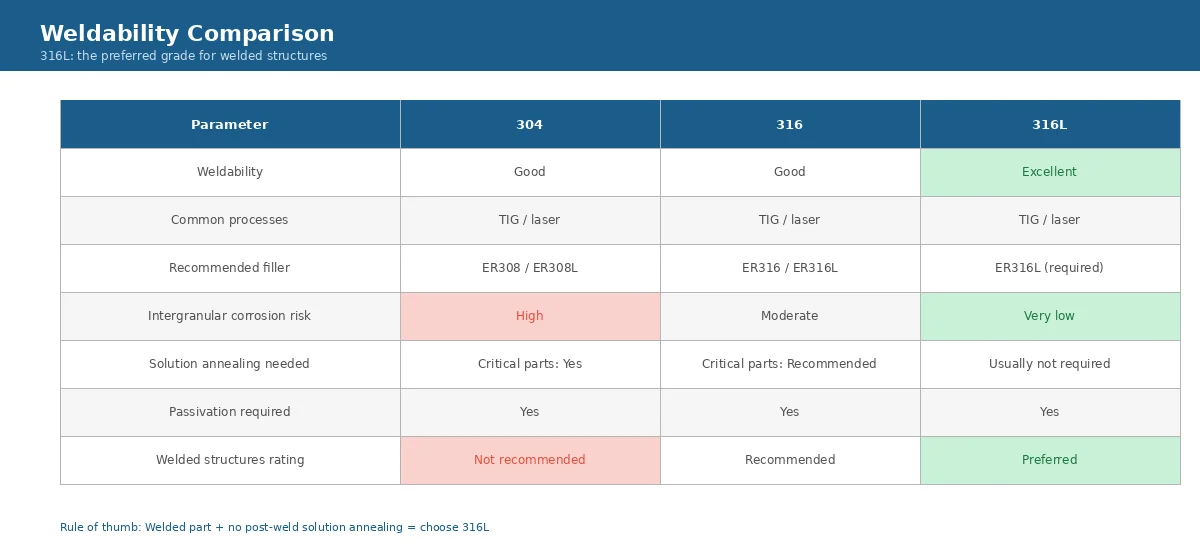
In practice, the decision rule is simple: if the part requires welding and cannot be solution-annealed afterward (large parts, complex geometries, field welding), choose 316L. If post-weld solution annealing or passivation is feasible, 316 works too. 304 is only suitable for non-critical weldments or cases where full post-weld solution treatment can be performed.
Surface Finishing and Corrosion Resistance
For passivation, electropolishing, brushing, blasting, polishing, and dimensional allowance after machining, see the surface finishing guide.
After welding, parts typically undergo surface finishing. The three grades perform similarly with mechanical polishing, brushing, and bead blasting. However, the corrosion resistance improvement after electropolishing and passivation differs. Thanks to higher chromium and nickel content, the 316 family forms a denser passive film, and the corrosion resistance gain after electropolishing is more significant than with 304. 316L offers the most stable passivation results, making it ideal for long-term medical and food service parts.
Surface Finish | 304 | 316 | 316L |
Mechanical polishing (mirror / satin) | Good | Good | Good |
Brushing (linear / non-directional) | Good | Good | Good |
Bead blasting | Good | Good | Good |
Electropolishing result | Good | Excellent | Excellent |
Corrosion improvement after electropolishing | Moderate | Significant | Significant |
Passivation result | Good | Excellent | Excellent (most stable) |
PVD coating adhesion | Good | Good | Good |
Recommended for medical / food-grade finish | Suitable for dry areas | Recommended | Preferred |
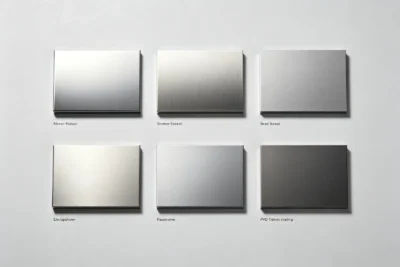
One often-overlooked point in surface finishing: electropolishing removes a small amount of material (typically 0.01–0.03 mm), so high-precision parts need to leave sufficient stock. Also, while passivation is effective for all three grades, passivated 304 still falls short in chloride environments — passivation cannot compensate for a wrong material choice.
304 vs 316 Stainless Steel Cost Comparison
For RFQ cost drivers beyond material price, including machining time, tooling, finishing, inspection, and supplier type, see the stainless steel CNC machining cost guide.
With performance understood, let us talk about cost. Many buyers focus only on material unit price, but when machining cost, tooling consumption, and post-processing are factored in, the material price difference is not as large as it seems. Using bar stock as a reference, 304 is the baseline, 316 costs roughly 1.5–1.8 times as much, and 316L costs 1.6–1.9 times.
Cost Factor | 304 | 316 | 316L |
Material unit price (bar stock, relative) | 1.0 (baseline) | 1.5–1.8 | 1.6–1.9 |
Machining efficiency (vs. 304) | 100% | ~75% | ~75% |
Tooling consumption cost (relative) | 1.0 | ~1.8 | ~2.0 |
Per-unit machining cost (relative) | 1.0 | 1.2–1.4 | 1.2–1.4 |
Post-weld treatment cost | High (solution annealing needed) | Moderate | Low (no solution annealing) |
Total cost (standard part, relative) | 1.0 | 1.4–1.7 | 1.5–1.8 |
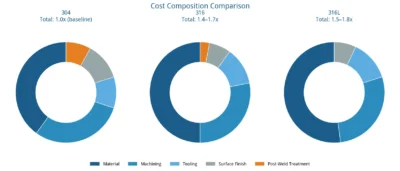
In total cost terms, 316 costs 40–70% more than 304, and 316L costs 50–80% more. But this premium is negligible compared to the cost of failure in harsh environments — a batch of marine parts returned due to pitting can cost more than ten times the material savings. When selecting material, calculate the full picture: material + machining + after-sales risk, not just the purchase price.
Considerations by Manufacturing Process
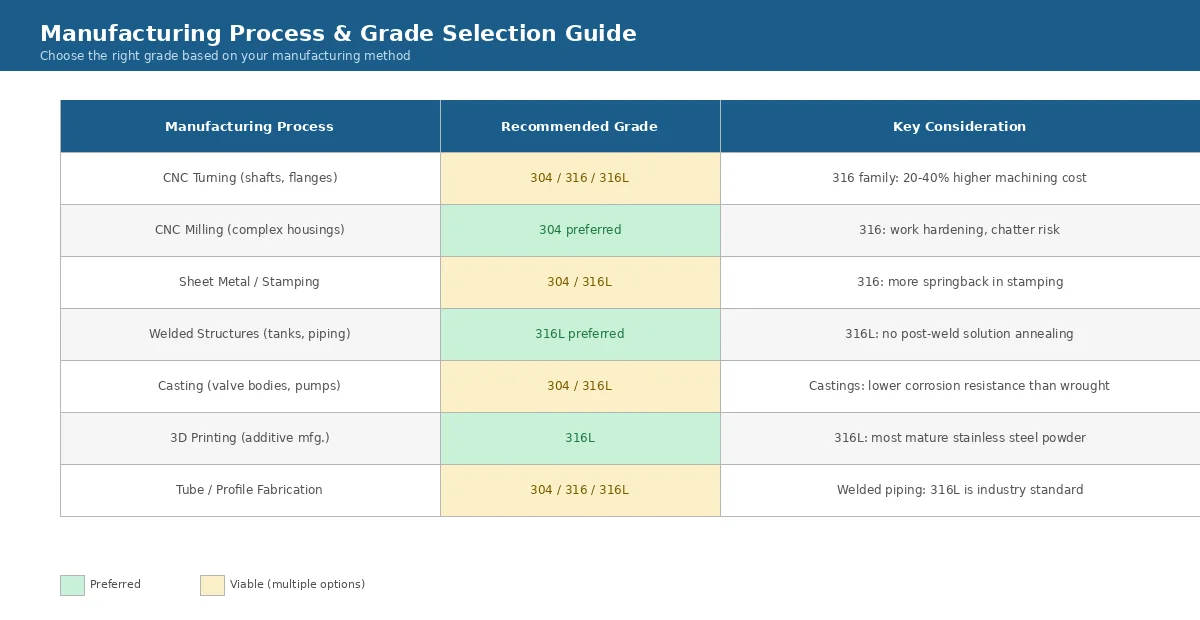
Material properties and cost are clear, but your choice also depends on how the part will be manufactured. The same material behaves very differently when turned, milled, sheet-formed, or welded. Here is what to consider for each common process.
CNC Turning (shafts, sleeves, flanges)
All three grades are suitable for turning. 304 machines best with the longest tool life, making it the most cost-effective choice for high-volume shaft and sleeve parts. 316/316L cause faster tool wear, increasing per-unit machining cost by 20–40%, but in corrosive environments this cost is unavoidable. For long shafts, note that the 316 family has a stronger work-hardening tendency — leave enough finishing stock so the final pass does not cut through a work-hardened layer, which would cause dimensional instability.
CNC Milling (complex structures, housings, panels)
For complex cavities and thin-wall parts, 304 is preferred for higher machining efficiency and lower chatter risk. 316/316L work-harden severely during milling; if the depth of cut is too shallow, the tool rubs on the hardened layer, causing surface chatter and dimensional instability. For high-precision complex parts in 316, confirm that the shop has sufficiently rigid machines and appropriate tooling — otherwise yield rates suffer and lead times can slip.
Sheet Metal / Stamping (thin sheet parts, enclosures, brackets)
All three grades are suitable for sheet metal work. 304 has excellent ductility and forms easily, making it the first choice for standard thin-sheet parts. The 316 family is slightly stronger and has more springback during stamping, so die design needs to account for additional springback compensation. For thin-sheet welded parts, 316L is preferred — no post-weld solution annealing is needed, saving a process step and potentially reducing total cost.
Welded Structures (tanks, piping, frames)
This is where 316L dominates. 304 develops intergranular corrosion in the weld HAZ, and critical parts require post-weld solution annealing — but large and complex parts often cannot fit in a furnace, creating a quality risk. 316 performs better than 304 but still carries some intergranular corrosion risk. 316L’s low-carbon design essentially eliminates this issue, which is why it is the standard for piping and tanks in food, pharmaceutical, and chemical industries.
Casting (complex valve bodies, pump housings, irregular shapes)
All three grades can be cast. 304 has good casting fluidity and high yield, making it the standard for general castings. 316/316L have slightly poorer fluidity and a greater tendency for shrinkage cavities, requiring more careful casting process control. For castings that will be welded afterward, 316L is preferred. One important note: castings generally have lower corrosion resistance than wrought parts (bar or forging) due to microsegregation in the cast structure. For critical corrosive environments, wrought material is recommended.
3D Printing (Metal Additive Manufacturing)
316L is currently the most widely used stainless steel for metal additive manufacturing, with mature powder availability and stable printing performance. 304 and 316 powders are more limited. If the part will be 3D printed, 316L is usually the default starting point because it offers broader process availability, good post-print corrosion resistance, and reliable weldability.
Tube / Profile Fabrication (railings, frames, fluid piping)
In the standard tube and profile market, 304 is most common with the widest size range and lowest price. 316 tubing is also widely available but costs more. 316L tubing is primarily used for welded piping systems — the standard in food and pharmaceutical industries. For fluid piping with welded joints, choose 316L; for compression-fit connections without welding, 316 is sufficient.
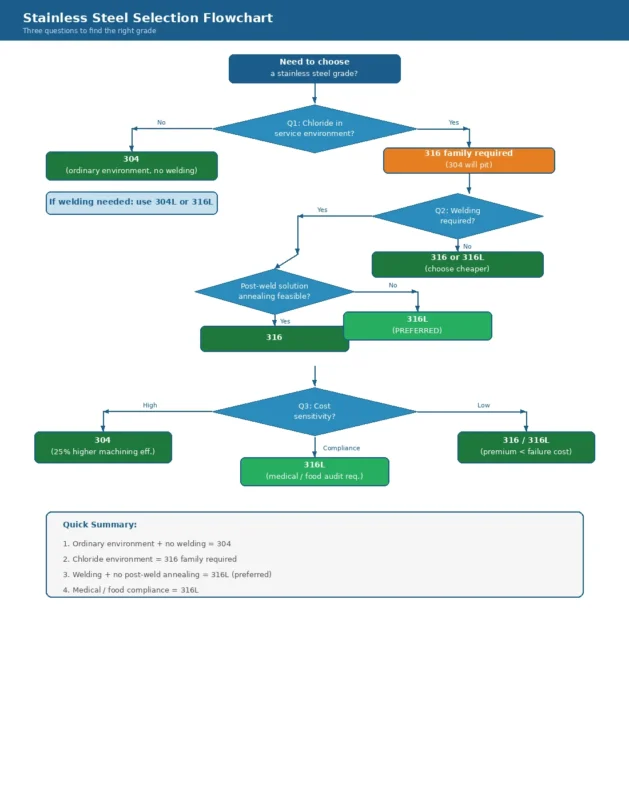
Selection Guide: Three Questions to Decide
For regulated applications, grade selection should also be checked against medical stainless steel machining and food machinery stainless steel machining requirements.
After all this detail, it may feel overwhelming. In practice, you do not need to memorize every parameter. Ask yourself three questions in order, and the answer usually becomes clear.
Question 1: Is there chloride in the service environment?
Yes (seawater, salt spray, chemical media, de-icing salts, chlorinated disinfection) → Must use 316 or 316L; 304 will pit.
No (indoor dry, normal atmosphere, fresh water, no corrosive media) → 304 is sufficient; using 316 is wasteful.
Question 2: Does the part require welding?
Yes, and post-weld solution annealing is not feasible (large parts, complex geometries, field welding) → Prefer 316L.
Yes, but post-weld solution annealing or passivation is feasible → Either 316 or 304, based on corrosion requirements.
No welding → Choose based on corrosion requirements; 316 and 316L are nearly identical, so use whichever is cheaper.
Question 3: How cost-sensitive is the project?
High volume, non-corrosive environment, strong cost pressure → 304, with 25% higher machining efficiency.
Harsh environment, safety-critical, long service life, customer-specified → 316/316L; the material premium is far less than the cost of failure.
Medical / food compliance parts → 316L; it is an audit requirement, not optional.
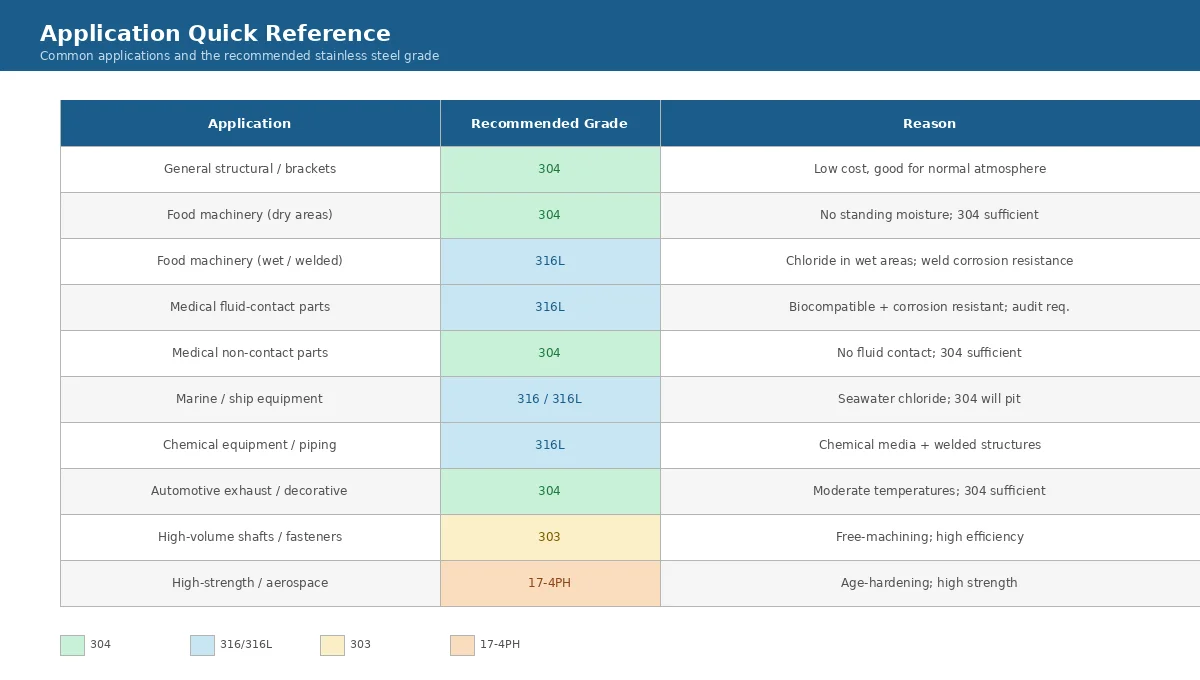
Application Quick Reference
If the three questions still leave you uncertain, the table below directly maps common applications to the recommended grade and the reason behind it.
Procurement and Quality Control for Stainless Steel Grades
Choosing the right material is only the first step. There are a few points in procurement and inspection that directly determine whether the material you receive is actually the material you specified.
Material Test Report (MTR)
Critical parts must come with a Material Test Report containing heat number, chemical composition, and mechanical properties. 304 being passed off as 316 is not uncommon in the industry — without a certificate, there is no traceability if problems arise. Reputable shops provide MTRs with every shipment. This is a baseline requirement, not a bonus.
Incoming Material Verification
A certificate alone is not enough. Reliable shops verify incoming material with a spectrometer for every batch. JADE-CNC can verify incoming material composition via spectrometer testing, and MTRs ship with every order, preventing material mix-ups at the source. Spectrometer testing takes only seconds and costs very little, but it avoids the risk of an entire batch being scrapped.
Total Cost Perspective
Finally, back to cost. Material unit price is only one part of the total. 304 is cheap per kilogram but carries high failure risk in harsh environments; 316L costs more but is the lowest-risk choice in medical and marine applications. When evaluating quotes, factor in machining efficiency, tooling consumption, yield rates, audit pass rates, and after-sales risk — not just the material price. Often, the more expensive material ends up being the more economical choice.
About JADE-CNC
JADE-CNC specializes in precision stainless steel machining. With 5-axis machining centers, turn-mill machines, and precision grinding equipment, and ISO 9001 certification, we provide one-stop precision machining services for the full 304/316/316L stainless steel range. Incoming material can be verified via spectrometer, and every process step includes self-inspection plus dedicated quality checks, keeping lead times and quality fully under control.
Send your drawings and application details for a material selection recommendation, process assessment, and quote — typically within 24 hours.
For a manufacturability review, material recommendation, and production quote, request a CNC machining quote with drawings, quantity, application environment, finish requirements, and inspection needs.
Related Stainless Steel Articles
- Stainless Steel CNC Machining: The Complete Problem-Solving Guide
- 303 Free-Machining Stainless Steel: Cost-Saving Choice for Batch Precision Parts
- 17-4PH Stainless Steel Machining: Solution Treatment, Aging and Finish Machining
- Stainless Steel CNC Machining Problems & Solutions: Built-Up Edge, Tool Wear, Broken Drills & Chatter
- Stainless Steel Surface Finishing Guide: Polishing, Brushing, Blasting, Passivation, Electropolishing & PVD
- Medical Stainless Steel Part Machining: 316L Material, Process and Compliance Requirements
- Food Machinery Stainless Steel Machining: Sanitary-Grade Material, Welding and Surface Finish
- Stainless Steel CNC Machining Cost & Quotation Guide: 10 Cost Factors and Supplier Comparison

Leo Liang, Founder Best Partner with R&D
JADE-CNC’s Founder LEO, who brings over two decades of industry expertise, Leo started his career as an apprentice and practice his skills in surface treatment and CNC machining.