


Welding: The Process Most Likely to Cause Problems in Stainless Steel Machining
In stainless steel part machining, welding is a process that looks simple but is actually complex. Stainless steel welding involves material selection, filler material, welding parameters, gas shielding, distortion control, and post-weld treatment. A problem in any one of these steps can lead to weld cracking, corrosion, distortion, or batch rejection.
The difficulty with stainless steel welded parts is not whether they can be welded together, but whether post-weld dimensions, appearance, corrosion resistance, and subsequent finish machining can still meet the drawing consistently. Many CNC machined parts use welding to reduce overall CNC machining cost, combine complex structures, or achieve thin-sheet to machined-part connections. However, if welding sequence, allowance, fixturing, and post-weld treatment are not planned in advance, later problems include out-of-tolerance distortion, sealing surface offset, weld discoloration, incomplete passivation, or insufficient finish machining allowance.
For example, the weldability of 304, 316, and 316L differs significantly. 316L, due to its low carbon content, has lower intergranular corrosion risk after welding and is often selected for welded stainless steel structures. 304 and 316 often need suitable post-weld treatment to restore corrosion resistance in the welded area. This guide explains the three welding processes commonly used for stainless steel CNC machined parts – TIG welding, laser welding, and plasma welding – with a focus on distortion control, post-weld machining, and surface treatment.
TIG, Laser, and Plasma Welding Compared
There are three commonly used welding processes for stainless steel machined parts, each with suitable applications. TIG welding (Tungsten Inert Gas) is highly versatile and can produce high-quality welds on many stainless steel grades, but it is slow with high heat input and significant distortion. Laser welding has low heat input, minimal distortion, and high speed, but equipment cost is high and fit-up gap requirements are strict. Plasma welding falls between the two, with deep penetration suitable for medium-thick plate welding.
Process | Heat Input | Distortion | Welding Speed | Suitable Thickness | Cost |
TIG | High | High | Slow | 0.5–6mm | Low |
Laser | Low | Low | Fast | 0.1–3mm | High |
Plasma | Medium | Medium | Medium | 1–8mm | Medium |
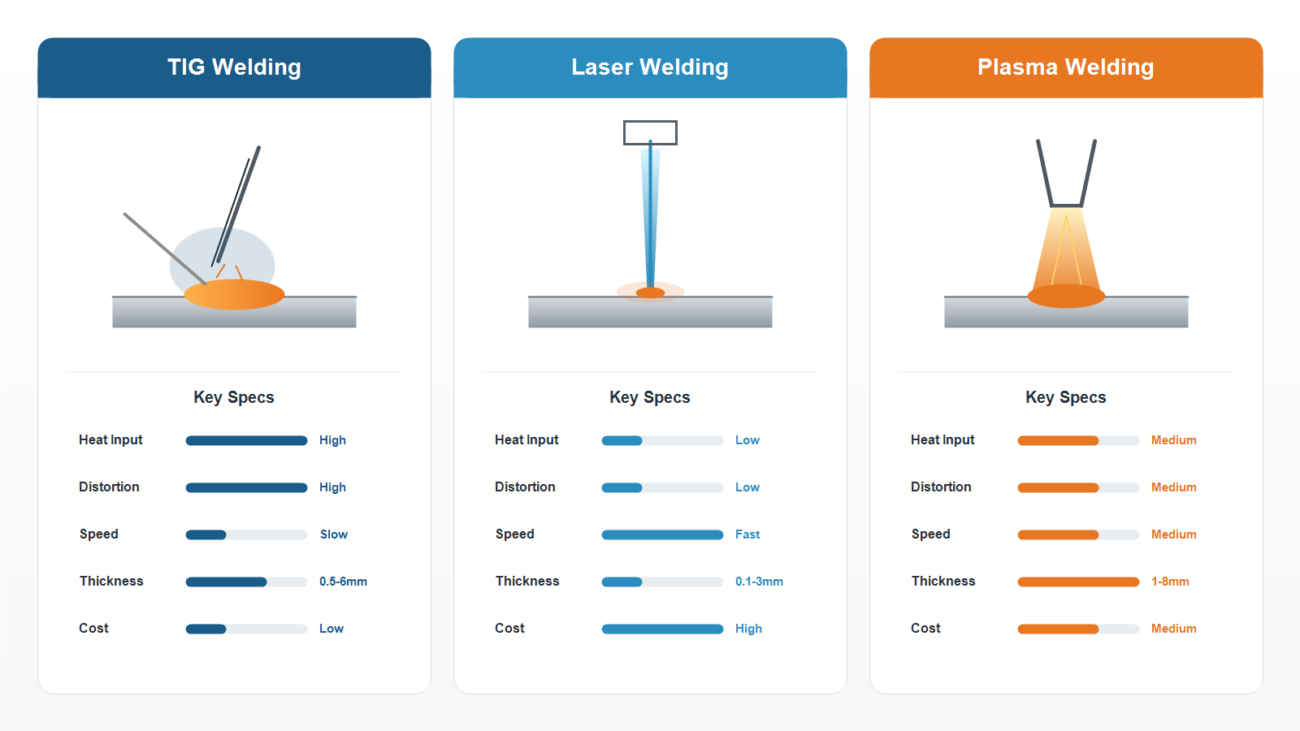
Image slot 1: Three welding processes comparison (can be designed as infographic)
TIG Welding: The Most Versatile Stainless Steel Welding Process
TIG welding is the most widely used welding process in stainless steel machining. It uses a tungsten electrode to generate an arc that melts the base metal and filler metal, while argon gas shields the molten pool from oxidation. The advantages of TIG welding are high weld quality, beautiful bead formation, and compatibility with many stainless steel grades. The disadvantages are high heat input, susceptibility to distortion on thin sheets, slow welding speed, and high skill requirements for welders.
When welding 316L, ER316L filler wire is usually specified rather than 308 or standard 316 wire; otherwise, the carbon content and alloy composition of the weld may not match the corrosion-resistance requirement. Welding current is selected based on plate thickness: 30-60A for 0.5-1mm thin sheet, 80-120A for 2-3mm, and bevel preparation with multi-pass welding for thickness over 3mm. Gas shielding uses pure argon at 8-12 L/min, and the back side should also be gas-shielded to reduce oxidation and discoloration.
Common TIG welding problems include porosity and lack of penetration. Porosity is usually caused by poor gas shielding, oily filler wire, or oxide layer on the base metal surface. Lack of penetration is caused by too little current, too fast travel speed, or insufficient bevel angle. Our approach is to clean the weld area with acetone or alcohol before welding, check filler wire packaging integrity before use, and perform weld cross-section inspection on the first piece to confirm penetration depth.
Laser Welding for High Precision and Low Distortion
Laser welding uses a high-energy-density laser beam to melt metal, with concentrated heat input, a small heat-affected zone, minimal distortion, and welding speed 3–5x that of TIG welding. Laser welding does not require filler material (autogenous welding), producing a narrow and aesthetically pleasing weld — especially suitable for thin-walled parts, precision components, and parts with high appearance requirements.
The limitations of laser welding are also clear. Equipment cost is high, and fit-up gap requirements are strict – gaps exceeding 0.1mm may result in lack of penetration, requiring precision fit-up or filler wire addition. Highly reflective materials (such as pure copper, pure aluminum) are difficult to weld, but stainless steel has acceptable absorption and usually does not require special pre-treatment for absorption. For thick plates over 3mm, laser welding requires multi-pass or bevel preparation, where its advantage diminishes.
We use laser welding extensively on medical parts, food machinery thin-walled components, and appearance decorative parts. After laser welding, straightening is often reduced, the weld is aesthetically pleasing, and subsequent polishing volume is small. However, for thick plates and structural parts, TIG welding is more economical and reliable.
Welding Distortion Control for Stainless Steel CNC Parts
Welding distortion is one of the most common production problems in stainless steel welding. Stainless steel has a thermal expansion coefficient about 1.5x that of carbon steel and thermal conductivity about half that of carbon steel, so heat does not dissipate quickly during welding and distortion can be greater than in carbon steel. Distortion control cannot rely only on post-weld straightening; it should start with welding process design and fixturing strategy.
Reducing heat input is usually the most effective measure. Use laser welding instead of TIG where possible; for TIG, use the smallest current and fastest speed that still ensures penetration. Symmetrical welding is also a common method. For long welds, use backstep welding from the center outward to avoid excessive heat accumulation at one end causing bending. The rigid fixation method uses fixtures to hold the workpiece firmly, using restraint to reduce distortion, but fixation points should not be directly above the weld because cracking may occur.
Welding sequence is also important for dimensional control. Weld high-shrinkage welds first, then low-shrinkage welds; weld short welds first, then long welds; for cross welds, weld the transverse seam before the longitudinal seam. For large welded assemblies, JADE-CNC can review welding sequence and reserve reverse distortion before welding so post-weld straightening can be reduced.
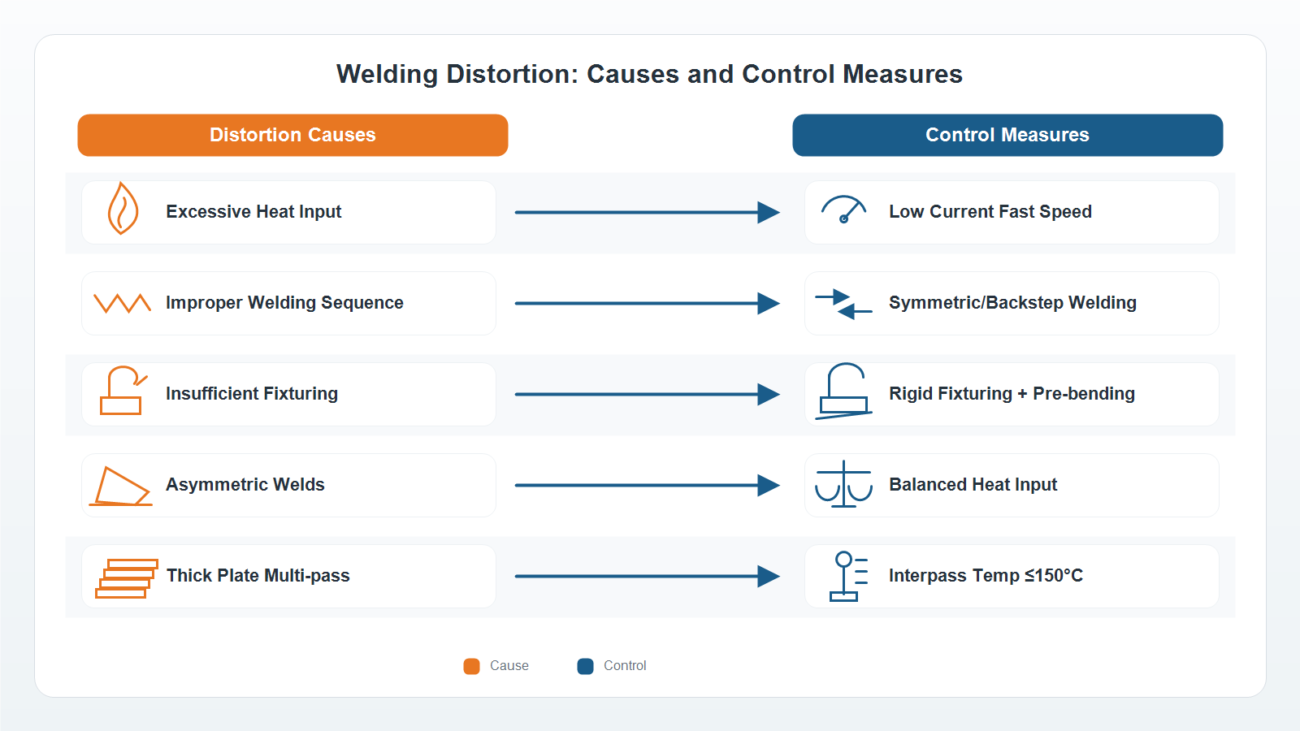
Image slot 2: Welding distortion control measures diagram
Post-Weld Treatment: Restoring Corrosion Resistance and Appearance
After stainless steel welding, corrosion resistance of the weld and heat-affected zone may decrease, so post-weld treatment is usually needed. The most basic process is passivation: nitric acid or citric acid removes surface free iron and helps restore the passive film. For 304 and 316 after welding, if solution treatment cannot be performed, passivation is normally specified.
Critical welded parts for medical, food, or chemical applications may require electropolishing, which both removes weld discoloration and achieves a smoother surface while improving corrosion resistance. Before electropolishing, ensure the weld is smooth with no undercut or excess weld metal, otherwise defects become more pronounced after electropolishing.
Some materials and structures allow post-weld stress treatment, while others are limited by material, performance, or surface requirements. If the project subsequently involves 17-4PH or other heat-treated stainless steels, the heat treatment route should be confirmed in advance to avoid interference between welding and aging processes.
316L, due to its low carbon content, has lower intergranular corrosion risk after welding and usually needs passivation according to the drawing or service environment. For 304 and 316 after welding, if the service environment is corrosive, post-weld solution treatment (typically 1050-1100掳C heating followed by rapid cooling) may be recommended to re-dissolve carbides precipitated during welding. However, large and complex parts often cannot fit in the furnace, which is why 316L is often selected for critical welded parts.
Common Welding Defects and Inspection Methods
Porosity is the most common defect, caused by poor gas shielding, oily or oxidized filler wire/base metal, or excessive arc length. Solutions include pre-weld cleaning, gas path inspection, and arc length control. Cracking is divided into hot cracking and cold cracking — stainless steel primarily experiences hot cracking, caused by weld solidification shrinkage under restraint. Solutions include using 316L filler wire (containing a small amount of ferrite), reducing restraint, and controlling interpass temperature. Lack of penetration is caused by low current, fast speed, or insufficient bevel angle, requiring parameter adjustment and bevel redesign. Undercut is caused by excessive current or incorrect torch angle, requiring current reduction and angle adjustment.
JADE-CNC welded parts receive visual inspection, critical welds undergo penetrant testing (PT), and pressure parts undergo hydrostatic or leak testing. Welding parameters and welder identification are recorded on the process card for traceability.

Image slot 3: Common welding defects comparison (porosity / cracking / lack of penetration / undercut)
About JADE-CNC
JADE-CNC specializes in precision stainless steel part machining, with five-axis machining, turn-mill compound machining, and precision grinding equipment, ISO 9001 certification, and one-stop service from machining and welding to surface finishing and inspection. Incoming material can be verified by spectrometer, with self-inspection plus dedicated inspection at key process stages, helping control lead time, quality, and batch consistency.
Send your drawings, material grade, welding position, finish requirement, tolerance requirement, and annual or batch quantity for process assessment and quotation, typically within 24 hours.
Related Stainless Steel Articles
– 304 vs 316 vs 316L Stainless Steel: Which One Should You Choose for CNC Machining?
– Stainless Steel CNC Machining Cost & Quotation Guide: 10 Cost Factors and Supplier Comparison
– 17-4PH Stainless Steel Machining: Solution Treatment, Aging and Finish Machining

Leo Liang, Founder Best Partner with R&D
JADE-CNC’s Founder LEO, who brings over two decades of industry expertise, Leo started his career as an apprentice and practice his skills in surface treatment and CNC machining.