


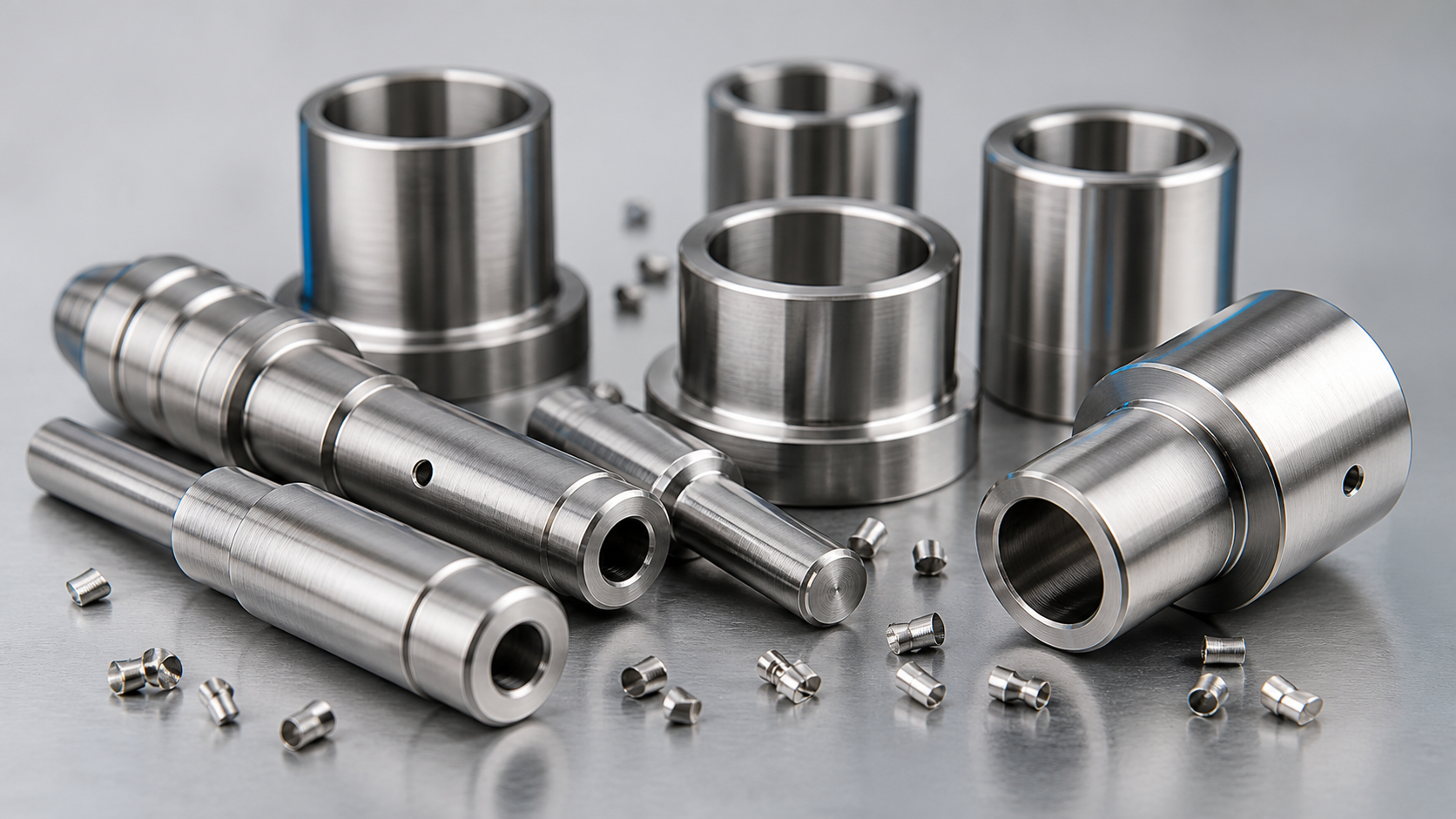
Koszt obróbki seryjnej stali nierdzewnej: Jest 304 Zawsze najbardziej ekonomiczny wybór?
Wsadowa obróbka stali nierdzewnej, 304 ma niższy koszt materiału, ale może tworzyć narosty, szybsze zużycie narzędzia, wolniejszy czas cyklu, i niestabilna kontrola wiórów. Jednorazowy koszt narzędzia, przestoje w usuwaniu wiórów, ryzyko dotknięcia, i czas obróbki są uwzględnione, najniższa cena materiału nie zawsze oznacza najniższy koszt części. Jeśli część nie wymaga spawania i nie będzie działać w środowisku korozyjnym, 303 bardziej ekonomicznym wyborem może być stal nierdzewna automatowa.
303 jest maszynową stalą nierdzewną na bazie 304 ze zwiększoną zawartością siarki. Siarka łączy się z manganem, tworząc wtrącenia siarczku manganu, które pomagają w łamaniu wiórów i miejscowym smarowaniu. Dzięki temu cięcie jest płynniejsze, dłuższa żywotność narzędzia, a wykończenie powierzchni jest bardziej stabilne. W tym artykule wyjaśniono zalety obróbki, ograniczenia, i przypadki zastosowania 303 więc możesz zdecydować, kiedy 303 może zastąpić 304 a kiedy nie powinno.
Do toczenia partii, małe wały, orzechy, armatura, szpilki lokalizujące, i elementy gwintowane, 303 może obniżyć całkowity koszt obróbki. Ale 303 nie jest uniwersalnym zamiennikiem 304, zwłaszcza do spawania, narażenie na korozję, kontakt z żywnością lub lekarzem, i wysokie wymagania dotyczące wyglądu w zakresie odporności na korozję.
W tym artykule skupiono się na kwestiach praktycznych 303 vs 304 decyzja o obróbce. Dla pełnego porównania odporności na korozję i spawalności pomiędzy 304, 316, i 316L, Widzieć 304 vs 316 w porównaniu ze stalą nierdzewną 316L. Dla szerszego wyboru materiału ze stali nierdzewnej i trasy obróbki, zobacz Przewodnik po obróbce CNC ze stali nierdzewnej.
Co jest 303 Stal nierdzewna?
303 stal nierdzewna, znany również jako AISI 303 lub Y12Cr18Ni9 w niektórych standardach, zwiększa zawartość siarki i fosforu w porównaniu z 304. Siarka i mangan tworzą wtrącenia MnS. Podczas cięcia, wtrącenia te pomagają wiórom dzielić się na krótsze segmenty i zapewniają miejscowy efekt smarowania pomiędzy narzędziem a wiórem, zmniejszenie tarcia i zużycia narzędzi.
Właściwości mechaniczne 303 są blisko 304, ale odporność na korozję jest zwykle niższa. Wtrącenia MnS mogą stać się punktem wyjścia dla wżerów, szczególnie w wilgotnym, chlorek, lub środowiska korozyjne. Spawalność jest również słaba, ponieważ siarka zwiększa ryzyko pękania na gorąco w spoinie. Części wymagających spawania zwykle nie należy używać 303.
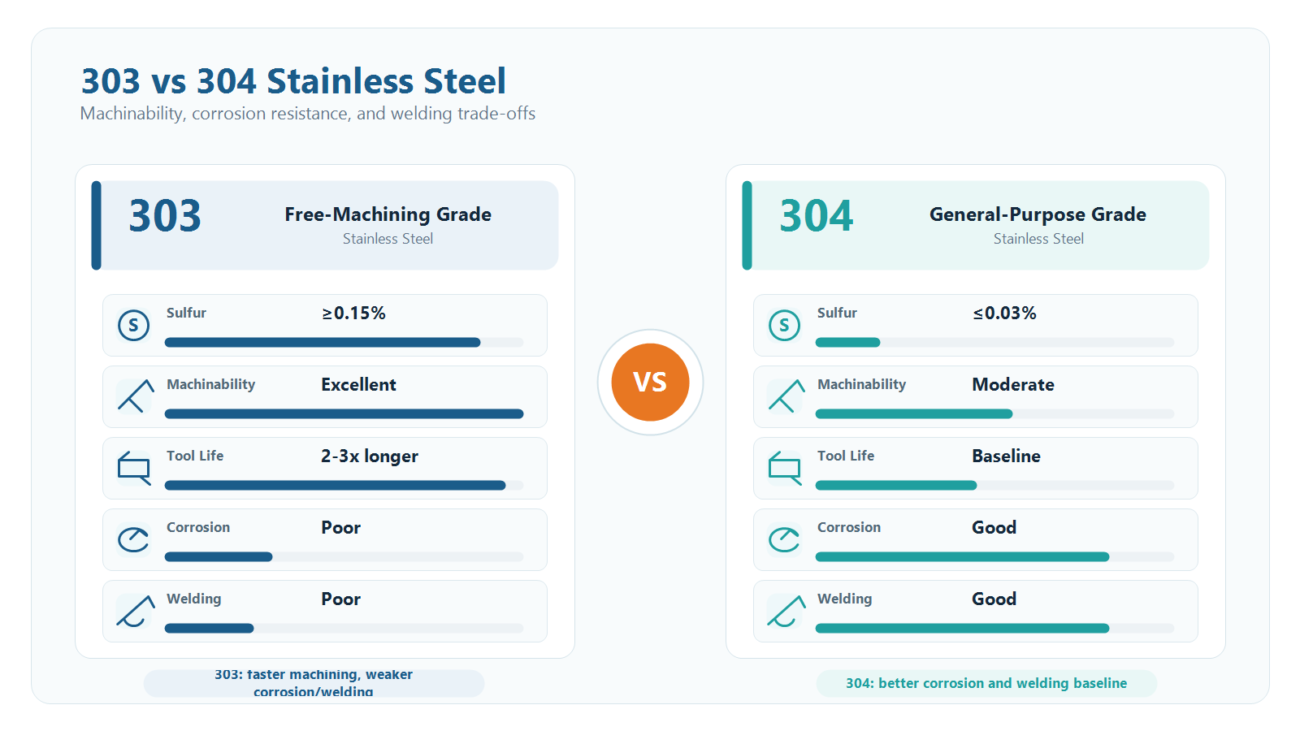
Gniazdo obrazu 1: kluczowe różnice pomiędzy 303 I 304 stal nierdzewna.
Zalety obróbki: Lepsze łamanie wiórów, Czas cyklu i trwałość narzędzia
Zaleta obróbki 303 staje się bardziej wartościowy w produkcja seryjna. W skręcaniu, 303 często może pracować z większą prędkością skrawania niż 304 z bardziej stabilnym podawaniem. Czas cyklu może zostać skrócony, a ta sama płytka zwykle obrabia więcej 303 części niż 304 strony. Koszty narzędzi i przestoje związane z wymianą narzędzi mogą się zmniejszyć. Rzeczywista poprawa zależy od geometrii części, obróbka, sztywność maszyny, płyn chłodzący, i dane wsadowe.
303 wytwarza krótsze wióry, które rzadziej owijają się wokół narzędzia lub przedmiotu obrabianego. Zmniejsza to przestoje maszyny w celu usunięcia wiórów. Dla Toczenie CNC z podajnikami prętowymi, stabilne łamanie wiórów bezpośrednio wpływa na czas cyklu i ryzyko produkcji bez nadzoru. Wykończenie powierzchni jest również zwykle lepsze niż 304, więc niektóre projekty mogą ograniczyć polerowanie lub wtórne wykończenie.
Często zdarza się wiercenie i gwintowanie 303 pokazuje największą wartość. Wióry łatwiej odprowadzają się podczas wiercenia, a wiercenie głębokie można często optymalizować w oparciu o głębokość i średnicę otworu. Moment gwintowania jest niższy, a ryzyko zepsutego kranu jest zwykle niższe niż w przypadku 304. Do części seryjnych z wieloma otworami, wątki, i małe elementy toczone, ta stabilność może mieć większe znaczenie niż cena surowca.
Metoda obróbki | 303 Parametry | 304 Parametry | Wpływ na efektywność |
Toczenie Vc | 120-180 m/min | 90-130 m/min | +30%-50% |
Frezowanie Vc | 100-150 m/min | 80-110 m/min | +25%-40% |
Wiercenie Vc | 25-40 m/min | 20-30 m/min | +25%-33% |
Żywotność narzędzia, obrócenie | 150-200 szt | 60-80 szt | +150% |
Wykończenie powierzchni | Ra 0.8-1.6 jeden | Ra 1.6-3.2 jeden | O jeden poziom lepiej |
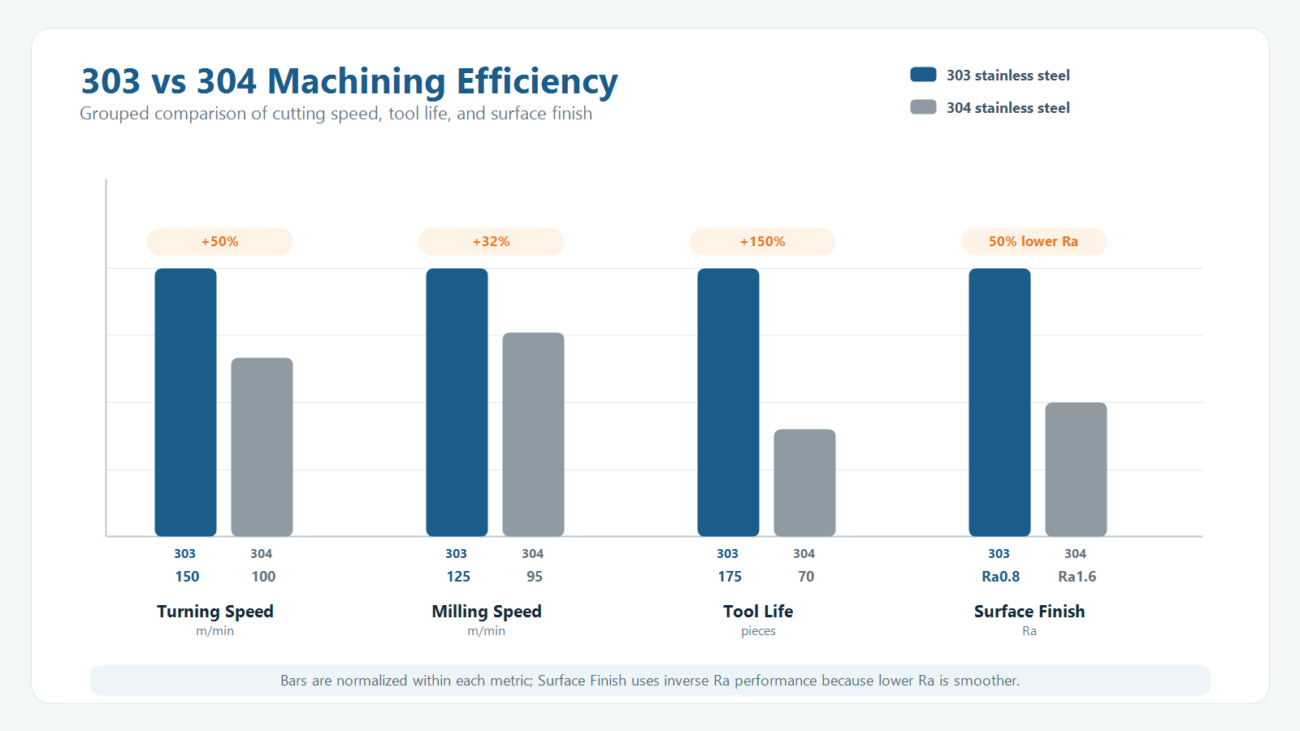
Gniazdo obrazu 2: porównanie parametrów obróbki i produktywności dla 303 vs 304.
Użyj ograniczeń: Spawalniczy, Korozja, Kontakt medyczny i spożywczy wymaga zachowania ostrożności
303 ma wyraźne zalety, ale jego ograniczenia muszą być częścią decyzji o wyborze materiału. Pierwszy, 303 nie nadaje się do spawania, ponieważ siarka zwiększa ryzyko pękania na gorąco. Konstrukcje spawane należy zwykle oceniać 304, 316, lub 316L. Drugi, 303 ma niższą odporność na korozję niż 304, tak wilgotno, plenerowy, morski, czyszczenie chlorkiem, lub środowiska korozyjne wymagają ostrożności. Trzeci, Części medyczne i mające kontakt z żywnością zwykle nie powinny być używane 303 i należy je oceniać w oparciu o rysunek, trasa regulacyjna, i środowisko kontaktu.
303 ma również gorszą odkształcalność na zimno niż 304, więc nie jest to dobry wybór w przypadku części wymagających dużego zginania, sięgnięcie, lub nitujące odkształcenie. Po obróbce na zimno, 303 może również wykazywać nieco większy magnetyzm, które należy sprawdzić pod kątem instrumentów wrażliwych na magnetyzm, czujniki, lub zespoły.
Dopasowanie aplikacji: Gdy 303 Jest bardziej ekonomiczny
303 jest najbardziej odpowiedni dla większych partii, bez spawania, sucha obsługa w pomieszczeniach zamkniętych, oraz części precyzyjne, w przypadku których ważny jest czas cyklu i trwałość narzędzia. Typowe zastosowania obejmują:
– Wały toczone partiami, rękawy, złączki gwintowane, i lokalizowanie części.
– Części mechaniczne o umiarkowanych wymaganiach korozyjnych i niezawierające silnych mediów korozyjnych.
– Części z wieloma dziurami, wątki, lub elementy toczone zewnętrznie, gdzie liczy się czas cyklu i trwałość narzędzia.
– Części wymagające stabilnego łamania wiórów w celu obsługi zautomatyzowanej obróbki.
Aby zdecydować, czy użyć 303, zadaj trzy pytania: Czy część wymaga spawania? Czy będzie używany w wilgotnym środowisku, chlorek, lub środowisko korozyjne? Czy będzie miał kontakt z żywnością lub środowiskiem medycznym? Jeśli wszystkie trzy odpowiedzi brzmią „nie”., 303 może być bardziej ekonomiczne niż 304. Jeśli jakakolwiek odpowiedź brzmi tak, materiał należy ponownie ocenić w porównaniu z rysunkiem, specyfikacja, i środowisko usług.
303 materiał jest zwykle droższy niż 304, ale koszt seryjnej obróbki CNC zależy nie tylko od ceny materiału. Czas cyklu, żywotność narzędzia, kontrola chipów, dotykając wskaźnika sukcesu, i ryzyko złomu wpływają na koszt jednostkowy. Dane dotyczące kosztów podane w tym artykule należy traktować jako typowe odniesienie do projektu, a nie gwarancję na każdą część. Im większa i bardziej powtarzalna partia, tym bardziej prawdopodobne, że przewaga obróbki 303 może zrównoważyć premię materiałową.
Scenariusz | Polecany materiał | Powód |
Wały wsadowe / rękawy / elementy złączne | 303 | Wysoka wydajność i niższy koszt narzędzia |
Części precyzyjne instrumentu | 303 | Dobre wykończenie i stabilne wymiary |
Części wymagające spawania | 304 / 316L | 303 nie nadaje się do spawania |
Morski / sprzęt plenerowy | 316 / 316L | 303 ma niższą odporność na korozję |
Medyczny / części mające kontakt z żywnością | 316L | 303 zwykle nie spełnia wymagań kontaktowych |
Prototyp / niska głośność | 304 | Niższy koszt materiałów i ograniczony wpływ na czas cyklu |
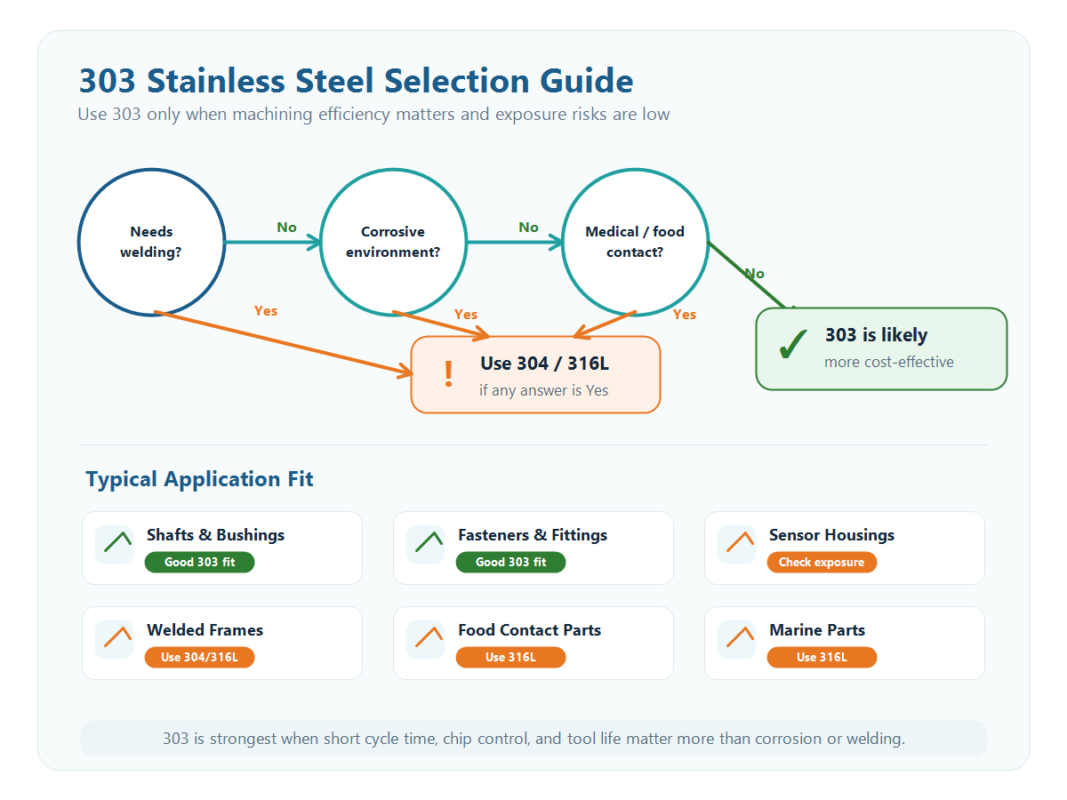
Gniazdo obrazu 3: tabela decyzyjna dla 303 zastosowania ze stali nierdzewnej.
Wartość oszczędnościowa 303 pochodzi z czasu cyklu, żywotność narzędzia, stabilność chipa, dotykając wskaźnika sukcesu, i mniejsze ryzyko złomowania partii. Do prostych prototypów, różnica może być niewielka. Dla tysięcy części lub długoterminowych powtarzalnych zamówień, czas cyklu i zużycie narzędzi mogą znacząco wpłynąć na całkowity koszt. Aby uzyskać więcej cytat logika, zobacz Przewodnik po kosztach obróbki CNC stali nierdzewnej.
Sprawa fabryczna: Redukcja kosztów tulei wału wsadowego w porównaniu z 304 Do 303
Projekt precyzyjnego instrumentu wymagał seryjnej produkcji tulei wałów ze stali nierdzewnej: średnica 20 mm, długość 50 mm, tolerancja +/-0.01 mm, i miesięczne zapotrzebowanie 2,000 sztuki. Oryginalnym materiałem był 304. W 304, zbliżał się czas zwrotu 4.5 minut na część, wkładki były wymieniane mniej więcej co 80 strony, miesięczny koszt narzędzia wynosił około RMB 1,200, a całkowity koszt jednostkowy wynosił około RMB 18.
Po zapoznaniu się ze środowiskiem usług i narysowaniem wymagań, materiał został zmieniony na 303. Koszt materiałów wzrósł o ok 15%, ale prędkość skrawania wzrosła z około Vc 100 m/min do około Vc 150 m/min. Czas cyklu spadł do ok 2.8 protokół, trwałość narzędzia wzrosła do ok 180 strony, a miesięczny koszt narzędzi spadł do około RMB 400. Koszt jednostkowy spadł do około RMB 13.5, o 25% niżej, oszczędzając około RMB 9,000 na miesiąc. Część nie wymagała spawania i znalazła zastosowanie w sprzęcie wewnętrznym, Więc 303 spełnił wymagania projektu.
303 Uwagi dotyczące obróbki i zaopatrzenia
Chociaż 303 jest swobodna obróbka, kontrola procesu jest nadal ważna. Utwardzanie przez zgniot jest niższe niż 304 ale nadal obecny, dlatego głębokość skrawania powinna unikać tarcia o utwardzoną warstwę powierzchniową. Narzędzia z węglika powlekanego są praktycznym punktem wyjścia, można zastosować chłodziwo emulsyjne lub olej chłodzący. 303 zwykle wymaga mniej agresywnego chłodzenia niż 316, ale stabilne chłodzenie nadal pomaga w wykończeniu powierzchni i spójności wymiarowej.
Weryfikacja materiału jest ważna dla 303. Rynek obejmuje 303, 303Cu, i równoważne stopnie według różnych standardów, i różnice chemiczne wpływają na skrawalność, odporność na korozję, i cytat. Przychodzący materiał należy sprawdzić pod względem jakości, norma materiałowa, MTR, liczba cieplna, i zawartość siarki. JADE-CNC może zweryfikować każdą przychodzącą partię za pomocą spektrometru i dostarczyć certyfikaty materiałowe wraz z wysyłką.
O JADE-CNC
JADE-CNC koncentruje się na precyzyjnej obróbce części ze stali nierdzewnej, z obróbką pięcioosiową, obróbka złożona tokarsko-frezarska, precyzyjny sprzęt do szlifowania, ISO 9001 orzecznictwo, i kompleksowe usługi w zakresie obróbki CNC, spawalniczy, wykończenie powierzchni, Do kontrola. Dla 303, 304, 316, i części 316L, JADE-CNC ocenia środowisko materiałowe, czas cyklu, żywotność narzędzia, spójność partii, i wymagania dotyczące obróbki końcowej, aby zalecić praktyczną trasę obróbki.
Wyślij swój rysunek, 3Model D, klasa materiału, środowisko usług, wymóg spawania, obróbka powierzchni, kluczowe tolerancje, ilość prototypowa, oraz ilość partii do oceny procesu i wyceny, zazwyczaj w obrębie 24 godziny.
Powiązane artykuły ze stali nierdzewnej
– 304 vs 316 w porównaniu ze stalą nierdzewną 316L: Który wybrać do obróbki CNC?
– 17-4Obróbka stali nierdzewnej PH: Leczenie roztworem, Starzenie się i obróbka wykańczająca

Leo Lianga, Założyciel Najlepszy Partner z R&D
Założyciel JADE-CNC, LEO, który wnosi ponad dwudziestoletnie doświadczenie branżowe, Leo rozpoczął karierę jako praktykant i ćwiczy swoje umiejętności w zakresie obróbki powierzchni i obróbki CNC.