


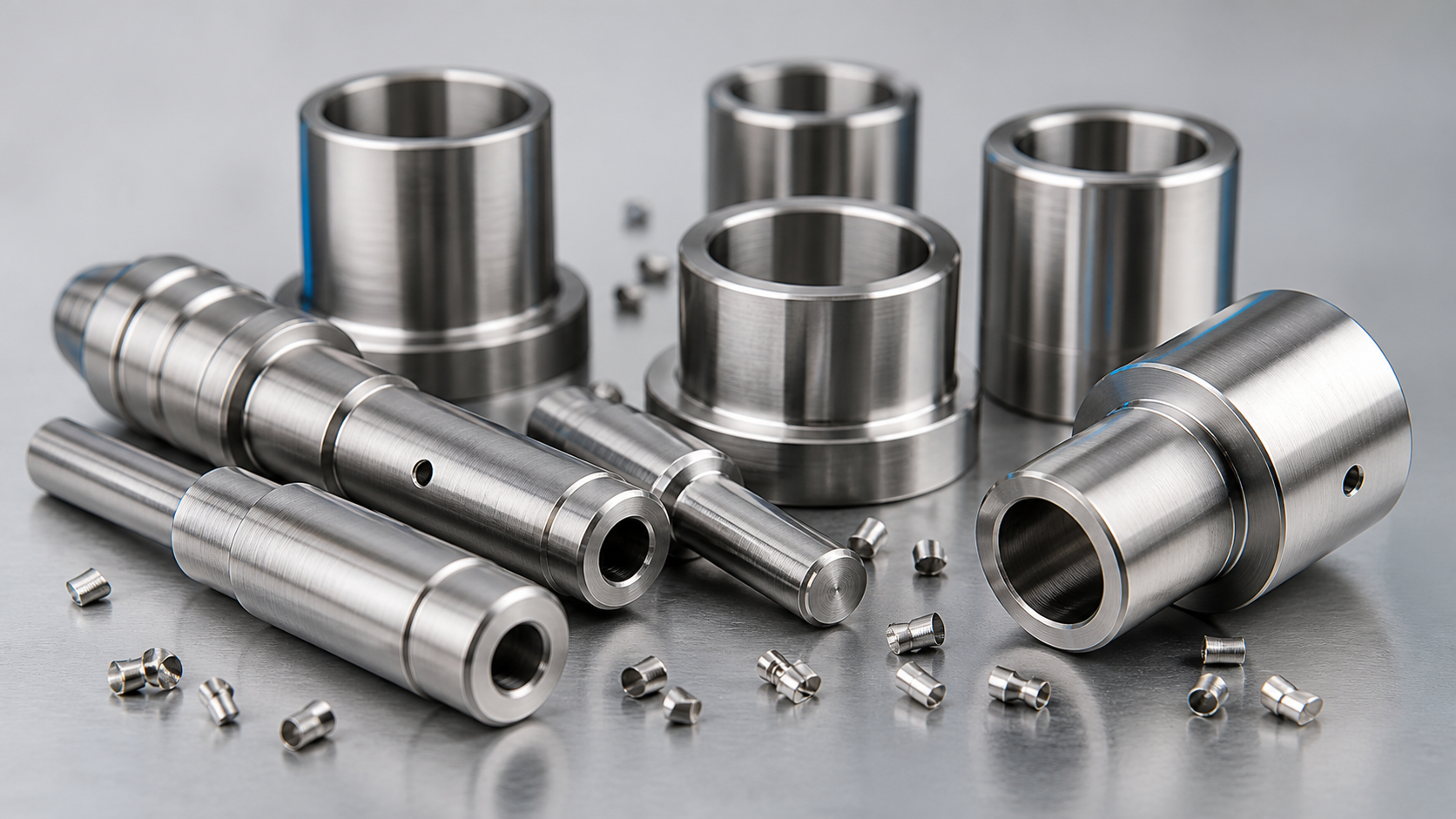
Coût d'usinage par lots de l'acier inoxydable: Est 304 Toujours le choix le plus économique?
Usinage par lots d'acier inoxydable, 304 a un coût matériel inférieur, mais cela peut créer un bord bâti, usure plus rapide des outils, temps de cycle plus lent, et contrôle des copeaux instable. Une fois le coût de l'outil, arrêts de dégagement des copeaux, exploiter le risque, et le temps d'usinage sont inclus, le prix des matériaux le plus bas ne signifie pas toujours le coût des pièces le plus bas. Si la pièce n'a pas besoin d'être soudée et ne fonctionnera pas dans un environnement corrosif, 303 L'acier inoxydable à usinage libre peut être le choix le plus économique.
303 est un acier inoxydable d'usinage libre à base de 304 avec une teneur accrue en soufre. Le soufre se combine au manganèse pour former des inclusions de sulfure de manganèse, ce qui aide à briser les copeaux et à lubrifier localement. Cela rend la coupe plus fluide, durée de vie de l'outil plus longue, et finition de surface plus stable. Cet article explique les avantages de l'usinage, limites, et cas d'application de 303 afin que vous puissiez décider quand 303 peut remplacer 304 et quand ça ne devrait pas.
Pour pièces de tournage par lots, petits arbres, noix, raccords, broches de localisation, et composants filetés, 303 peut réduire le coût total d'usinage. Mais 303 n'est pas un substitut universel à 304, surtout pour le soudage, exposition à la corrosion, contact alimentaire ou médical, et des exigences d'apparence élevées en matière de résistance à la corrosion.
Cet article se concentre sur la pratique 303 contre 304 décision d'usinage. Pour une comparaison complète de la résistance à la corrosion et de la soudabilité entre 304, 316, et 316L, voir 304 contre 316 contre l'acier inoxydable 316L. Pour une sélection plus large de matériaux et d'usinage en acier inoxydable, voir le guide d'usinage CNC en acier inoxydable.
Qu'est-ce que 303 Acier inoxydable?
303 acier inoxydable, également connu sous le nom d'AISI 303 ou Y12Cr18Ni9 dans certaines normes, augmente la teneur en soufre et en phosphore par rapport à 304. Le soufre et le manganèse forment des inclusions de MnS. Pendant la coupe, ces inclusions aident les copeaux à se diviser en segments plus courts et fournissent un effet lubrifiant local entre l'outil et le copeau, réduisant la friction et l'usure des outils.
Les propriétés mécaniques de 303 sont proches de 304, mais la résistance à la corrosion est généralement inférieure. Les inclusions de MnS peuvent devenir des points de départ pour des piqûres, surtout par temps humide, chlorure, ou environnements corrosifs. La soudabilité est également mauvaise car le soufre augmente le risque de fissuration à chaud dans la soudure. Les pièces qui nécessitent du soudage ne doivent généralement pas être utilisées 303.
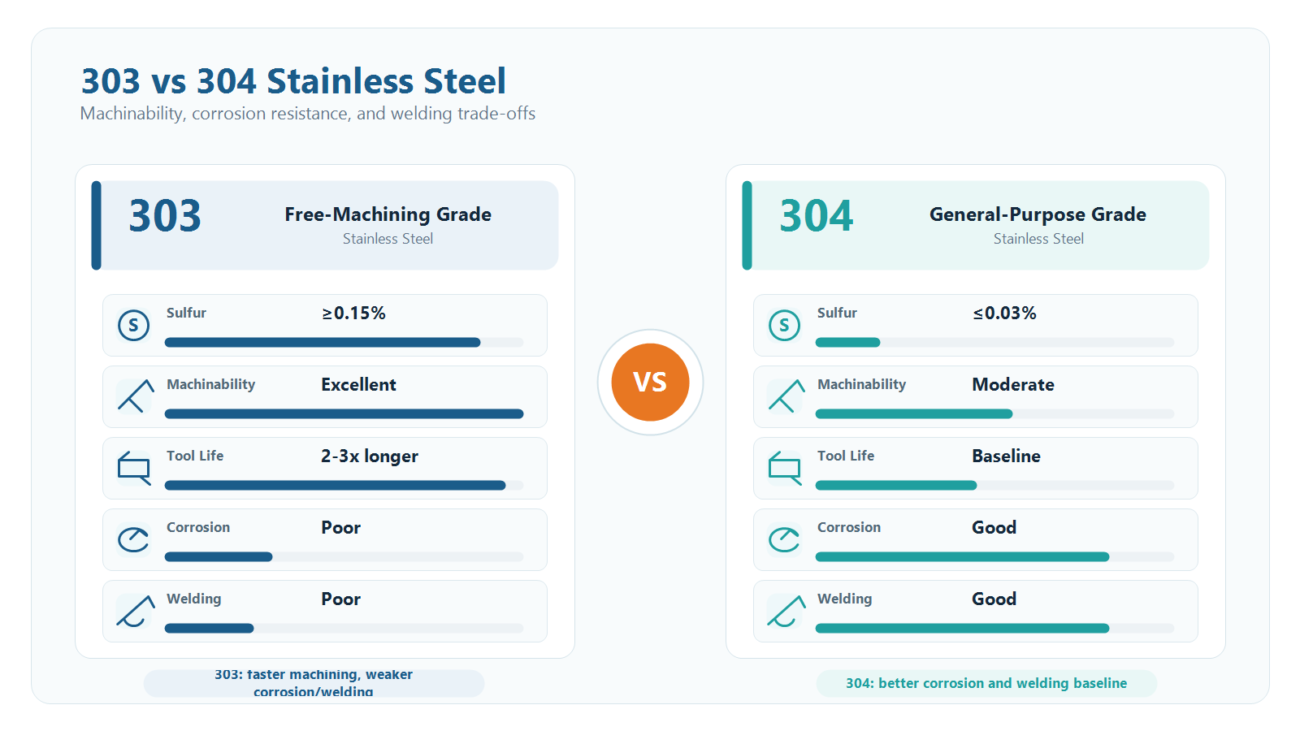
Emplacement pour images 1: principales différences entre 303 et 304 acier inoxydable.
Avantages de l'usinage: Meilleur bris de copeaux, Temps de cycle et durée de vie de l'outil
L'avantage d'usinage de 303 devient plus précieux dans production par lots. En tournant, 303 peut souvent fonctionner à une vitesse de coupe plus élevée que 304 avec une alimentation plus stable. Le temps de cycle peut être réduit, et le même insert usine généralement plus 303 pièces que 304 parties. Le coût des outils et les arrêts liés aux changements d’outils peuvent tous deux diminuer. L'amélioration réelle dépend de la géométrie de la pièce, outillage, rigidité de la machine, liquide de refroidissement, et données par lots.
303 produit des copeaux plus courts qui sont moins susceptibles de s'enrouler autour de l'outil ou de la pièce à usiner. Cela réduit les arrêts de la machine pour l'élimination des copeaux. Pour Tournage CNC avec ravitailleur de barres, La rupture stable des copeaux affecte directement le temps de cycle et le risque de production sans surveillance. La finition de surface est également généralement meilleure que 304, donc certains projets peuvent réduire le polissage ou la finition secondaire.
Le perçage et le taraudage sont souvent des endroits où 303 montre la plus grande valeur. Les copeaux s'évacuent plus facilement lors du perçage, et le perçage par débourrage peut souvent être optimisé en fonction de la profondeur et du diamètre du trou. Le couple de taraudage est inférieur, et le risque de rupture de robinet est généralement plus faible qu'avec 304. Pour pièces en lot comportant de nombreux trous, fils de discussion, et petits traits tournés, cette stabilité peut avoir plus d’importance que le prix des matières premières.
Méthode d'usinage | 303 Paramètres | 304 Paramètres | Impact sur l'efficacité |
Tourner Vc | 120-180 m/min | 90-130 m/min | +30%-50% |
Fraisage Vc | 100-150 m/min | 80-110 m/min | +25%-40% |
Forage Vc | 25-40 m/min | 20-30 m/min | +25%-33% |
Durée de vie de l'outil, tournant | 150-200 pièces | 60-80 pièces | +150% |
Finition superficielle | Râ 0.8-1.6 un | Râ 1.6-3.2 un | Un niveau mieux |
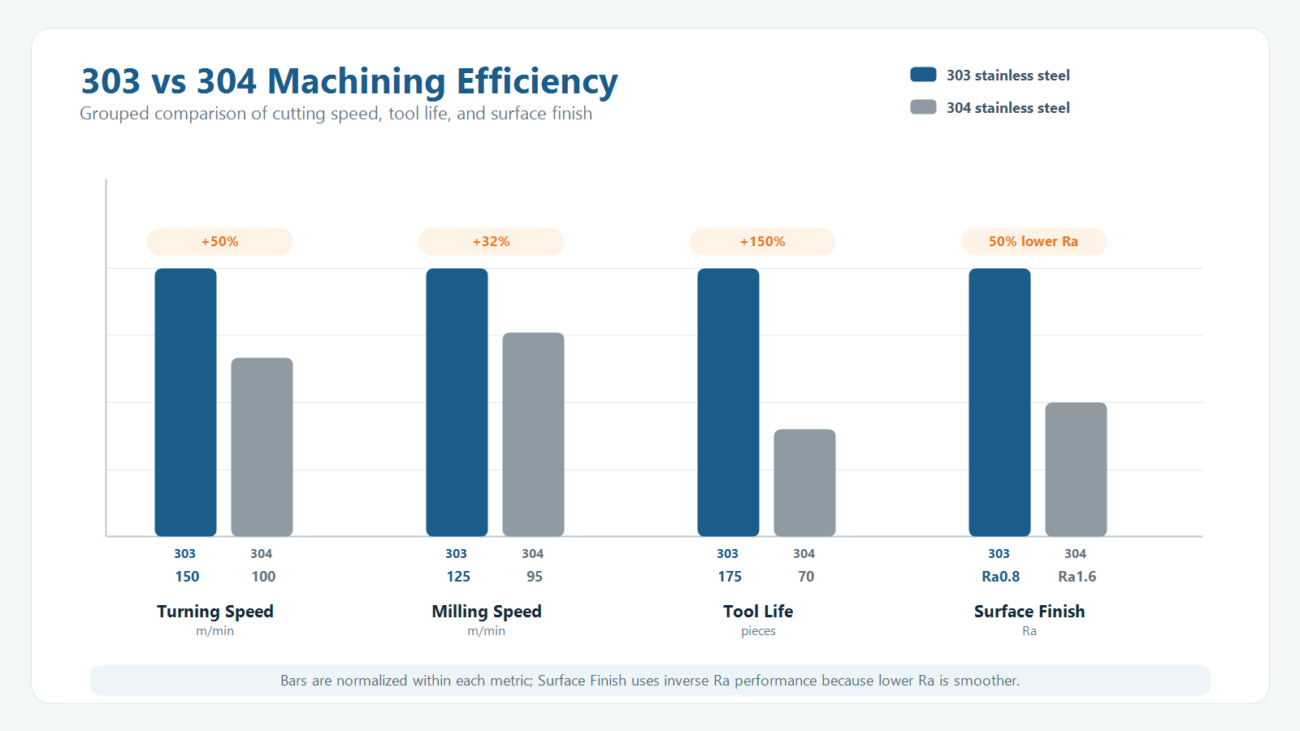
Emplacement pour images 2: comparaison des paramètres d'usinage et de la productivité pour 303 contre 304.
Limites d'utilisation: Soudage, Corrosion, Le contact médical et alimentaire nécessite une prudence
303 présente des avantages évidents, mais ses limites doivent faire partie de la décision de sélection du matériau. D'abord, 303 ne convient pas au soudage car le soufre augmente le risque de fissuration à chaud. Les structures soudées doivent généralement évaluer 304, 316, ou 316L. Deuxième, 303 a une résistance à la corrosion inférieure à celle 304, si humide, de plein air, marin, nettoyage au chlorure, ou les environnements corrosifs nécessitent de la prudence. Troisième, les pièces médicales et en contact avec les aliments ne doivent généralement pas être utilisées 303 et doit être évalué par rapport au dessin, voie réglementaire, et environnement de contact.
303 a également une moins bonne formabilité à froid que 304, ce n'est donc pas un bon choix pour les pièces qui nécessitent un pliage important, étirage, ou déformation de rivetage. Après un travail à froid, 303 peut également montrer un magnétisme légèrement plus élevé, qui doit être vérifié pour les instruments sensibles au magnétisme, capteurs, ou des assemblées.
Ajustement de l'application: Quand 303 Est plus économique
303 est le plus adapté aux lots plus importants, pas de soudure, service intérieur sec, et pièces de précision où le temps de cycle et la durée de vie de l'outil sont importants. Les applications typiques incluent:
– Arbres tournés par lots, manches, raccords filetés, et localisation des pièces.
– Pièces mécaniques avec des exigences de corrosion modérées et sans fluides fortement corrosifs.
– Pièces avec de nombreux trous, fils de discussion, ou des fonctionnalités tournées externes où le temps de cycle et la durée de vie de l'outil sont importants.
– Pièces nécessitant un bris de copeaux stable pour prendre en charge l'usinage automatisé.
Pour décider d'utiliser ou non 303, poser trois questions: La pièce doit-elle être soudée? Sera-t-il utilisé dans un environnement humide, chlorure, ou environnement corrosif? Sera-t-il en contact avec des aliments ou un environnement médical? Si les trois réponses sont non, 303 peut être plus économique que 304. Si la réponse est oui, le matériau doit être réévalué par rapport au dessin, spécification, et environnement de service.
303 le matériel est généralement plus cher que 304, mais le coût de l'usinage CNC par lots ne dépend pas seulement du prix du matériau.. Temps de cycle, durée de vie de l'outil, contrôle des copeaux, taux de réussite d'exploitation, et le risque de rebut affectent tous le coût unitaire. Les chiffres de coûts dans cet article doivent être traités comme une référence de projet typique plutôt que comme une garantie pour chaque pièce.. Plus le lot est grand et reproductible, plus l'avantage d'usinage du 303 est susceptible de compenser la prime de matériau.
Scénario | Matériel recommandé | Raison |
Arbres en lots / manches / attaches | 303 | Haute efficacité et coût d'outil réduit |
Pièces de précision pour instruments | 303 | Bonne finition et dimensions stables |
Pièces nécessitant une soudure | 304 / 316L | 303 ne convient pas au soudage |
Marin / équipement extérieur | 316 / 316L | 303 a une résistance à la corrosion inférieure |
Médical / pièces en contact avec les aliments | 316L | 303 ne correspond généralement pas aux exigences de contact |
Prototype / faible volume | 304 | Coût des matériaux réduit et impact limité sur le temps de cycle |
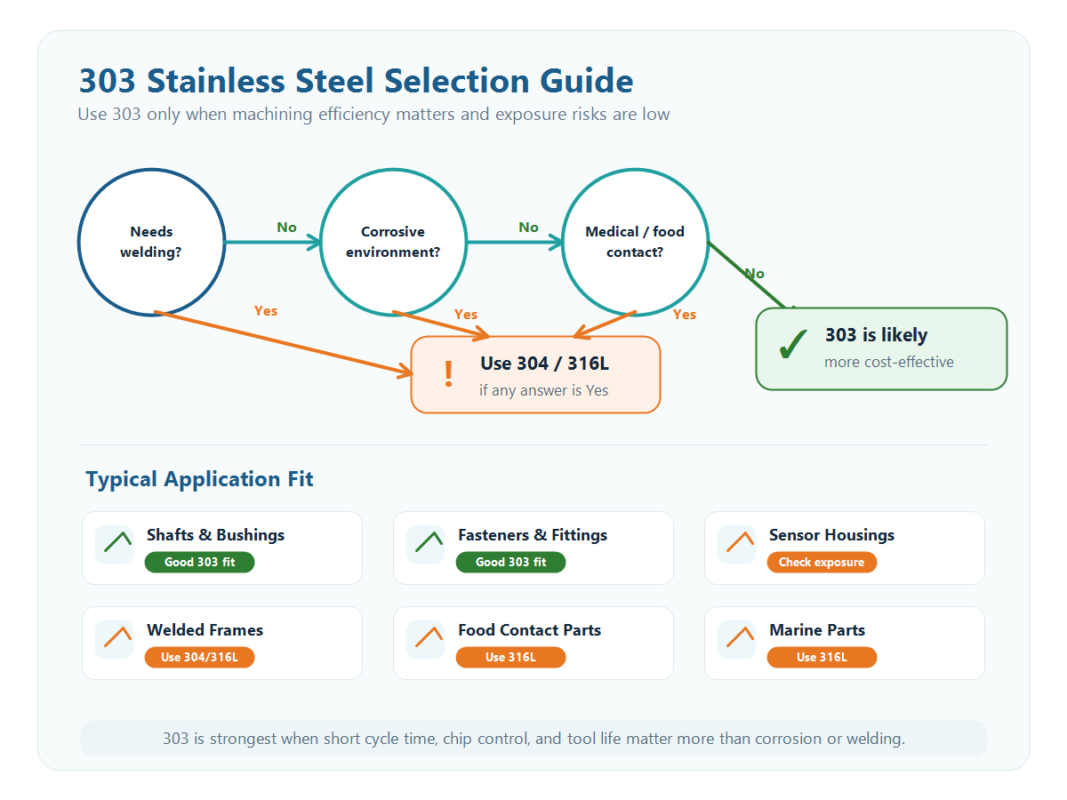
Emplacement pour images 3: table de décision pour 303 applications en acier inoxydable.
La valeur économique de 303 vient du temps de cycle, durée de vie de l'outil, stabilité des copeaux, taux de réussite d'exploitation, et un risque de rebut de lot réduit. Pour les prototypes simples, la différence peut être petite. Pour des milliers de pièces ou des commandes répétées à long terme, le temps de cycle et la consommation d'outils peuvent affecter de manière significative le coût total. Pour plus citation logique, voir le guide des coûts d'usinage CNC en acier inoxydable.
Cas d'usine: Réduction des coûts des manchons d'arbre par lots 304 à 303
Un projet d'instrument de précision nécessitait la production par lots de manchons d'arbre en acier inoxydable: diamètre 20 mm, longueur 50 mm, tolérance +/-0.01 mm, et la demande mensuelle de 2,000 pièces. Le matériel original était 304. Dans 304, le temps de tournage était d'environ 4.5 minutes par partie, les inserts étaient changés presque tous les 80 parties, le coût mensuel de l'outil était d'environ RMB 1,200, et le coût unitaire total était d'environ RMB 18.
Après avoir examiné l'environnement de service et les exigences de dessin, le matériel a été changé en 303. Le coût du matériel a augmenté d'environ 15%, mais la vitesse de coupe a augmenté d'environ Vc 100 m/min à environ Vc 150 m/min. Le temps de cycle est tombé à environ 2.8 minutes, durée de vie de l'outil augmentée à environ 180 parties, et le coût mensuel de l'outil est tombé à environ RMB 400. Le coût unitaire a diminué à environ RMB 13.5, à propos 25% inférieur, économiser sur le RMB 9,000 par mois. La pièce ne nécessitait pas de soudure et était utilisée dans des équipements intérieurs, donc 303 satisfait aux exigences du projet.
303 Notes d'usinage et d'approvisionnement
Bien que 303 est un usinage gratuit, le contrôle des processus est toujours important. L'écrouissage est inférieur à 304 mais toujours présent, la profondeur de coupe doit donc éviter de frotter sur une couche de surface durcie. Les outils en carbure revêtus constituent un point de départ pratique, et un liquide de refroidissement en émulsion ou de l'huile de coupe peut être utilisé. 303 nécessite généralement un refroidissement moins agressif que 316, mais un refroidissement stable contribue toujours à la finition de surface et à la cohérence dimensionnelle.
La vérification des matériaux est importante pour 303. Le marché comprend 303, 303Cu, et grades équivalents selon différentes normes, et les différences chimiques affectent l'usinabilité, résistance à la corrosion, et devis. Le matériel entrant doit être vérifié pour la qualité, norme matérielle, MTR, numéro de série, et teneur en soufre. JADE-CNC peut vérifier chaque lot entrant par spectromètre et fournir des certificats de matériaux avec l'expédition.
À propos de JADE-CNC
JADE-CNC se concentre sur l'usinage de précision des pièces en acier inoxydable, avec usinage à cinq axes, usinage composé de tour-fraisage, équipement de meulage de précision, OIN 9001 attestation, et un service à guichet unique pour l'usinage CNC, soudage, finition de surface, à inspection. Pour 303, 304, 316, et pièces 316L, JADE-CNC évalue l'environnement matériel, temps de cycle, durée de vie de l'outil, cohérence des lots, et exigences de post-traitement pour recommander un itinéraire d'usinage pratique.
Envoyez votre dessin, 3Modèle D, qualité du matériau, environnement de service, exigence de soudage, traitement de surface, tolérances clés, quantité de prototypes, et la quantité de lots pour l'évaluation du processus et le devis, généralement dans 24 heures.
Articles connexes sur l'acier inoxydable
– 17-4Usinage de l'acier inoxydable PH: Traitement en solution, Vieillissement et finition usinage

Léo Liang, Fondateur Meilleur partenaire avec R&D
LEO, fondateur de JADE-CNC, qui apporte plus de deux décennies d'expertise dans l'industrie, Leo a commencé sa carrière en tant qu'apprenti et met en pratique ses compétences en traitement de surface et en usinage CNC..