


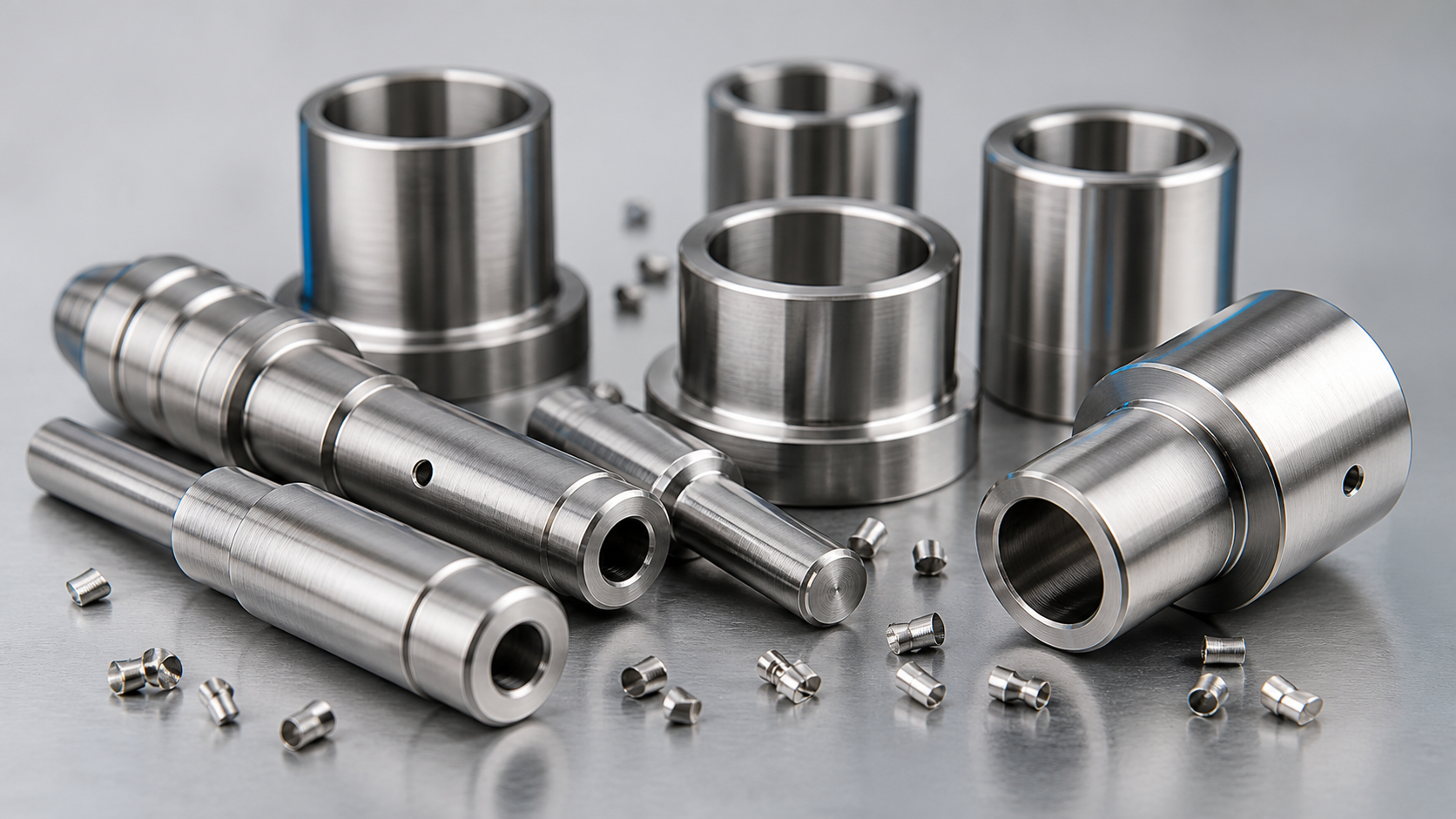
Costo di lavorazione in batch dell'acciaio inossidabile: È 304 Sempre la scelta più economica?
Lavorazione in batch dell'acciaio inossidabile, 304 ha un costo materiale inferiore, ma può creare un bordo di riporto, usura più rapida degli utensili, tempo di ciclo più lento, e controllo truciolo instabile. Una volta il costo dello strumento, interruzioni nello smaltimento dei trucioli, toccando il rischio, e tempo di lavorazione sono inclusi, il prezzo del materiale più basso non sempre significa il costo della parte più basso. Se la parte non necessita di saldatura e non funzionerà in un ambiente corrosivo, 303 l'acciaio inossidabile a lavorazione libera può essere la scelta più economica.
303 è un acciaio inossidabile a lavorazione libera a base di 304 con maggiore contenuto di zolfo. Lo zolfo si combina con il manganese per formare inclusioni di solfuro di manganese, che aiutano la rottura del truciolo e la lubrificazione locale. Ciò rende il taglio più fluido, vita dell'utensile più lunga, e finitura superficiale più stabile. Questo articolo spiega i vantaggi della lavorazione, limitazioni, e casi applicativi di 303 quindi puoi decidere tu quando 303 può sostituire 304 e quando non dovrebbe.
Per pezzi di tornitura in lotti, piccoli alberi, noci, raccordi, perni di posizionamento, e componenti filettati, 303 può ridurre il costo totale di lavorazione. Ma 303 non è un sostituto universale per 304, soprattutto per la saldatura, esposizione alla corrosione, contatto alimentare o medico, e requisiti estetici di elevata resistenza alla corrosione.
Questo articolo si concentra sulla pratica 303 contro 304 decisione di lavorazione. Per un confronto completo tra resistenza alla corrosione e saldabilità tra 304, 316, e 316L, Vedere 304 contro 316 rispetto all'acciaio inossidabile 316L. Per la più ampia selezione di materiali in acciaio inossidabile e il percorso di lavorazione, vedere il guida per la lavorazione CNC in acciaio inossidabile.
Cosa è 303 Acciaio inossidabile?
303 acciaio inossidabile, noto anche come AISI 303 o Y12Cr18Ni9 in alcuni standard, aumenta il contenuto di zolfo e fosforo rispetto a 304. Zolfo e manganese formano inclusioni MnS. Durante il taglio, queste inclusioni aiutano i trucioli a rompersi in segmenti più corti e forniscono un effetto lubrificante locale tra l'utensile e il truciolo, riducendo l'attrito e l'usura degli utensili.
Le proprietà meccaniche di 303 sono vicini a 304, ma la resistenza alla corrosione è generalmente inferiore. Le inclusioni di MnS possono diventare punti di partenza per la vaiolatura, soprattutto in umido, cloruro, o ambienti corrosivi. Anche la saldabilità è scarsa perché lo zolfo aumenta il rischio di cricche a caldo nella saldatura. Le parti che richiedono saldatura solitamente non dovrebbero essere utilizzate 303.
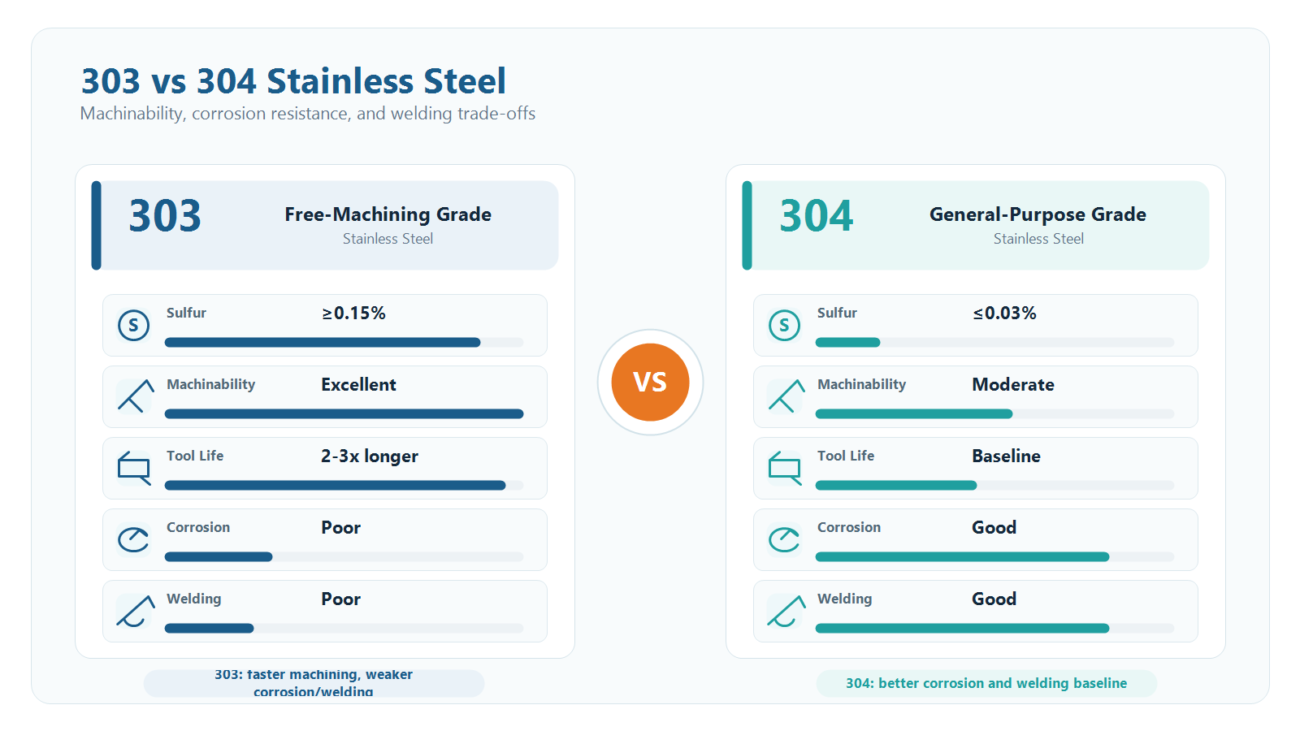
Slot immagine 1: differenze chiave tra 303 E 304 acciaio inossidabile.
Vantaggi della lavorazione: Migliore rottura del truciolo, Tempo di ciclo e durata dell'utensile
Il vantaggio di lavorazione di 303 diventa più prezioso in produzione in lotti. Nel girare, 303 può spesso funzionare a velocità di taglio superiori a 304 con alimentazione più stabile. Il tempo del ciclo potrebbe essere ridotto, e lo stesso inserto solitamente lavora di più 303 parti di 304 parti. Sia il costo degli strumenti che le interruzioni per il cambio degli strumenti possono diminuire. Il miglioramento effettivo dipende dalla geometria della parte, utensileria, rigidità della macchina, refrigerante, e dati batch.
303 produce trucioli più corti che hanno meno probabilità di avvolgersi attorno all'utensile o al pezzo in lavorazione. Ciò riduce i fermi macchina per l'evacuazione dei trucioli. Per Tornitura CNC con caricatori di barre, la stabilità del truciolo influisce direttamente sul tempo ciclo e sul rischio di produzione non presidiata. Anche la finitura superficiale è generalmente migliore di 304, quindi alcuni progetti possono ridurre la lucidatura o la finitura secondaria.
La foratura e la maschiatura sono spesso dove 303 mostra il valore più grande. I trucioli vengono evacuati più facilmente durante la foratura, e la perforazione a penetrazione può spesso essere ottimizzata in base alla profondità e al diametro del foro. La coppia di maschiatura è inferiore, e il rischio di rubinetto rotto è solitamente inferiore rispetto a quello con 304. Per pezzi in lotti con molti fori, discussioni, e piccole caratteristiche tornite, questa stabilità può essere più importante del prezzo delle materie prime.
Metodo di lavorazione | 303 Parametri | 304 Parametri | Impatto sull'efficienza |
Girando Vc | 120-180 m/min | 90-130 m/min | +30%-50% |
Fresatura Vc | 100-150 m/min | 80-110 m/min | +25%-40% |
Perforazione Vc | 25-40 m/min | 20-30 m/min | +25%-33% |
Durata dell'utensile, girando | 150-200 pz | 60-80 pz | +150% |
Finitura superficiale | Ra 0.8-1.6 uno | Ra 1.6-3.2 uno | Un livello migliore |
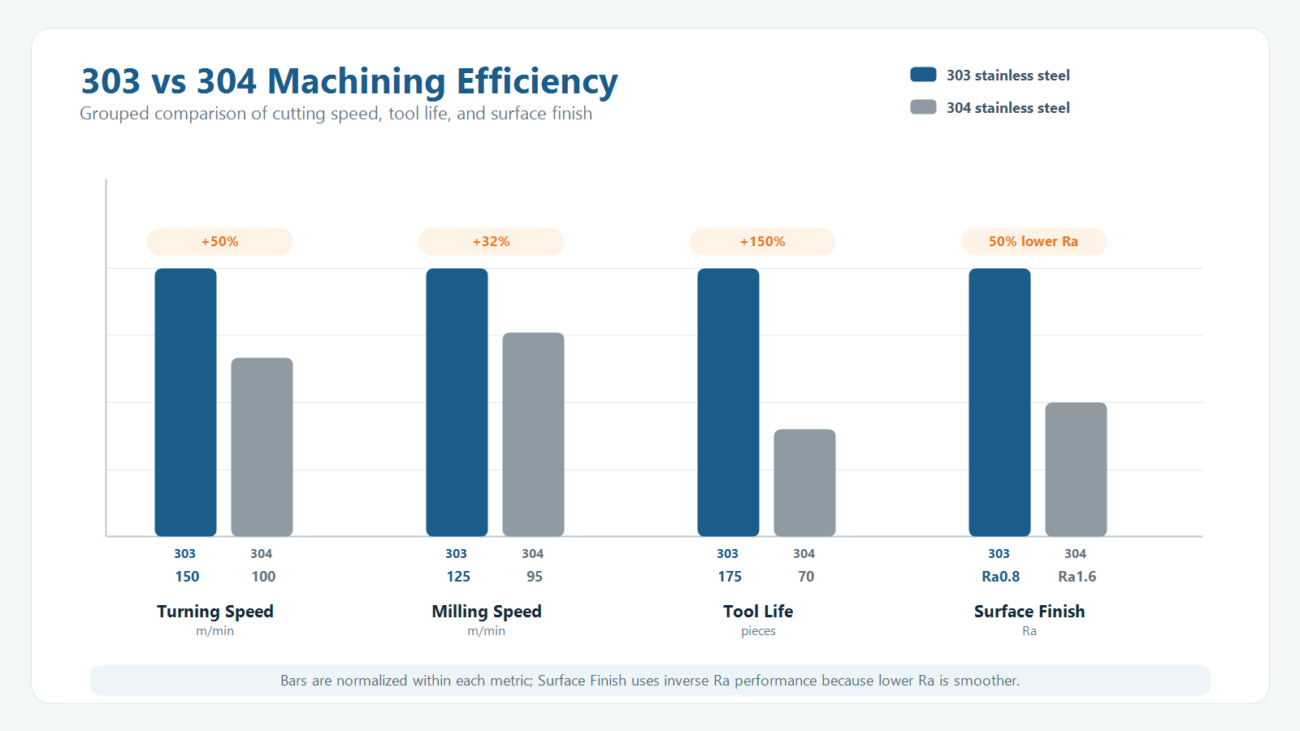
Slot immagine 2: parametri di lavorazione e confronto della produttività per 303 contro 304.
Limitazioni all'uso: Saldatura, Corrosione, Il contatto medico e alimentare richiede cautela
303 presenta chiari vantaggi, ma i suoi limiti devono far parte della decisione sulla selezione del materiale. Primo, 303 non è adatto alla saldatura poiché lo zolfo aumenta il rischio di cricche a caldo. Le strutture saldate dovrebbero solitamente essere valutate 304, 316, o 316L. Secondo, 303 ha una resistenza alla corrosione inferiore a 304, così umido, all'aperto, marino, pulizia del cloruro, o ambienti corrosivi richiedono cautela. Terzo, le parti mediche e a contatto con gli alimenti di solito non dovrebbero essere utilizzate 303 e dovrebbe essere valutato rispetto al disegno, percorso normativo, e ambiente di contatto.
303 ha anche una formabilità a freddo inferiore rispetto a 304, quindi non è una buona scelta per le parti che necessitano di piegature pesanti, allungamento, o deformazione della rivettatura. Dopo la lavorazione a freddo, 303 potrebbe anche mostrare un magnetismo leggermente più elevato, che dovrebbero essere controllati per strumenti sensibili al magnetismo, sensori, o assemblee.
Adattamento dell'applicazione: Quando 303 È più economico
303 è più adatto per lotti più grandi, nessuna saldatura, servizio interno asciutto, e parti di precisione in cui il tempo ciclo e la durata dell'utensile sono importanti. Le applicazioni tipiche includono:
– Alberi torniti in serie, maniche, raccordi filettati, e localizzazione delle parti.
– Parti meccaniche con requisiti di corrosione moderati e senza mezzi fortemente corrosivi.
– Parti con molti fori, discussioni, o lavorazioni di tornitura esterna in cui il tempo ciclo e la durata dell'utensile sono importanti.
– Parti che necessitano di una rottura truciolo stabile per supportare la lavorazione automatizzata.
Per decidere se utilizzare 303, fai tre domande: La parte necessita di saldatura? Verrà utilizzato in un ambiente umido?, cloruro, o ambiente corrosivo? Entrerà in contatto con il cibo o con un ambiente medico? Se tutte e tre le risposte sono no, 303 potrebbe essere più economico di 304. Se qualche risposta è sì, il materiale dovrebbe essere rivalutato rispetto al disegno, specifica, e ambiente di servizio.
303 il materiale è solitamente più costoso di 304, ma il costo della lavorazione CNC in batch è determinato da qualcosa di più del prezzo del materiale. Tempo di ciclo, vita dell'utensile, controllo del truciolo, toccando il tasso di successo, e il rischio di rottamazione influiscono tutti sul costo unitario. Le cifre sui costi contenute in questo articolo dovrebbero essere trattate come un tipico riferimento di progetto piuttosto che come una garanzia per ogni parte. Più grande e ripetibile è il batch, è più probabile che il vantaggio di lavorazione del 303 possa compensare il premio del materiale.
Scenario | Materiale consigliato | Motivo |
Alberi in lotti / maniche / elementi di fissaggio | 303 | Alta efficienza e costo dell'utensile inferiore |
Parti di precisione dello strumento | 303 | Buone finiture e dimensioni stabili |
Parti che necessitano di saldatura | 304 / 316l | 303 non è adatto alla saldatura |
Marino / attrezzatura per esterni | 316 / 316l | 303 ha una minore resistenza alla corrosione |
Medico / parti a contatto con gli alimenti | 316l | 303 di solito non soddisfa i requisiti di contatto |
Prototipo / volume basso | 304 | Costo del materiale inferiore e impatto limitato sul tempo di ciclo |
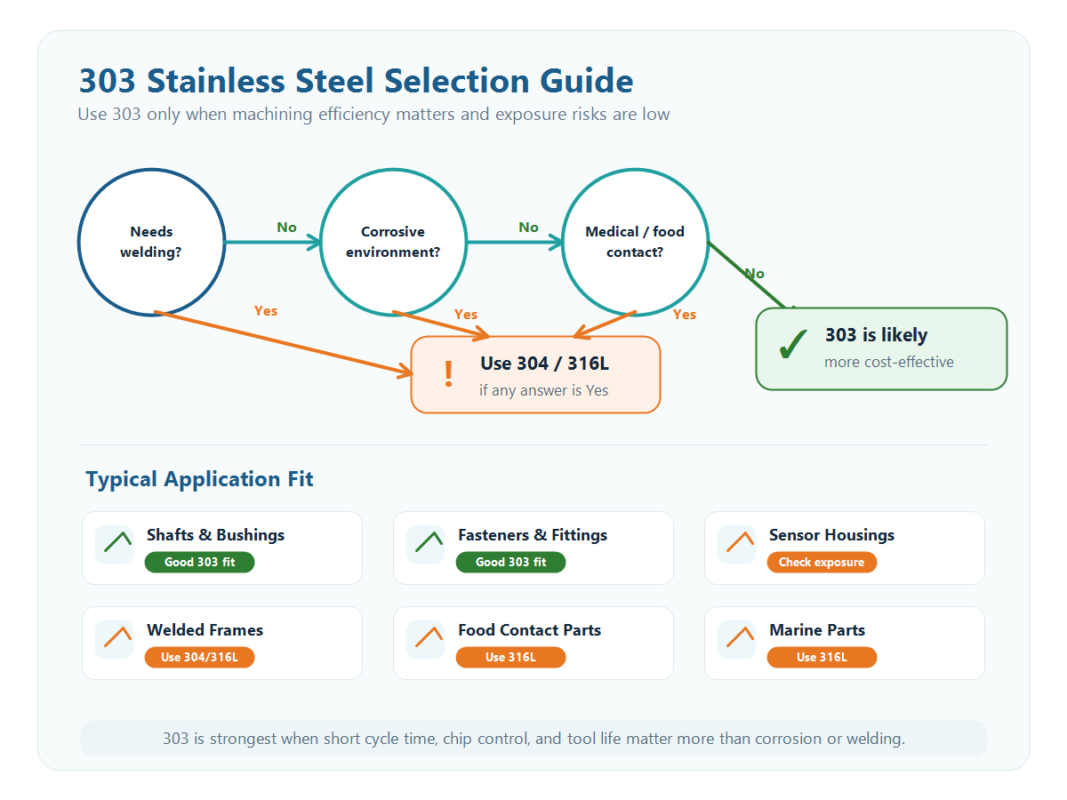
Slot immagine 3: tavolo decisionale per 303 applicazioni in acciaio inossidabile.
Il valore di risparmio sui costi di 303 deriva dal tempo del ciclo, vita dell'utensile, stabilità del truciolo, toccando il tasso di successo, e ridurre il rischio di scarti di lotti. Per prototipi semplici, la differenza potrebbe essere piccola. Per migliaia di parti o ordini ripetuti a lungo termine, il tempo di ciclo e il consumo degli utensili possono incidere in modo significativo sul costo totale. Per di più preventivo logica, vedere il Guida ai costi di lavorazione CNC in acciaio inossidabile.
Caso di fabbrica: Riduzione dei costi della manica dell'albero in batch da 304 A 303
Un progetto di uno strumento di precisione richiedeva la produzione in serie di manicotti per alberi in acciaio inossidabile: diametro 20 mm, lunghezza 50 mm, tolleranza +/-0.01 mm, e domanda mensile di 2,000 pezzi. Il materiale originale era 304. In 304, era quasi il momento della svolta 4.5 minuti per parte, gli inserti sono stati cambiati circa ogni 80 parti, il costo mensile dello strumento era di circa RMB 1,200, e il costo unitario totale era di circa RMB 18.
Dopo aver esaminato l'ambiente di servizio e i requisiti di disegno, il materiale è stato cambiato in 303. Il costo del materiale è aumentato di circa 15%, ma la velocità di taglio è aumentata da circa Vc 100 m/min a circa Vc 150 m/min. Il tempo di ciclo è sceso a circa 2.8 minuti, la durata dell'utensile è aumentata a circa 180 parti, e il costo mensile degli strumenti è sceso a circa RMB 400. Il costo unitario è sceso a circa RMB 13.5, Di 25% inferiore, risparmiando circa RMB 9,000 al mese. La parte non necessitava di saldatura ed è stata utilizzata in apparecchiature interne, COSÌ 303 soddisfatto il requisito del progetto.
303 Note di lavorazione e approvvigionamento
Sebbene 303 è una lavorazione gratuita, il controllo del processo è ancora importante. L'incrudimento è inferiore a 304 ma ancora presente, quindi la profondità del taglio dovrebbe evitare lo sfregamento su uno strato superficiale indurito. Gli utensili in metallo duro rivestito rappresentano un pratico punto di partenza, ed è possibile utilizzare emulsione refrigerante o olio da taglio. 303 di solito necessita di un raffreddamento meno aggressivo rispetto a 316, ma il raffreddamento stabile aiuta comunque la finitura superficiale e la consistenza dimensionale.
La verifica dei materiali è importante per 303. Il mercato comprende 303, 303Cu, e gradi equivalenti secondo standard diversi, e le differenze chimiche influiscono sulla lavorabilità, resistenza alla corrosione, e citazione. Il materiale in entrata deve essere controllato per verificarne il grado, norma materiale, MTR, numero di calore, e contenuto di zolfo. JADE-CNC può verificare ogni lotto in entrata mediante spettrometro e fornire certificati dei materiali con la spedizione.
A proposito di JADE-CNC
JADE-CNC si concentra sulla lavorazione di pezzi di precisione in acciaio inossidabile, con lavorazione a cinque assi, lavorazione composta di tornitura e fresatura, attrezzature per la rettifica di precisione, ISO 9001 certificazione, e servizio one-stop dalla lavorazione CNC, saldatura, finitura superficiale, A ispezione. Per 303, 304, 316, e parti 316L, JADE-CNC valuta l'ambiente materiale, tempo di ciclo, vita dell'utensile, consistenza del lotto, e requisiti di post-elaborazione per consigliare un percorso di lavorazione pratico.
Invia il tuo disegno, 3Modello D, grado del materiale, ambiente di servizio, requisito di saldatura, trattamento superficiale, tolleranze chiave, quantità del prototipo, e quantità di batch per la valutazione del processo e il preventivo, tipicamente all'interno 24 ore.
Articoli correlati sull'acciaio inossidabile

Leone Liang, Fondatore Miglior Partner con R&D
Il fondatore di JADE-CNC LEO, che vanta oltre due decenni di esperienza nel settore, Leo ha iniziato la sua carriera come apprendista e ha messo in pratica le sue competenze nel trattamento superficiale e nella lavorazione CNC.