


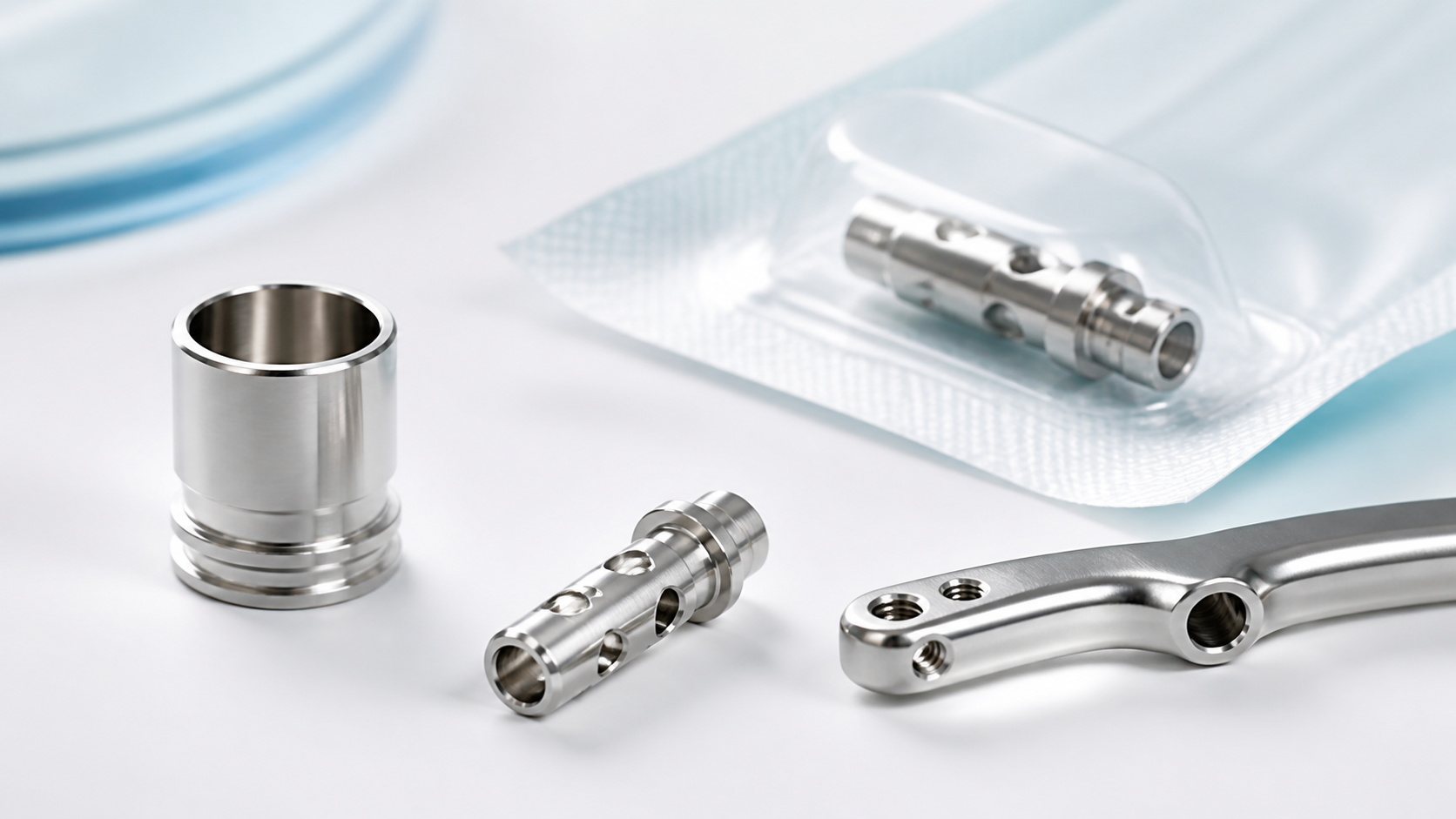
Medical Stainless Steel Part Machining: What Makes It Different from Standard Parts
The machining requirements for medical stainless steel parts are much stricter than for standard industrial parts. Standard parts must meet dimensional and appearance requirements, but medical parts often add biocompatibility, burr control, low residual stress, traceability, and clean packaging requirements. A problem in any one of these steps can lead to customer audit rejection, delayed release, or batch rework.
The most commonly used stainless steel in the medical industry is 316L because it offers a strong balance of corrosion resistance, biocompatibility, and weldability. This article explains the special requirements and JADE-CNC’s practical approach to medical stainless steel part machining across four areas: material selection, CNC machining process, surface finishing, and compliance support. For the broader stainless steel CNC machining route, see our stainless steel CNC machining guide.
316L Material Selection for Medical Stainless Steel Parts
Parts that contact the human body must meet the material and biocompatibility requirements defined by the drawing, specification, and regulatory route. Material grade, batch, MTR (Material Test Report), heat number, and machining records also need to be traceable. 316L stainless steel, with its low carbon content (typically <=0.03%), has lower intergranular corrosion risk after welding, good corrosion resistance, and wide use in implants, surgical instruments, and medical device contact parts. 304 can be used for some medical non-contact parts, but its corrosion resistance and weldability are lower than 316L, so it is usually avoided for parts contacting body fluids.
The difference between medical-grade 316L and industrial-grade 316L often lies in impurity control and documentation. Medical-grade material has stricter control over sulfur, phosphorus, and other impurities, fewer non-metallic inclusions, and more stable mechanical properties. For critical parts, material certificates may need to reference ASTM F138/F139 or the customer’s approved material specification.
Material | Medical Contact Parts | Medical Non-Contact Parts | Reason |
316L | Preferred | Acceptable | Corrosion resistance + biocompatibility + good weldability |
316 | Not recommended | Acceptable | Intergranular corrosion risk after welding |
304 | Not recommended | Acceptable | Insufficient corrosion resistance, prone to corrosion in body fluid environments |
17-4PH | Specific applications | Acceptable | High strength, but lower corrosion resistance than 316L |
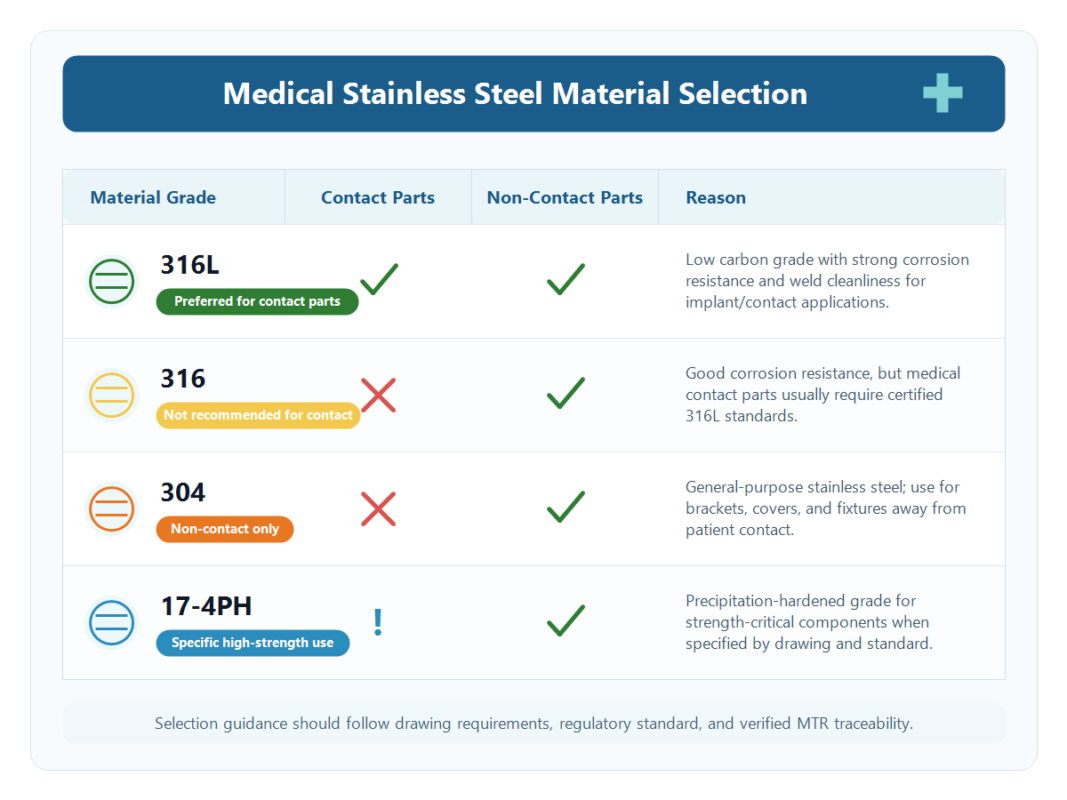
Image slot 1: Medical stainless steel material selection reference table
CNC Machining Process Essentials: Burr Control, Low Stress and High Surface Finish
The core requirements for medical part machining are burr control, low residual stress, and high surface finish. Burrs can detach in a medical environment and create product risk. Therefore, edge breaks, hole exits, cross holes, threads, slots, and sharp transitions should be reviewed during process planning, then deburred using a suitable combination of hand deburring, controlled mechanical finishing, vibratory finishing, and ultrasonic cleaning.
Residual stress can cause parts to deform during later machining, finishing, sterilization, or service, which is especially critical for thin-wall medical components and implant-related parts. JADE-CNC’s approach is to leave sufficient allowance after rough machining, perform stress relief annealing after semi-finishing when the material and specification allow it, and use small depth of cut with stable feed for finish machining to reduce cutting stress. Thin-walled parts use dedicated fixturing to reduce clamping deformation.
In terms of surface finish, medical contact parts often require Ra 0.4um or below, and some implant-related parts may require Ra 0.1um or below. Standard CNC machining can often achieve around Ra 1.6um; higher finishes may require precision grinding, polishing, or electropolishing. JADE-CNC selects the machining and finishing method during process planning so the finish requirement is not discovered too late in production.
Surface Finishing for Medical Stainless Steel Parts: Passivation and Electropolishing
Surface finishing for medical stainless steel parts often uses a passivation and electropolishing route when the drawing, function, or cleanliness requirement calls for it. Passivation restores the chromium oxide protective film on the surface, while electropolishing creates a smoother surface and can help remove micro-burrs and free iron. Electropolished surfaces are smoother than mechanically polished surfaces and avoid the embedded particles that can come from uncontrolled mechanical polishing.
Electropolishing typically removes about 0.01-0.03mm of material, so high-precision parts require allowance. For welded parts, the weld should be processed before electropolishing to ensure it is smooth with no undercut or excess weld metal; otherwise, depressions may appear at the weld after electropolishing. Depending on the specification, JADE-CNC can support ferrite checks, corrosion-resistance checks, or other surface-quality verification after electropolishing.
Passivation is often the final process, using citric acid passivation when it is suitable for the part and customer requirement. After passivation, parts are rinsed with purified water to reduce residual ions. Passivated parts should not be touched directly by hand; clean gloves are used because salts and oils from hands can affect the passive film.
Compliance Support: Traceability from Material to Finished Product
Compliance requirements in the medical industry run through the entire production process. On the material side, each controlled batch should have a Material Test Report (MTR) containing heat number, chemical composition, and mechanical properties. JADE-CNC can verify incoming material composition with a spectrometer to confirm that the material matches the certificate.
On the production side, the machining route card for medical parts records equipment, process steps, operators, and inspection results for controlled operations. Critical processes such as welding, electropolishing, final cleaning, and final inspection can be supported with work instructions and first-article inspection records.
Clean packaging is the final gate. After cleaning, medical parts are ultrasonically cleaned and rinsed with purified water, dried, and individually packaged in VCI paper or cleanroom bags according to the part requirement. The outer carton is labeled with part number, batch, quantity, and production date. If customers have special cleanliness requirements, such as Class 1000 cleanroom packaging, JADE-CNC can review the requirement during quotation.
Compliance Item | Requirement | Our Approach |
Material Traceability | MTR + heat number | Spectrometer verification per batch, certificates shipped with goods |
Process Documentation | Route card + first-article inspection | Equipment/parameters/personnel recorded per process |
Surface Quality | Ra ≤0.4μm, burr-free | Electropolishing + visual inspection per drawing |
Clean Packaging | Cleanroom / rust-preventive | Ultrasonic cleaning + individual packaging |
System Certification | ISO 13485 (if customer requires) | ISO 9001, can support customer audits |
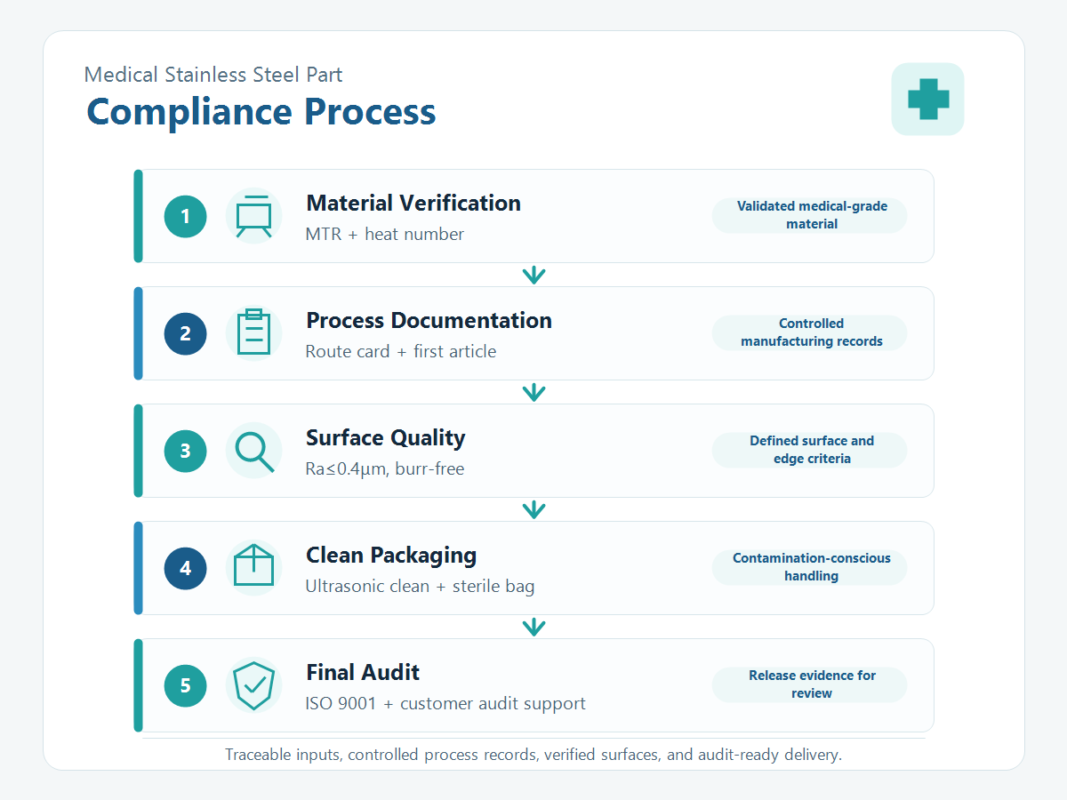
Image slot 2: Medical part compliance process flow diagram
Common Medical Stainless Steel Machining Problems and Solutions
A common problem with medical parts is dimensional deviation after electropolishing. The cause is often failure to reserve electropolishing allowance or excessive polishing time leading to over-removal. JADE-CNC’s approach is to calculate removal during process planning, apply masking protection to mating surfaces when needed, and perform CMM inspection after polishing according to the drawing.
Another common problem is weld corrosion after welding. The cause may be using the wrong filler wire, such as ER308 for 316L, or failing to passivate after welding. For 316L welded medical parts, JADE-CNC controls filler-wire selection, post-weld cleaning, passivation, and penetrant testing for critical welds when required.
Cleanliness non-conformance is also a frequent issue, often caused by incomplete cleaning or dust in the packaging environment. JADE-CNC uses a controlled cleaning route such as ultrasonic cleaning, purified-water rinsing, and alcohol cleaning when required, then packages parts on a clean bench and supports particle checks when specified.
About JADE-CNC
JADE-CNC specializes in precision stainless steel part machining, with five-axis machining, turn-mill compound machining, precision grinding equipment, ISO 9001 certification, and one-stop service from machining and welding to surface finishing and inspection. Incoming material can be verified by spectrometer, with self-inspection plus dedicated inspection at key process stages, helping control lead time, quality, and batch consistency.
Send your drawing, CAD model, material specification, surface finish requirement, cleanliness requirement, inspection standard, and batch quantity for process assessment and quotation, typically within 24 hours.
Related Stainless Steel Articles
– 304 vs 316 vs 316L Stainless Steel: Which One Should You Choose for CNC Machining?
– Food Machinery Stainless Steel Machining: Sanitary-Grade Material, Welding and Surface Finish
– Stainless Steel Welding for CNC Machined Parts: TIG, Laser Welding and Distortion Control

Leo Liang, Founder Best Partner with R&D
JADE-CNC’s Founder LEO, who brings over two decades of industry expertise, Leo started his career as an apprentice and practice his skills in surface treatment and CNC machining.