


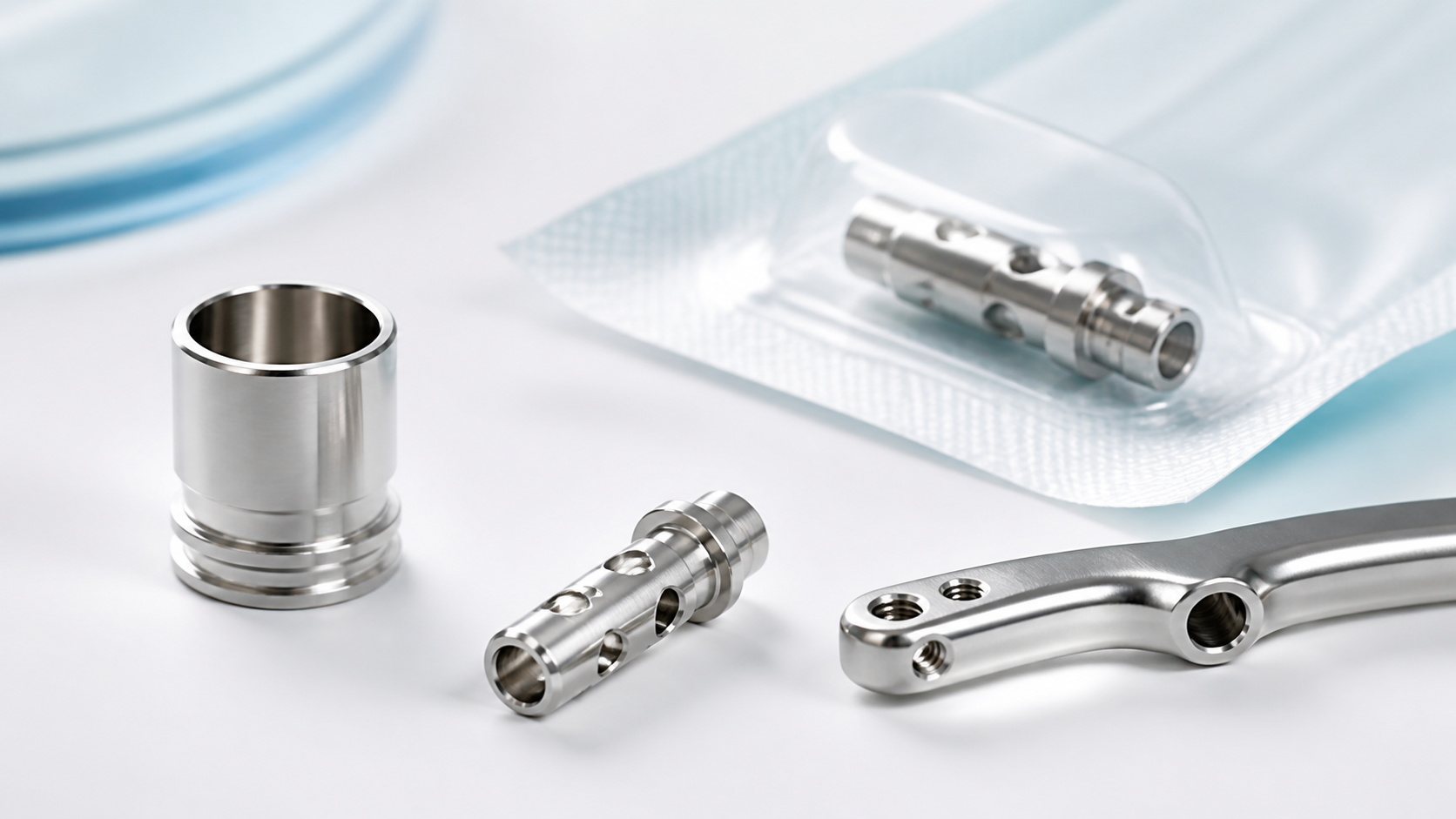
Lavorazione di pezzi medicali in acciaio inossidabile: Cosa lo rende diverso dalle parti standard
I requisiti di lavorazione per le parti in acciaio inossidabile medicale sono molto più severi rispetto a quelli per le parti industriali standard. Le parti standard devono soddisfare i requisiti dimensionali e estetici, ma le parti mediche spesso aggiungono biocompatibilità, controllo delle bave, basso stress residuo, tracciabilità, e requisiti di imballaggio pulito. Un problema in uno qualsiasi di questi passaggi può portare al rifiuto dell'audit del cliente, rilascio ritardato, o rilavorazione batch.
L'acciaio inossidabile più comunemente utilizzato nell'industria medica è il 316L perché offre un forte equilibrio di resistenza alla corrosione, biocompatibilità, e saldabilità. Questo articolo spiega i requisiti speciali e l'approccio pratico di JADE-CNC alla lavorazione di parti in acciaio inossidabile medicale in quattro aree: selezione del materiale, Processo di lavorazione CNC, finitura superficiale, e supporto alla conformità. Per il più ampio percorso di lavorazione CNC dell'acciaio inossidabile, vedi il nostro guida per la lavorazione CNC in acciaio inossidabile.
316L Selezione dei materiali per parti mediche in acciaio inossidabile
Le parti che entrano in contatto con il corpo umano devono soddisfare i requisiti di materiale e biocompatibilità definiti dal disegno, specifica, e percorso normativo. Grado del materiale, lotto, MTR (Rapporto di prova sui materiali), numero di calore, e anche i registri delle lavorazioni devono essere tracciabili. 316L acciaio inossidabile, grazie al suo basso contenuto di carbonio (tipicamente <=0,03%), ha un rischio di corrosione intergranulare inferiore dopo la saldatura, buona resistenza alla corrosione, e ampio utilizzo negli impianti, strumenti chirurgici, E dispositivo medico parti di contatto. 304 può essere utilizzato per alcune parti mediche senza contatto, ma la sua resistenza alla corrosione e saldabilità sono inferiori a 316L, quindi di solito viene evitato per le parti a contatto con i fluidi corporei.
La differenza tra il 316L di grado medico e il 316L di grado industriale spesso risiede nel controllo e nella documentazione delle impurità. Il materiale di grado medico ha un controllo più rigoroso sullo zolfo, fosforo, e altre impurità, meno inclusioni non metalliche, e proprietà meccaniche più stabili. Per parti critiche, potrebbe essere necessario che i certificati dei materiali facciano riferimento a ASTM F138/F139 o alla specifica del materiale approvata dal cliente.
Materiale | Parti di contatto medico | Parti mediche senza contatto | Motivo |
316l | Preferito | Accettabile | Resistenza alla corrosione + biocompatibilità + buona saldabilità |
316 | Non raccomandato | Accettabile | Rischio di corrosione intergranulare dopo la saldatura |
304 | Non raccomandato | Accettabile | Resistenza alla corrosione insufficiente, soggetto a corrosione in ambienti fluidi corporei |
17-4PH | Applicazioni specifiche | Accettabile | Alta resistenza, ma resistenza alla corrosione inferiore rispetto al 316L |
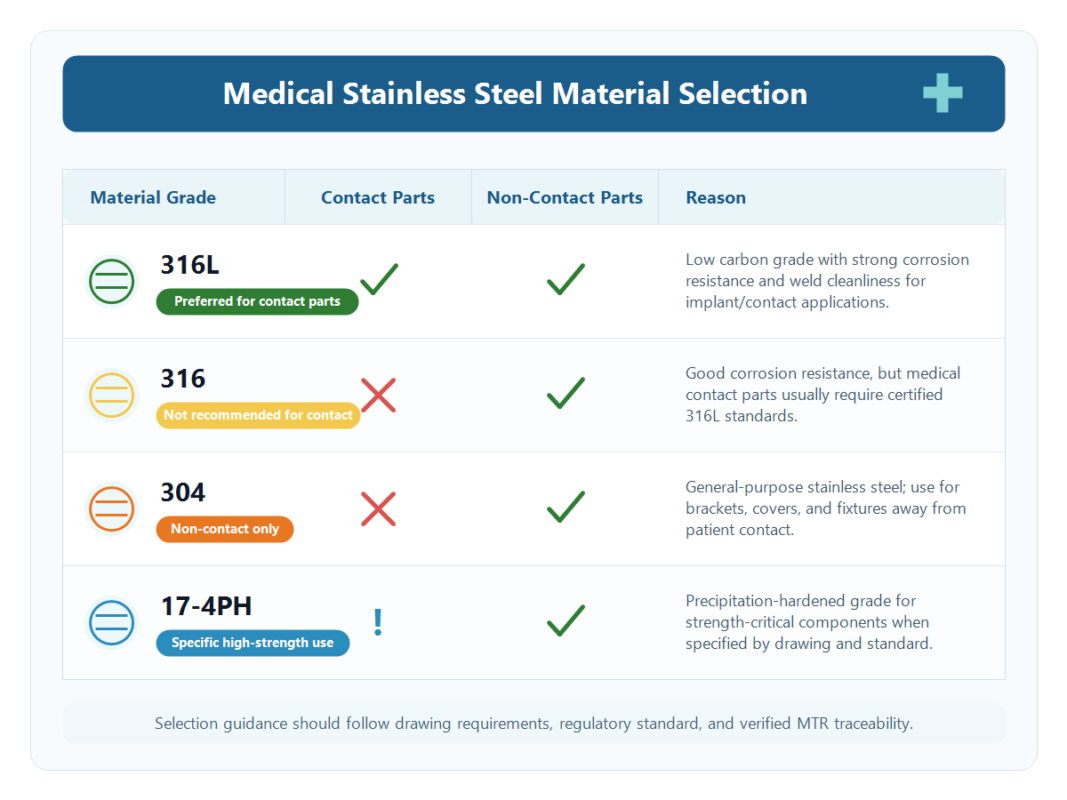
Slot immagine 1: Tabella di riferimento per la selezione dei materiali in acciaio inossidabile medicale
Elementi essenziali del processo di lavorazione CNC: Controllo delle bave, Basso stress ed elevata finitura superficiale
I requisiti fondamentali per la lavorazione di componenti medicali sono il controllo delle bave, basso stress residuo, ed elevata finitura superficiale. Le bave possono staccarsi in un ambiente medico e creare rischi per il prodotto. Perciò, rotture dei bordi, uscite del foro, fori trasversali, discussioni, slot, e le transizioni nette dovrebbero essere riviste durante la pianificazione del processo, quindi sbavato utilizzando un'adeguata combinazione di sbavatura manuale, finitura meccanica controllata, finitura vibrante, e pulizia ad ultrasuoni.
Lo stress residuo può causare la deformazione delle parti durante la lavorazione successiva, finitura, sterilizzazione, o servizio, che è particolarmente critico per i componenti medici a parete sottile e le parti relative agli impianti. L’approccio di JADE-CNC è quello di lasciare un margine sufficiente dopo la lavorazione di sgrossatura, eseguire la ricottura di distensione dopo la semifinitura quando il materiale e le specifiche lo consentono, e utilizzare una profondità di taglio ridotta con avanzamento stabile per la lavorazione di finitura per ridurre lo stress da taglio. Le parti a pareti sottili utilizzano dispositivi di fissaggio dedicati per ridurre la deformazione del bloccaggio.
In termini di finitura superficiale, le parti a contatto medico spesso richiedono Ra 0,4um o inferiore, e alcune parti relative all'impianto potrebbero richiedere Ra 0,1um o inferiore. La lavorazione CNC standard può spesso raggiungere circa Ra 1,6um; finiture superiori potrebbero richiedere una rettifica di precisione, lucidatura, o elettrolucidatura. JADE-CNC seleziona il metodo di lavorazione e finitura durante la pianificazione del processo in modo che i requisiti di finitura non vengano scoperti troppo tardi nella produzione.
Finitura superficiale per parti mediche in acciaio inossidabile: Passivazione ed Elettrolucidatura
La finitura superficiale delle parti in acciaio inossidabile medicale utilizza spesso un percorso di passivazione ed elettrolucidatura durante il disegno, funzione, o i requisiti di pulizia lo richiedono. La passivazione ripristina la pellicola protettiva di ossido di cromo sulla superficie, mentre l'elettrolucidatura crea una superficie più liscia e può aiutare a rimuovere micro-bave e ferro libero. Le superfici elettrolucidate sono più lisce delle superfici lucidate meccanicamente ed evitano le particelle incastrate che possono provenire da una lucidatura meccanica incontrollata.
L'elettrolucidatura rimuove tipicamente circa 0,01-0,03 mm di materiale, quindi le parti di alta precisione richiedono un margine. Per parti saldate, la saldatura deve essere lavorata prima dell'elettrolucidatura per garantire che sia liscia senza sottosquadri o metallo di saldatura in eccesso; Altrimenti, dopo l'elettrolucidatura possono comparire delle depressioni sulla saldatura. A seconda delle specifiche, JADE-CNC può supportare i controlli della ferrite, controlli di resistenza alla corrosione, o altra verifica della qualità della superficie dopo l'elettrolucidatura.
La passivazione è spesso il processo finale, utilizzando la passivazione con acido citrico quando è adatta alla parte e alle esigenze del cliente. Dopo la passivazione, le parti vengono risciacquate con acqua purificata per ridurre gli ioni residui. Le parti passivate non devono essere toccate direttamente con le mani; utilizzare guanti puliti perché i sali e gli oli delle mani possono intaccare la pellicola passiva.
Supporto per la conformità: Tracciabilità dal materiale al prodotto finito
I requisiti di conformità nel settore medico attraversano l'intero processo di produzione. Dal lato materiale, ogni lotto controllato deve avere un rapporto di prova sui materiali (MTR) contenente il numero di calore, composizione chimica, e proprietà meccaniche. JADE-CNC può verificare la composizione del materiale in entrata con uno spettrometro per confermare che il materiale corrisponde al certificato.
Dal lato della produzione, la scheda del percorso di lavorazione per le apparecchiature di registrazione delle parti mediche, fasi del processo, operatori, E ispezione risultati per le operazioni controllate. Processi critici come la saldatura, elettrolucidatura, pulizia finale, e l'ispezione finale può essere supportata da istruzioni di lavoro e registri di ispezione del primo articolo.
L'imballaggio pulito è l'ultima porta. Dopo la pulizia, le parti mediche vengono pulite ad ultrasuoni e risciacquate con acqua purificata, essiccato, e confezionati singolarmente in carta VCI o sacchetti per camere bianche in base ai requisiti della parte. La scatola esterna è etichettata con il numero di parte, lotto, quantità, e data di produzione. Se i clienti hanno esigenze particolari di pulizia, come Classe 1000 imballaggio per camere bianche, JADE-CNC può rivedere il requisito durante preventivo.
Articolo di conformità | Requisito | Il nostro approccio |
Tracciabilità dei materiali | MTR + numero di calore | Verifica spettrometrica per lotto, certificati spediti con la merce |
Documentazione del processo | Scheda itinerario + ispezione del primo articolo | Attrezzature/parametri/personale registrati per processo |
Qualità della superficie | Ra ≤0,4μm, senza sbavature | Elettrolucidatura + ispezione visiva per disegno |
Imballaggio pulito | Camera bianca / antiruggine | Pulizia ad ultrasuoni + confezione individuale |
Certificazione del sistema | ISO 13485 (se il cliente richiede) | ISO 9001, può supportare gli audit dei clienti |
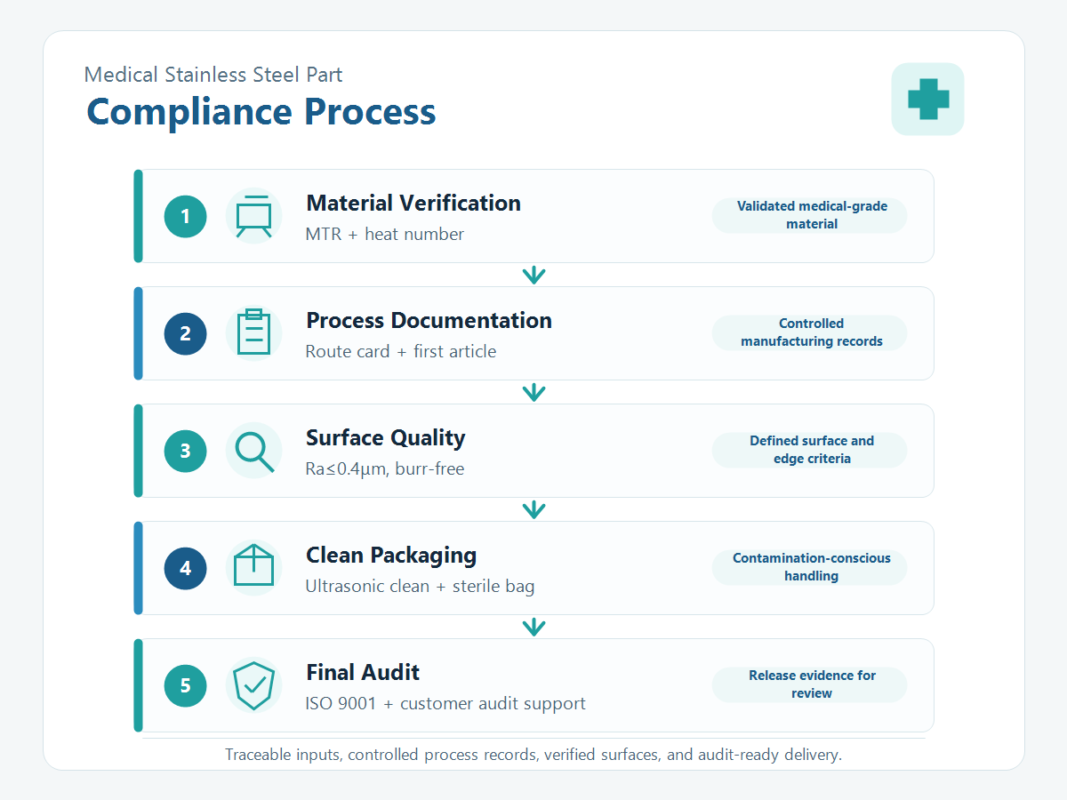
Slot immagine 2: Diagramma di flusso del processo di conformità delle parti mediche
Problemi e soluzioni comuni nella lavorazione dell'acciaio inossidabile per uso medico
Un problema comune con le parti mediche è la deviazione dimensionale dopo l'elettrolucidatura. La causa è spesso la mancata riserva di spazio per elettrolucidatura o un tempo di lucidatura eccessivo che porta ad una rimozione eccessiva. L’approccio di JADE-CNC è quello di calcolare l’asportazione durante la pianificazione del processo, applicare la protezione di mascheramento alle superfici di accoppiamento quando necessario, ed eseguire l'ispezione CMM dopo la lucidatura secondo il disegno.
Un altro problema comune è corrosione della saldatura dopo la saldatura. La causa potrebbe essere l'utilizzo del filo di apporto sbagliato, come ER308 per 316L, o mancata passivazione dopo la saldatura. Per parti medicali saldate 316L, JADE-CNC controlla la selezione del filo di apporto, pulizia post saldatura, passivazione, e test penetranti per saldature critiche quando richiesto.
Anche la non conformità della pulizia è un problema frequente, spesso causati da una pulizia incompleta o dalla polvere nell'ambiente di imballaggio. JADE-CNC utilizza un percorso di pulizia controllato come la pulizia ad ultrasuoni, risciacquo con acqua purificata, e pulizia con alcol quando necessario, quindi imballa le parti su un banco pulito e supporta i controlli delle particelle quando specificato.
A proposito di JADE-CNC
JADE-CNC è specializzata nella lavorazione di pezzi di precisione in acciaio inossidabile, con lavorazione a cinque assi, lavorazione composta di tornitura e fresatura, attrezzature per la rettifica di precisione, ISO 9001 certificazione, e un servizio completo dalla lavorazione meccanica e saldatura alla finitura superficiale e all'ispezione. Il materiale in entrata può essere verificato mediante spettrometro, con autoispezione più ispezione dedicata nelle fasi chiave del processo, aiutando a controllare i tempi di consegna, qualità, e consistenza del lotto.
Invia il tuo disegno, Modello CAD, specifica del materiale, requisito di finitura superficiale, requisito di pulizia, norma di ispezione, e quantità di batch per la valutazione del processo e il preventivo, tipicamente all'interno 24 ore.
Articoli correlati sull'acciaio inossidabile
Leone Liang, Fondatore Miglior Partner con R&D
Il fondatore di JADE-CNC LEO, che vanta oltre due decenni di esperienza nel settore, Leo ha iniziato la sua carriera come apprendista e ha messo in pratica le sue competenze nel trattamento superficiale e nella lavorazione CNC.