


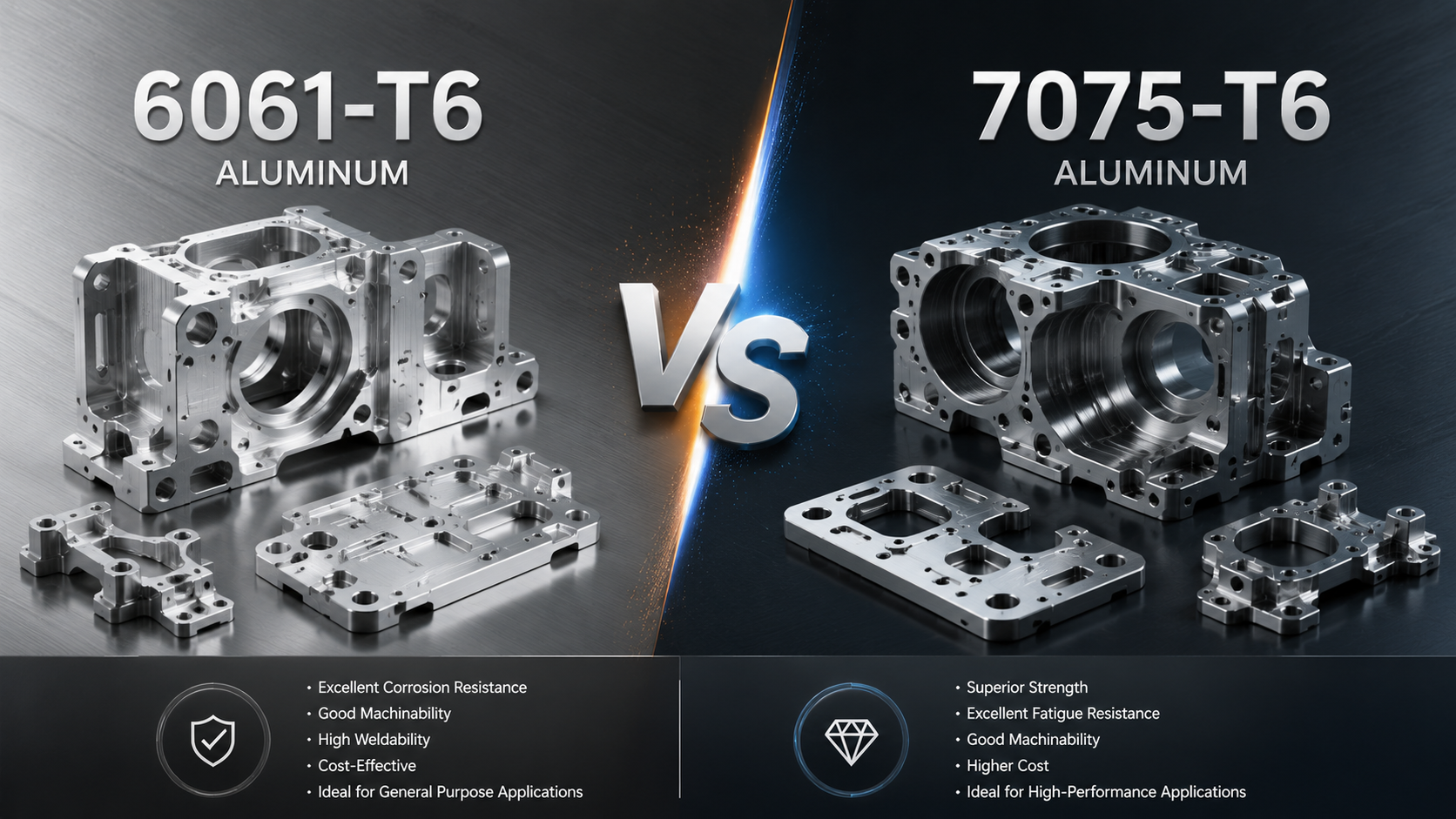
Praktyczne porównanie wytrzymałości, sztywność, obrabialność, odporność na korozję, spawalniczy, anodowanie, koszt, and application fit.
Wstęp
6061-T6 and 7075-T6 are two of the most frequently compared aluminum alloys for precision parts. Both are heat treatable, widely available in engineering stock, and suitable for niestandardowa obróbka CNC. The important difference is not that one alloy is universally better. It is that each solves a different design problem.
6061-T6 is usually the more balanced choice when corrosion resistance, spawalniczy, anodized appearance, availability, and cost all matter. 7075-T6 or T651 is the stronger choice when load capacity and strength-to-weight ratio dominate the decision. This guide explains where those trade-offs come from and how they affect CNC machining, wykończeniowy, kontrola, and purchasing.
6061-T6 vs 7075-T6 at a Glance
For many brackets, obudowy, talerze, oprawy, and enclosures, 6061-T6 is the practical default. Move to 7075 when analysis shows that 6061 cannot meet the required load or weight target. Do not choose 7075 to solve a stiffness problem: the two alloys have almost the same elastic modulus, so a deflection-limited part usually needs a geometry change or a stiffer material.
Nieruchomość | 6061-T6 | 7075-T6/T651 | Design implication |
Ultimate tensile strength | 310 MPa | 572 MPa | 7075 provides much higher static strength |
Yield strength | 276 MPa | 503 MPa | 7075 suits higher-load, weight-limited parts |
Elastic modulus | 68.3 GPa | 71.7 GPa | Stiffness is nearly the same |
Gęstość | 2.70 g/cm3 | 2.80 g/cm3 | 7075 is about 4% denser |
Thermal conductivity | 167 W/m-K | 130 W/m-K | 6061 dissipates heat more effectively |
Odporność na korozję | Dobry | Lower in T6 | 7075 needs earlier protection planning |
Fusion weldability | Good with process control | Generally not recommended | 6061 is the practical welded option |
Anodizing response | Consistent and cosmetic-friendly | Functional, but color can vary | 6061 is easier for appearance-critical parts |
Material cost | Lower and widely available | Higher and stock-dependent | Quote both when strength is not decisive |
Typical values for sheet and plate; product form, thickness, specification, and supplier data take precedence.
Chemical Composition and Strengthening
6061 belongs to the Al-Mg-Si family. During heat treatment, magnesium and silicon form Mg2Si precipitates that give the alloy its useful combination of strength, odporność na korozję, i produktywność. 7075 is an Al-Zn-Mg-Cu alloy. Its zinc- and magnesium-rich strengthening system produces much higher strength, while the higher copper content contributes to lower corrosion resistance and poor conventional fusion weldability.
Element | 6061 range (%) | 7075 range (%) | Why it matters |
Zinc | 0.25 max | 5.1-6.1 | Primary strengthening element in 7075 |
Magnez | 0.8-1.2 | 2.1-2.9 | Supports precipitation hardening |
Miedź | 0.15-0.40 | 1.2-2.0 | Raises strength but reduces corrosion and weldability |
Silicon | 0.4-0.8 | 0.40 max | Combines with magnesium to strengthen 6061 |
Chromium | 0.04-0.35 | 0.18-0.28 | Helps control grain structure |
Composition limits are nominal alloy ranges, not a substitute for the material certificate supplied with a specific batch.
The alloy number alone is not enough for purchasing. Confirm temper, product form, thickness, governing specification, and certification requirements. JADE-CNC’s CNC machining materials guidance can help frame those checks before quotation.
Mechanical and Physical Properties
Wytrzymałość, Fatigue, and Ductility
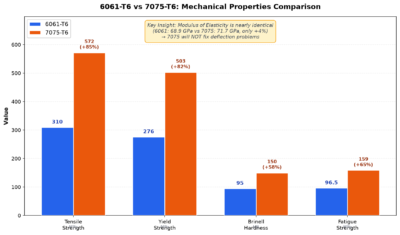
7075-T6 provides roughly 84% higher ultimate tensile strength and 82% higher yield strength than typical 6061-T6 sheet or plate. That is a meaningful advantage in highly loaded parts, but it does not automatically translate into a better design. Stress concentration, fatigue spectrum, grain direction, fastener loads, corrosion exposure, and safety factors still control the final choice.
Typical property | 6061-T6/T651 | 7075-T6/T651 | Difference |
Ultimate tensile strength | 310 MPa | 572 MPa | 7075 about 84% higher |
Yield strength | 276 MPa | 503 MPa | 7075 about 82% higher |
Shear strength | 207 MPa | 331 MPa | 7075 about 60% higher |
Fatigue strength | 97 MPa | 159 MPa | 7075 about 64% higher |
Typical elongation | 17% | 11% | Varies with product form and thickness |
Values are typical, not guaranteed design allowables. Use the applicable material specification and certified properties for final calculations.
Stiffness, Gęstość, and Heat Flow
The elastic modulus differs by only about 5%. If a plate bends too much in 6061, a same-size 7075 replacement will not reduce deflection by much. Increasing section depth, adding ribs, shortening an unsupported span, or changing material class can have a much larger effect.
6061 also conducts heat better. For thermally loaded housings and heat sink CNC machining, fin geometry, base flatness, airflow, interface pressure, and surface treatment often matter more than tensile strength.
Typical property | 6061-T6/T651 | 7075-T6/T651 | Engineering meaning |
Brinell hardness | 95 HB | 150 HB | 7075 better resists indentation |
Elastic modulus | 68.3 GPa | 71.7 GPa | Only a small stiffness difference |
Gęstość | 2.70 g/cm3 | 2.80 g/cm3 | Strength-to-weight still favors 7075 |
Thermal conductivity | 167 W/m-K | 130 W/m-K | 6061 is usually better for heat flow |
Thermal and mechanical values shown are typical at room temperature.
CNC Machinability: Both Are Good, but They Behave Differently
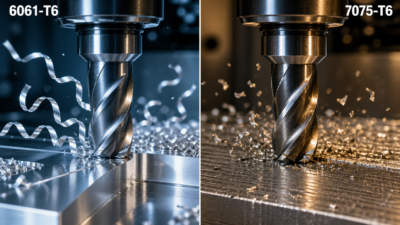
It is misleading to describe 7075 simply as difficult to machine. Both alloys machine well with modern carbide tooling. 6061 is softer and can develop built-up edge if the tool rubs or chip evacuation is poor. 7075 is harder, but it often forms shorter chips and can produce an excellent finish. Tool life and cycle time depend on geometry, stock condition, spindle capability, coolant delivery, wyczerpanie, and material removal strategy.
Machining factor | 6061-T6 | 7075-T6/T651 | Practical response |
Chip behavior | Materiały plastyczne; can form built-up edge | Often shorter, more manageable chips | Use sharp aluminum geometry for both |
Tool loading | Can smear if the edge rubs | Higher hardness increases cutting load | Avoid generic fixed speed reductions |
Wykończenie powierzchni | Excellent with sharp tools | Excellent with a stable process | Control runout, chip recutting, and coolant |
Distortion risk | Manageable; T651 helps in plate | Residual stress can matter in heavy removal | Rough, relax, then finish critical features |
Tool life | Usually favorable | Proces- and geometry-dependent | Monitor wear instead of assuming a fixed penalty |
Practical Machining Guidance
- Use sharp, polished cutting edges and flute geometry intended for aluminum.
- Keep chip load high enough to cut cleanly; rubbing promotes heat and built-up edge.
- Provide effective chip evacuation so recutting does not damage the surface.
- For thin walls or heavy material removal, separate roughing and finishing and allow the part to relax.
- Use T651 or another stress-relieved plate condition when dimensional stability is important.
- Treat speeds and feeds as starting points that must be adjusted for tool diameter, flute count, stick-out, machine rigidity, coolant, and toolmaker data.
A supplier experienced in Frezowanie CNC should review deep pockets, thin ribs, long-reach tools, datum strategy, and critical tolerances before production, regardless of which alloy is selected.
Corrosion Resistance and Stress-Corrosion Cracking
6061-T6 generally offers better corrosion resistance than 7075-T6. In 7075, copper-rich constituents can increase pitting susceptibility, and the T6 condition can be vulnerable to stress-corrosion cracking under sustained tensile stress in unfavorable orientations and environments. This is why 7075-T73 or T7351 is often considered when SCC resistance matters, even though over-aging reduces strength.
Exposure factor | 6061-T6 | 7075-T6/T651 |
Atmospheric exposure | Generally good | Lower resistance; protect exposed parts |
Pitting tendency | Lower | Higher because of copper-rich phases |
Stress-corrosion cracking | Good resistance in common product forms | T6 is more sensitive, especially in short-transverse loading |
Temper option | T6/T651 common | T73/T7351 improves SCC resistance with some strength loss |
Protection strategy | Anodizing or coating as required | Anodowanie, powłoka, cladding, and isolation deserve early review |
Avoid universal salt-spray-hour claims unless the alloy, finish thickness, metoda uszczelniania, edge preparation, specimen geometry, and acceptance standard are all defined. A useful corrosion plan starts with the actual service environment and the complete coating specification.
Weldability and Joining
6061-T6 is commonly TIG- or MIG-welded, but the heat-affected zone loses strength. The joint should therefore be designed and calculated for the welded condition rather than for the original T6 base-metal value. Filler selection depends on service temperature, cracking sensitivity, ductility, and post-finish appearance.
Conventional fusion welding of 7075-T6 is generally avoided for structural work because hot cracking and property loss are difficult to control. Mocowanie mechaniczne, adhesive bonding, friction-stir welding under a qualified process, or a change to a weldable alloy may be more appropriate.
Welding factor | 6061-T6 | 7075-T6 |
Conventional fusion welding | Commonly welded by TIG or MIG | Generally not recommended for structural joints |
Main concern | Strength loss in the heat-affected zone | Hot cracking and severe property loss |
Filler selection | ER4043 or ER5356 depending on service and finish | No universal filler makes a T6 structural joint equivalent |
Design response | Recalculate the welded condition | Use mechanical fastening or change alloy/joining route |
Anodizing and Other Surface Finishes
6061-T6 is a reliable choice for clear, czarny, and colored Type II anodizing. 7075 can also be anodized, including Type III hard anodizing, but its higher copper content can make the oxide darker and color matching less predictable. For cosmetic parts, approve a representative sample and keep alloy, temper, pretreatment, finish batch, and surface texture consistent.
Finishing factor | 6061-T6 | 7075-T6/T651 |
Type II anodizing | Uniform and suitable for dyed cosmetic finishes | Usable, but color may be darker or less uniform |
Type III hard anodizing | Well suited | Well suited for functional wear protection |
Color matching | More predictable across controlled batches | Approve samples for appearance-critical work |
Dimensional planning | Allow for coating growth and masking | Same requirement, with added attention to alloy response |
Recenzja surface finishing options before machining is released. Grubość powłoki, maskowanie, wątki, obszary styku elektrycznego, mating bores, and visible faces should all be identified on the drawing or finish specification.
Cost and Availability
7075 usually carries a substantial raw-material premium, but a fixed percentage is not reliable across regions, stock forms, thicknesses, certifications, and order quantities. Machining cost is also not automatically 30% Lub 50% higher. A well-designed 7075 part may run efficiently, while a thin, cosmetic 6061 housing can be expensive because of setup, distortion control, and finishing risk.
Cost driver | 6061-T6 | 7075-T6/T651 |
Raw stock | Broad availability and lower baseline cost | Higher alloy premium and fewer stock choices |
Obróbka | Efficient for prototypes and production | Cycle time is often similar, but strategy may change |
Wykończeniowy | Cosmetic anodizing is comparatively predictable | Sampling or coating controls can add cost |
Kontrola | Based on drawing risk | High-load applications may require more certification and traceability |
Commercial risk | Easy to substitute stock forms | Availability and certification can affect lead time |
For prototypes and obróbka CNC na małą skalę, compare complete quotations using the same drawing revision, material specification, finish, zakres kontroli, and delivery requirement. That produces a much more useful decision than comparing price per kilogram alone.
Application-Based Selection
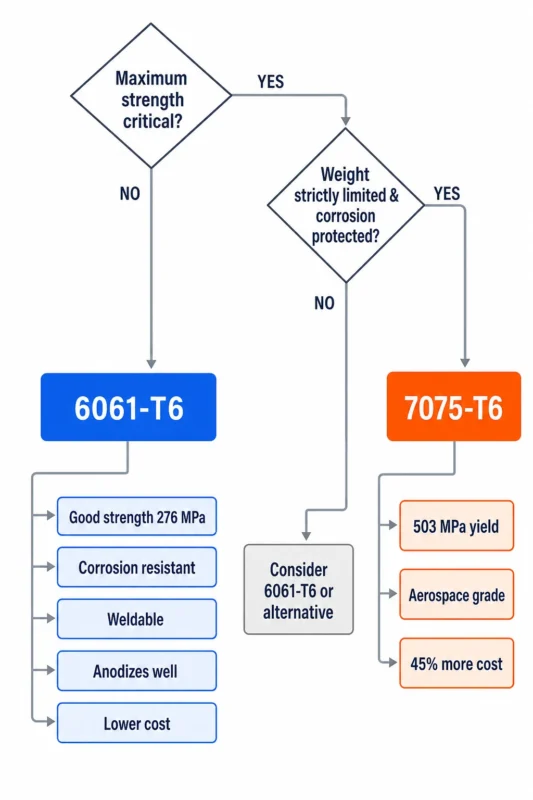
Choose 6061-T6 When
- The required strength is moderate and already meets the design safety factor.
- Odporność na korozję, weldability, or a consistent anodized appearance matters.
- The part is a housing, bracket, osprzęt, plate, enclosure, heat sink, or general structural component.
- Broad material availability and cost control are important.
Choose 7075-T6 or T651 When
- Yield strength or fatigue strength is the limiting requirement.
- Weight is tightly constrained and geometry cannot increase enough to use 6061.
- The part will not rely on conventional fusion welding.
- Corrosion protection and material traceability can be controlled.
- The application involves high-load fixtures, motorsport, robotyka, Lub precision aerospace machining.
When Another Alloy or Process Fits Better
Project priority | Usually choose | Reason |
Balanced cost, korozja, spawalniczy, and appearance | 6061-T6 | The broadest all-round manufacturing fit |
Maximum static strength at low weight | 7075-T6/T651 | Much higher yield and tensile strength |
Deflection is the failure mode | Redesign first | Both alloys have nearly the same elastic modulus |
Marine sheet or formed enclosure | Consider 5052-H32 | Better formability and corrosion resistance |
Cosmetic extrusion | Consider 6063-T6 | Excellent extrusion and anodizing response |
Thick, high-strength aerospace plate with SCC concerns | Consider 7050-T7451 | Better short-transverse SCC performance |
Very high volume and complex geometry | Evaluate casting | Tooling may reduce unit cost after break-even |
Rysunek, Purchasing, and Inspection Checks
Material selection should end in a clear drawing and purchase specification. Vague notes such as ‘AL 7075’ leave too much room for interpretation and can create problems with temper, stock form, grain direction, certification, and finish response.
- Specify alloy, temper, product form, and governing material standard.
- Identify whether T651/T7351 stress-relieved plate is required.
- State mill-certificate, lot-traceability, or aerospace documentation needs before quoting.
- Define grain-direction requirements for highly loaded or fatigue-critical parts.
- Mark cosmetic surfaces, anodizing type, kolor, thickness, opieczętowanie, and masking areas.
- Place tight tolerances only on functional features and define datums clearly.
- Agree on inspection method, sampling plan, and reporting for critical dimensions.
JADE-CNC can coordinate material review with CNC inspection so the alloy choice, machining plan, finish, and measurement method are considered as one process rather than separate purchasing steps.
How JADE-CNC Supports 6061 I 7075 Projects
JADE-CNC machines both 6061 I 7075 for prototypes and production parts. The engineering review focuses on the drawing, stock condition, geometria, tolerance stack, wykończenie powierzchni, planu inspekcji, i wymagania aplikacji. That allows the material recommendation to reflect the actual part instead of relying on a generic alloy ranking.
- Material and temper review before quotation
- 3-oś, 4-oś, and 5-axis milling plus CNC turning
- Machining strategies for thin walls, deep pockets, precision holes, and cosmetic faces
- Anodowanie, piaskowanie perełek, szczotkowanie, coating coordination, and masking review
- Dimensional inspection and reporting based on drawing requirements
- Prototyp, niska głośność, and repeat production support
To compare 6061-T6 and 7075-T6 for a specific component, send the 3D model, 2Rysunek D, ilość, finish, and service conditions to JADE-CNC and request a machining review.
Frequently Asked Questions
Common Engineering Questions
Is 7075-T6 always stronger than 6061-T6?
For typical T6 sheet and plate, 7075 has much higher yield and tensile strength. That does not make it stiffer by the same margin, because the elastic moduli are nearly identical.
Can 6061-T6 replace 7075-T6 to reduce cost?
Only after the loads, fatigue duty, stress concentrations, environment, and safety factor have been checked. A purchasing substitution should never bypass engineering approval.
Which alloy is easier to CNC machine?
Both machine well. 6061 is softer but more prone to built-up edge; 7075 is harder but often produces shorter chips. Part geometry and process control usually matter more than a simple machinability ranking.
Can 7075-T6 be color anodized?
Tak, but the result can be darker and less consistent than 6061. For cosmetic work, use representative samples and define an acceptable color range rather than assuming a perfect visual match.
Is 7075-T6 suitable for marine use?
T6 requires careful protection and is not a casual default for sustained marine exposure. Review SCC risk, powłoka, isolation from dissimilar metals, grain direction, and whether T73/T7351 or another alloy is more appropriate.
Why specify T651 instead of T6 for a machined plate?
T651 includes stress relief by stretching after solution heat treatment. It is often preferred for plate because reduced residual stress can improve dimensional stability during heavy machining.
Wniosek
Choose 6061-T6 when the project needs a dependable balance of strength, odporność na korozję, spawalniczy, wykończeniowy, availability, i koszt. Choose 7075-T6 or T651 when higher strength is necessary and the design can accommodate its corrosion, joining, wykończeniowy, and purchasing constraints. If stiffness controls the design, changing from 6061 Do 7075 will rarely be enough on its own.
The most defensible material decision combines structural analysis with product form, temper, machining strategy, finish, kontrola, certification, and service environment. That is also the information a machining supplier needs to quote the part accurately.
Related 6061-T6 Articles
- 6061-Kompletny przewodnik po obróbce aluminium CNC T6
- 6061-T6 kontra aluminium 7075-T6: Wytrzymałość, Koszt & Skrawalność
- 6061-T6 Aluminum Anodizing: Typy, Zabarwienie, Thickness & Zasady projektowania
- 6061-T6 kontra aluminium ADC12: Obróbka CNC lub odlewanie ciśnieniowe?
- 6061-Wytyczne DFM dotyczące obróbki CNC T6: Zasady projektowania & Lista kontrolna
- 6061-Właściwości aluminium T6: Mechaniczny, Termiczny & Dane chemiczne
Material Data Sources
Composition and density ranges can be checked against the Aluminum Association Teal Sheets. Typical sheet and plate properties in this comparison are aligned with Kaiser Aluminum’s 6061 technical data I Kaiser Aluminum’s 7075 technical data. Final design values must come from the governing specification and certified material for the actual product form and thickness.

Leo Lianga, Founder Best Partner with R&D
Założyciel JADE-CNC, LEO, który wnosi ponad dwudziestoletnie doświadczenie branżowe, Leo rozpoczął karierę jako praktykant i ćwiczy swoje umiejętności w zakresie obróbki powierzchni i obróbki CNC.