


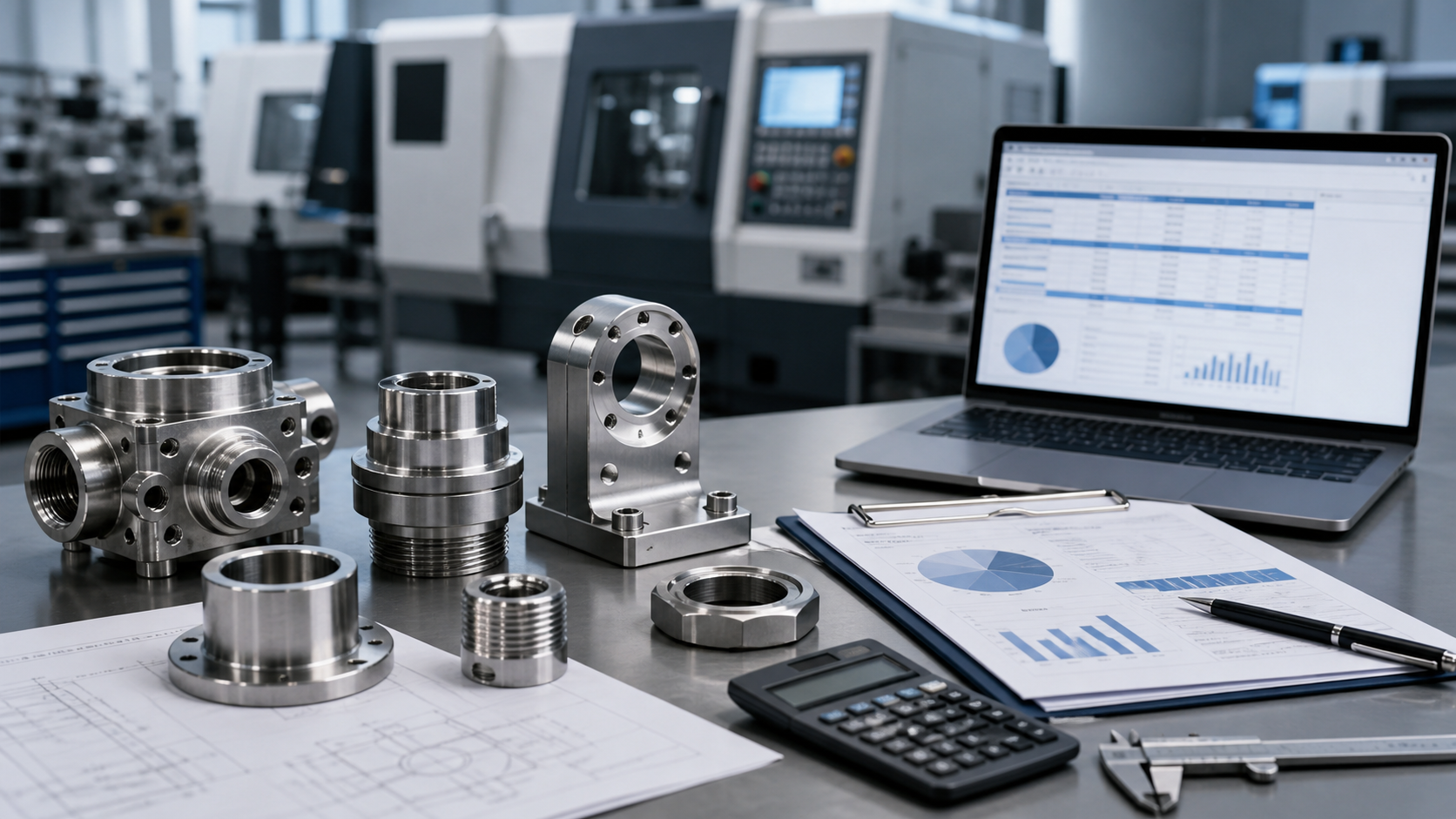
Pourquoi le même dessin peut-il obtenir des citations différentes selon 100%?
De nombreuses équipes d'ingénierie et d'approvisionnement l'ont constaté: le même dessin de pièce en acier inoxydable envoyé à trois ateliers d'usinage revient avec des prix qui peuvent différer d'un facteur deux. Le devis bas manque-t-il de portée ?? Le devis élevé entraîne-t-il des coûts inutiles? En réalité, les différences entre les devis suivent une logique de coût claire : la comprendre vous aide à juger quel devis est complet, réaliste, et adapté au projet.
Les différences de devis proviennent généralement du coût total de fabrication
Pour la même pièce en inox, citations différant par 20% à 50% ne sont pas rares. Un prix inférieur peut provenir de cycles d'usinage plus rapides, ou cela peut provenir de l'omission du post-traitement, inspection documentation, ou risque de contingence. Lors de la comparaison des devis, ne comparez pas uniquement le prix unitaire — confirmez si la portée du devis comprend des certificats de matériaux, inspection des dimensions critiques, finition de surface, exigences d'emballage, et la responsabilité du traitement des non-conformités.
Facteur de coût | Pourquoi cela affecte le devis | Orientation vers la réduction des coûts |
Qualité du matériau | 304, 316, 316L, 303, 17-4Les PH diffèrent par leur prix et leur usinabilité | Ne spécifiez pas trop les notes supérieures; sélectionner en fonction de la corrosion, force, et exigences de conformité |
Complexité géométrique | Cavités profondes, parois minces, longs surplombs, et les petits coins internes augmentent le temps d'usinage | Détendez les coins intérieurs non fonctionnels, ajouter des chanfreins et des surfaces de serrage usinables |
Tolérance & Rugosité | Des tolérances trop serrées augmentent l'usinage de finition, affûtage, et inspection | Distinguer les dimensions fonctionnelles des dimensions générales |
Usure des outils | L'adhésivité et l'écrouissage de l'acier inoxydable augmentent le coût de l'outillage | Optimiser les paramètres de coupe, refroidissement, et parcours d'outils |
Post-traitement | Passivation, électropolissage, PVD, et le dynamitage ajoutent toutes des étapes de processus et d'inspection | Spécifiez clairement les zones requises sur les dessins; éviter de sur-traiter des pièces entières |
En usinage CNC en acier inoxydable, qualité du matériau, complexité de la pièce, exigences de tolérance, quantité commandée, finition de surface, soudage, inspection, conditionnement, et le délai de livraison affectent tous le devis final. Pour une compréhension plus large de l’usinage de l’acier inoxydable, se référer au Guide d'usinage CNC en acier inoxydable.
Répartition de la structure des coûts d’usinage de l’acier inoxydable
Un devis d'usinage de l'acier inoxydable est construit à partir de plusieurs niveaux de coûts. Pour typique 304/316 pièces usinées avec précision, le coût des matériaux représente généralement 30 % à 40 %, usinage (y compris l'amortissement du matériel et la main d'œuvre) 35%–45%, finition de surface et post-traitement 10 % à 15 %, inspection et contrôle qualité 5 % à 10 %, et gestion et profit 5 % à 10 %.
Ces proportions changent avec les caractéristiques des pièces. Pour les pièces complexes à cinq axes, l'usinage peut dépasser 60% tandis que le matériau tombe à 20%. Pour pièces simples en grand volume, le matériau peut dépasser 50% tandis que l'usinage chute à 30%. Comprendre cette structure permet d'identifier où un devis est élevé et où le coût peut être réduit sans ajouter de risque de qualité..
Élément de coût | Gamme | Remarques |
Coût du matériel | 30%–40% | 316 coûte 50 à 80 % de plus que 304; barre/plaque/forgeage diffèrent considérablement |
Usinage | 35%–45% | Comprend l'amortissement de l'équipement, travail, consommation d'outillage, liquide de refroidissement |
Finition des surfaces | 10%–15% | L’électropolissage/PVD coûte 2 à 5 fois plus cher que le polissage standard |
Soudage/Traitement thermique | 5%–15% | Les pièces soudées nécessitent un traitement après soudage; le traitement thermique ajoute du temps de cycle |
Inspection/CQ | 5%–10% | L’inspection complète sur MMT coûte plus cher que l’échantillonnage; test au brouillard salin en supplément |
Gestion/Bénéfice | 5%–10% | Comprend l'emballage, expédition, aérien |
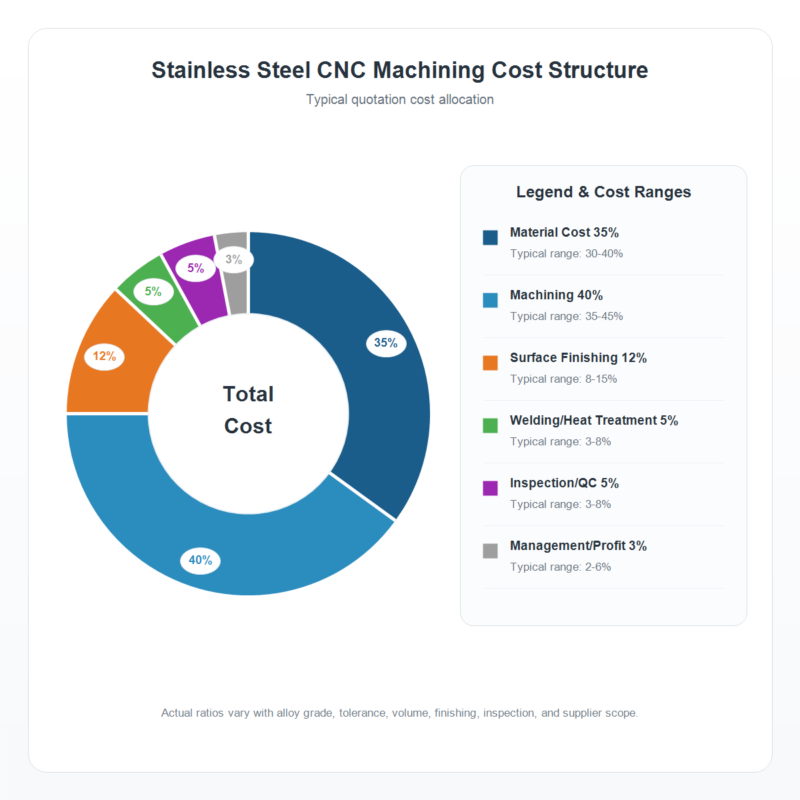
Emplacement pour images 1: Tableau en anneau de la structure des coûts d'usinage de l'acier inoxydable (6 segments)
10 Facteurs de coûts fondamentaux
Qualité et forme du matériau
Le matériel est la base de tout devis. 316 la barre en acier inoxydable coûte souvent plus cher que 304; 316L est légèrement au-dessus 316; 17-4Le PH et l'acier duplex sont plus chers. La forme matérielle affecte également le prix – le stock de barres est le plus courant avec une tarification transparente, la plaque nécessite des calculs d'imbrication pour son utilisation, les pièces forgées nécessitent des coûts d'outillage, et les pièces moulées ont des quantités de commande minimales. En plus, norme matérielle (GB/ASTM/EN) et si un rapport d'essai de matériau (MTR) est fourni, cela affecte le prix — un devis complet doit indiquer si la documentation MTR est incluse.
Pour la sélection des matériaux, se référer à 304 contre 316 par rapport à l'acier inoxydable 316L
Complexité des pièces et temps d'usinage
La complexité détermine directement le temps d'usinage. Les pièces de bague simples peuvent prendre quelques minutes chacune, alors que les boîtiers complexes à cinq axes peuvent prendre des heures. Évaluer la complexité à travers plusieurs dimensions: si un usinage simultané sur cinq axes est nécessaire, s'il y a des trous et des cavités profonds, si l'épaisseur de la paroi est inférieure à 2 mm, si plusieurs opérations angulaires sont nécessaires. Chaque niveau de complexité peut doubler le coût d'usinage. Les équipes CNC expérimentées peuvent estimer le temps d'usinage avec plus de précision à partir de modèles et de dessins 3D complets..
Pour les problèmes connexes, se référer à Problèmes d'usinage CNC en acier inoxydable & Solutions
Exigences de tolérance et de rugosité de surface
Des tolérances plus strictes signifient des coûts plus élevés. Tolérances générales (±0,05 mm) sont réalisables avec une CNC standard; tolérances de précision (±0,01mm) nécessitent un meulage de précision et des ateliers à température contrôlée, augmentation des coûts de 30 à 50 %. La rugosité de surface suit la même logique : Ra 1,6 μm est réalisable avec un fraisage standard, Ra 0,4 μm nécessite un meulage de finition, Ra 0,05 μm nécessite un polissage miroir ou un électropolissage. Chaque tolérance inutilement stricte ou exigence de finition élevée sur le dessin augmente les coûts..
Quantité commandée
La quantité commandée est l'un des principaux facteurs affectant le prix unitaire. Pour prototypes de 1 à 5 pièces, programmation, installation, et les coûts de contrôle du premier article sont répartis sur très peu de pièces, rendre le prix unitaire le plus élevé. À 100+ pièces, ces coûts fixes sont amortis et le prix unitaire peut chuter jusqu'à 40 à 60 % du prix du prototype. À 1000+ pièces, les itinéraires de processus peuvent être optimisés et des montages dédiés utilisés, réduire encore le prix unitaire. Cependant, de très grandes quantités peuvent prolonger le délai de livraison, exigeant un équilibre.
Exigences de finition de surface
L’impact financier de la finition de surface est souvent sous-estimé. Le polissage et le brossage mécaniques standards sont relativement peu coûteux. L'électropolissage nécessite un équipement et un électrolyte spécialisés, coûte 2 à 3 fois plus cher qu'un polissage standard. Le revêtement PVD nécessite un équipement de dépôt sous vide et un prétraitement, avec un coût encore plus élevé et des exigences minimales en matière de surface de revêtement. La passivation est peu coûteuse mais nécessite des produits chimiques et une manipulation environnementale; le sablage est le moins cher mais généralement plus adapté aux pièces internes non esthétiques ou fonctionnelles. Lorsque plusieurs finitions sont combinées, pile de coûts.
Pour la sélection de finition de surface, se référer à Guide de finition des surfaces en acier inoxydable
Traitement de soudage et post-soudage
Le coût des pièces soudées en acier inoxydable va au-delà de l’opération de soudage elle-même. 316Le soudage en L nécessite du fil d'apport ER316L, passivation après soudure, et pour les pièces critiques, traitement de solution ou inspection des soudures (ressuage/radiographie). Le contrôle de la distorsion du soudage nécessite un montage dédié, et la déformation après soudage nécessite un redressement. Ces coûts sont faciles à ignorer dans les devis simplifiés et peuvent entraîner une pression budgétaire pendant la production..
Exigences de traitement thermique
Les aciers inoxydables à durcissement par précipitation comme le 17-4PH nécessitent un traitement en solution + durcissement par le vieillissement, ajouter 2 à 3 opérations et 3 à 5 jours au cycle. Traitement de solution après soudage pour 304/316 les pièces soudées nécessitent de grands fours de traitement thermique, qui peut ne pas accueillir de grandes pièces. Le traitement thermique ajoute non seulement des coûts directs, mais prolonge également les délais de livraison, affectant le calendrier global du projet.
Exigences d'inspection et de certification
Les pièces standard peuvent nécessiter uniquement un échantillonnage dimensionnel, ce qui est relativement peu coûteux. Les pièces de l'industrie médicale et alimentaire peuvent nécessiter une inspection par CMM, mesure de la rugosité d'une surface, vérification matérielle, et des dossiers documentés, ce qui augmente le coût. Si des tests spéciaux sont nécessaires – essais au brouillard salin, test de ferrite, tests de propreté – chacun entraîne des frais supplémentaires. Les projets nécessitant une documentation de qualité médicale ou des systèmes de qualité certifiés entraînent généralement des coûts de gestion et de documentation plus élevés..
Emballage et expédition
Les pièces de précision nécessitent un emballage antirouille (Papier VCI/huile antirouille) et emballage résistant aux chocs (caisses en mousse/bois). Les pièces exportées nécessitent des caisses en bois fumigées ou traitées thermiquement. Les pièces volumineuses et lourdes ont des proportions de frais d'expédition plus élevées, et l'expédition internationale nécessite un dédouanement et une assurance. Ces frais sont parfois répertoriés séparément dans les guillemets, parfois inclus dans le prix unitaire — confirmez si l'emballage et l'expédition sont inclus lors de la comparaison.
Délai et urgence
Délais standards (2–4 semaines) sont tarifés aux tarifs standards. Commandes urgentes (livraison dans 1 semaine) nécessiter des sauts de file d'attente et des heures supplémentaires, avec des frais de pointe généralement de 1,3 à 1,5x la norme. Plus le délai est serré, moins il y a de place pour l’optimisation des processus, ce qui augmente généralement le coût. En plus, l'utilisation de la capacité du fournisseur affecte les devis — capacité, calendrier de commande, et la disponibilité du matériel peuvent tous affecter le devis final.
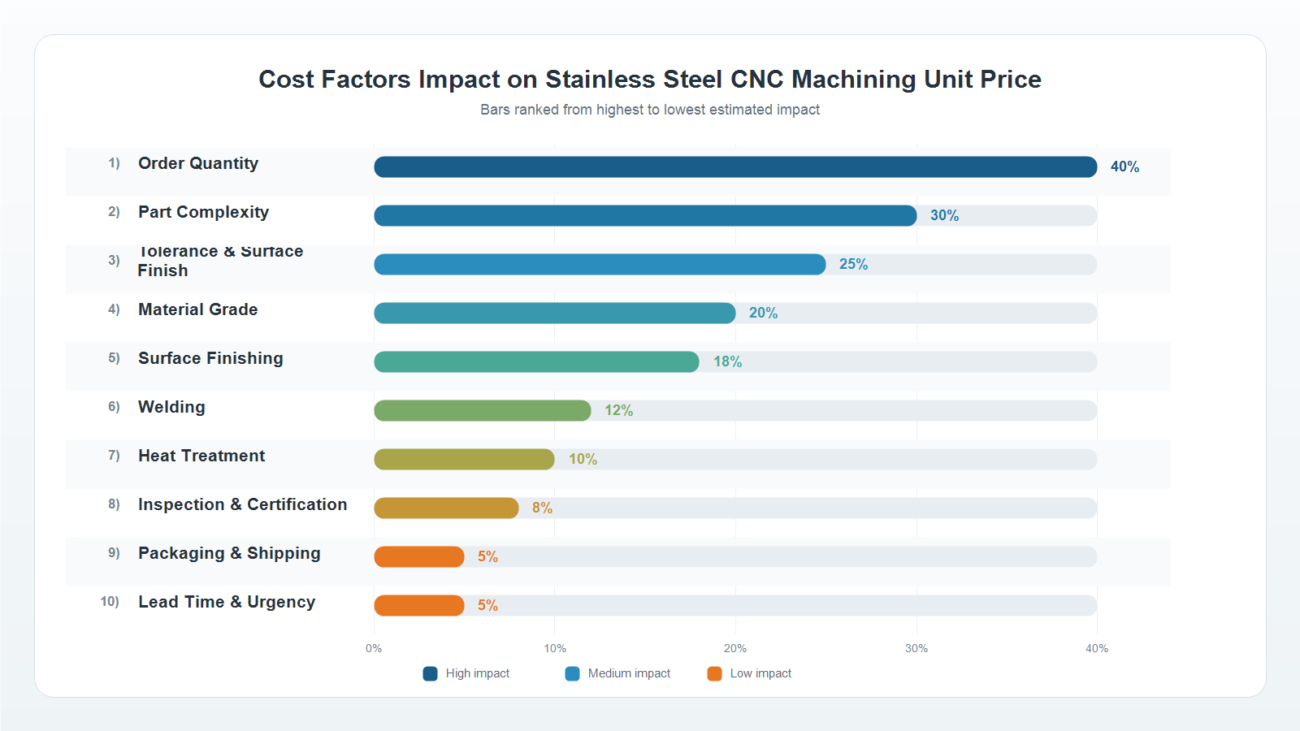
Emplacement pour images 2: 10 les facteurs de coût ont un impact sur le graphique à barres de classement (par pourcentage d'impact sur le prix unitaire)
5 Orientations pratiques d’optimisation des coûts
Comprendre les facteurs de coût permet une optimisation raisonnable des coûts sans sacrifier la qualité. Voici les orientations de réduction des coûts que JADE-CNC a trouvées efficaces dans les projets de production.
L'optimisation des matériaux est souvent la méthode de réduction des coûts la plus directe. Là où l'environnement le permet, remplacement 304 pour 316 peut réduire le coût des matériaux lorsque l'environnement de service le permet; pour pièces non soudées, en utilisant 316 au lieu du 316L, cela peut réduire les coûts lors du soudage, corrosion, et les exigences des spécifications le permettent. Cependant, la déclassification des matériaux doit être fondée sur une évaluation de l'environnement de service — maritime, médical, et les environnements réglementés nécessitent un examen minutieux des éléments.
L'optimisation de la tolérance est souvent négligée. Le marquage de chaque dimension à ± 0,01 mm sur un dessin augmente considérablement les coûts d'usinage.. En réalité, seules les surfaces de contact nécessitent des tolérances strictes; le relâchement des surfaces non correspondantes à une tolérance plus appropriée peut réduire les coûts sans affecter la fonction. Pendant l'examen du processus, nous aidons nos clients à distinguer les dimensions critiques des dimensions générales.
La consolidation par lots réduit également les coûts. Combiner plusieurs commandes de petits lots en production, ou partager du matériel et des accessoires entre des pièces similaires, réduit considérablement le coût unitaire. Les programmes à long terme peuvent également utiliser la planification des stocks de sécurité ou des commandes globales pour réduire les coûts d'installation et d'achat répétés..
La simplification de la finition des surfaces est également efficace. Polir les surfaces d’aspect tout en sablant ou en laissant les surfaces sans aspect non traitées coûte bien moins cher que le tout électropolissage. La passivation offre souvent un bon rapport coût/performance pour la résistance à la corrosion dans des environnements appropriés; l'électropolissage n'est pas toujours nécessaire.
L'intégration des processus est l'un des avantages d'un partenaire de fabrication unique. Fin de l'usinage, soudage, finition de surface, et l'inspection via un itinéraire géré peut réduire les transferts, coût des communications, et responsabilité peu claire entre plusieurs magasins. JADE-CNC fournit un service unique, de l'usinage à la finition de surface, avec coût, délai de mise en œuvre, et risques qualité revus ensemble avant production.
Types de fournisseurs comparés pour les devis d'usinage CNC en acier inoxydable
La sélection des fournisseurs ne doit pas être basée uniquement sur le prix unitaire. Coût, livraison, communication technique, réactivité, et la stabilité de la qualité comptent. Ce qui suit compare JADE-CNC avec les principaux concurrents du secteur dans cinq dimensions.
Dimension | JADE-CNC | Grande usine leader | Petit atelier d'usinage |
Transparence des devis | devis détaillés, 10 éléments de coût traçables | Devis forfaitaires, détail limité | Devis estimés, grande variance |
Capacité à guichet unique | Usinage + soudage + finition + inspection | Certains processus externalisés | Focus sur un seul processus |
Flexibilité de livraison | Toutes les tailles de commande, commandes urgentes prises en compte | Les grosses commandes sont prioritaires, les petites commandes attendent | Rapide pour les petites commandes, capacité limitée pour les grands |
Coopération | Suggestions d'optimisation proactives lors de l'examen des processus | Machines à imprimer, contribution proactive limitée | Capacité technique coopérative mais limitée |
Réactivité | 24-heure de réponse, interlocuteur dédié | Long processus, 3–Réponse sous 5 jours | Réponse rapide mais qualité incohérente |
Stabilité de la qualité | OIN 9001, CQ complet du processus | Système robuste mais peu flexible | Variation de haute qualité |
Coût global | 10%–15% de moins que les grandes usines | Haut (allocation des frais généraux de gestion) | Prix unitaire bas mais coût de reprise élevé |
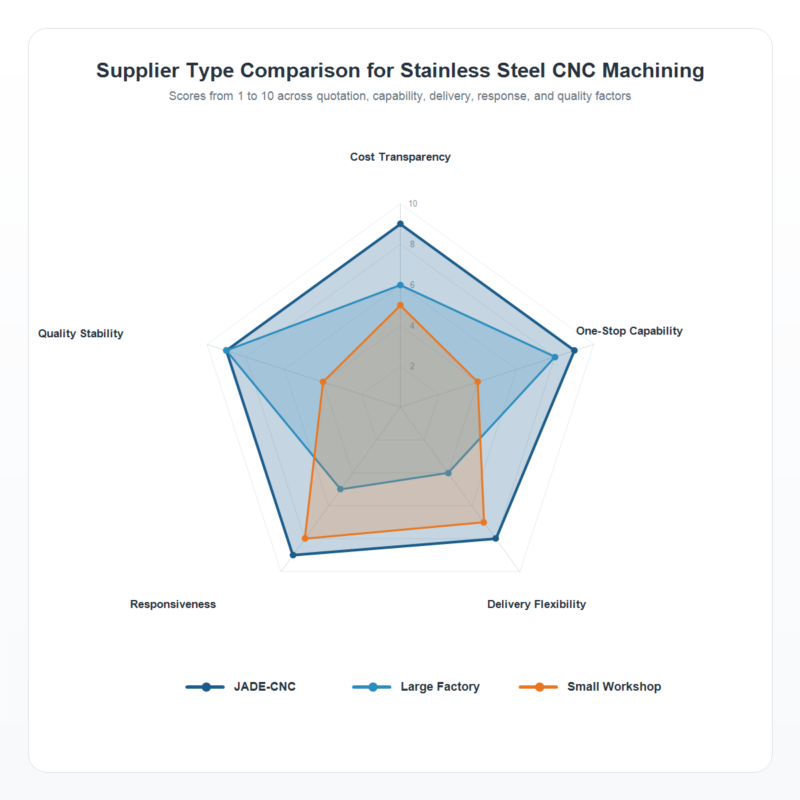
Emplacement pour images 3: Tableau radar de comparaison en cinq dimensions des fournisseurs (Partenaire CNC à guichet unique, grande usine ou petit atelier d'usinage)
Les grandes usines de premier plan ont l'avantage de disposer de systèmes robustes et d'une grande capacité, mais des coûts de gestion élevés, planning long pour les petites commandes, processus de communication plus lents, et des cotations généralement plus élevées. Les petits ateliers d'usinage offrent des prix unitaires bas et une réponse rapide, mais capacité technique et stabilité de la qualité limitées - les pièces complexes et très exigeantes sont sujettes à des problèmes, et les coûts de retouche finissent par être plus élevés.
JADE-CNC est positionné pour les projets nécessitant un soutien technique, quantités de commande flexibles, et une exécution stable — avec un système qualité et un équipement approprié (cinq axes, usinage tour-fraisage, OIN 9001), tout en gardant une certaine réactivité, flexibilité, et la vitesse. Lors des revues de processus, JADE-CNC aide ses clients à identifier les facteurs de coûts et les risques de fabricabilité avant l'usinage pour l'impression. Petits lots, commandes en volume, et les projets urgents peuvent être examinés par rapport à la capacité actuelle, avec des contacts dédiés pour réduire les lacunes de communication.
Processus de devis JADE-CNC
JADE-CNC utilise un processus de devis structuré pour améliorer la vitesse et la précision. Pour de nombreux projets, JADE-CNC peut répondre dans les délais 24 heures après réception des dessins complets, y compris des recommandations de sélection de matériaux, itinéraire de processus, plan de finition de surface, délai de mise en œuvre, et devis détaillé. Pour pièces complexes, nous procédons d'abord à un examen du processus, identifier les points de conception sur le dessin qui peuvent augmenter les coûts, fournir des suggestions d'optimisation, et émettre un devis formel après confirmation du client.
Le détail du devis comprend le coût du matériel, coût d'usinage, coût de finition de surface, coût d'inspection, et frais d'emballage/d'expédition — chaque article peut être examiné et tracé. Les devis de volume offrent une tarification échelonnée (10/50/100/500 pièces) pour aider les clients à choisir en fonction de la demande. Après confirmation du prototype, les prix de volume peuvent être examinés et planifiés en fonction de la disponibilité des matériaux et du calendrier des commandes.
À propos de JADE-CNC
JADE-CNC est spécialisé dans l'usinage de précision de pièces en acier inoxydable, avec cinq axes simultanés, usinage tour-fraisage, et équipement de meulage de précision, OIN 9001 attestation, et un service à guichet unique depuis l'usinage et le soudage jusqu'à la finition et l'inspection des surfaces. Ses cotations sont structurées et traçables, et les examens des processus aident les clients à identifier les opportunités de réduction des coûts, risques de délais, et exigences de contrôle de qualité avant la fabrication.
Envoyez vos dessins 3D/2D, qualité du matériau, quantité, tolérances, finition de surface, exigences d'inspection, et délai de livraison cible pour un devis détaillé, examen de la fabricabilité, et évaluation des délais.
Articles connexes sur l'acier inoxydable
Usinage CNC en acier inoxydable: Le guide complet de résolution de problèmes
Léo Liang, Fondateur Meilleur partenaire avec R&D
LEO, fondateur de JADE-CNC, qui apporte plus de deux décennies d'expertise dans l'industrie, Leo a commencé sa carrière en tant qu'apprenti et met en pratique ses compétences en traitement de surface et en usinage CNC..