



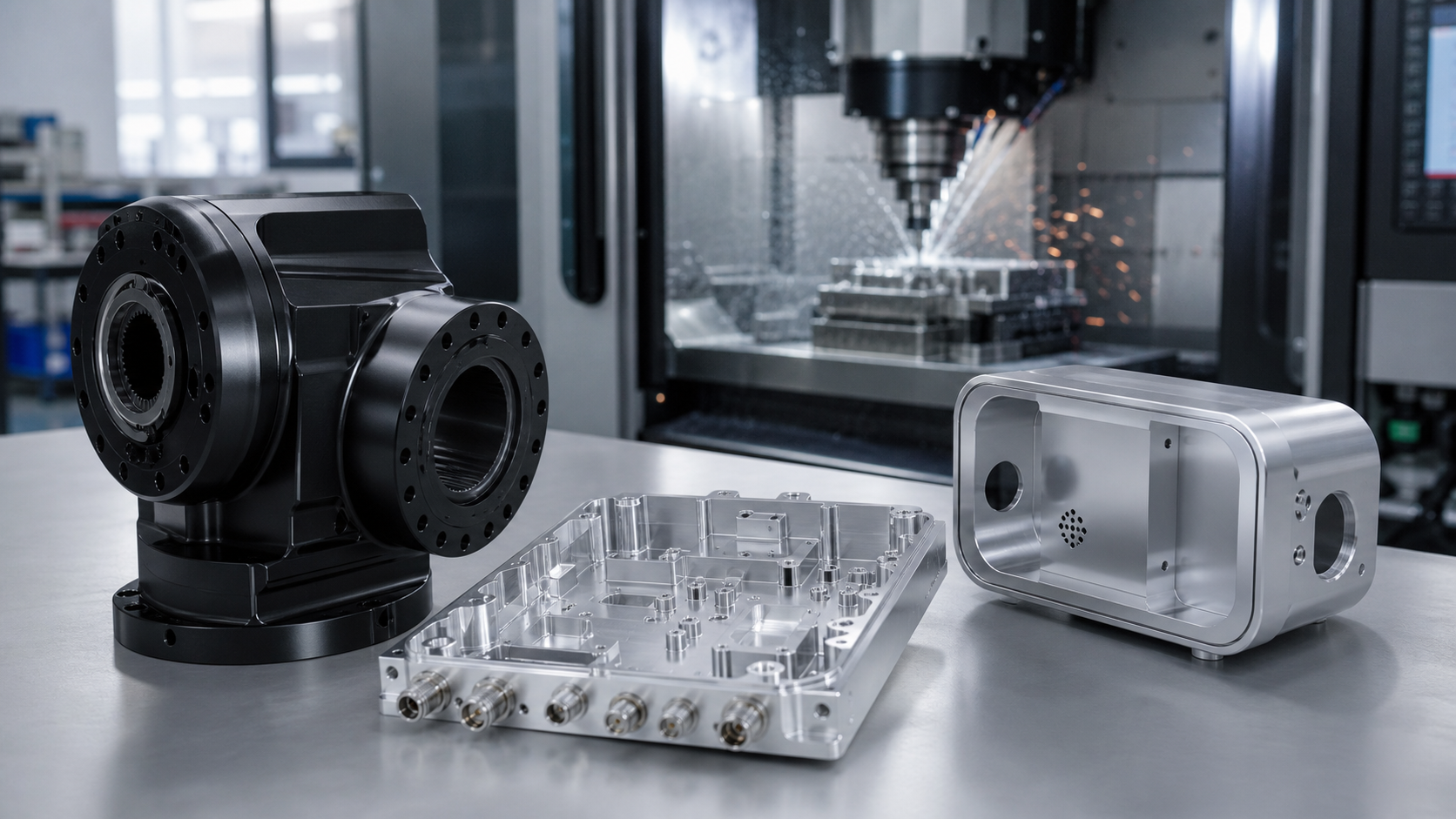
Un guide d'ingénierie pratique pour le 6061-T6 usinage CNC en aluminium, y compris le comportement des matériaux, Trempe T6, comparaisons d'alliages, paramètres d'usinage, finitions de surface, facteurs de coût, Règles DFM, et des exemples de projets réels.
Introduction
6061-L'aluminium T6 est l'un des matériaux les plus couramment spécifiés pour les pièces usinées avec précision, car il offre un équilibre pratique de résistance., résistance à la corrosion, usinabilité, disponibilité, et le coût. Les ingénieurs l'utilisent pour les supports, logements, dissipateurs de chaleur, luminaires, composants robotiques, Cavités RF, et de nombreuses autres applications d'usinage CNC en aluminium.
Toujours, choisir le 6061-T6 ne garantit pas automatiquement un bon résultat. Épaisseur de paroi, stratégie de tolérance, sélection d'outils, contrôle de la température, allocation d'anodisation, et la géométrie des pièces affectent tous la qualité de l'usinage et le coût final. Ce guide explique comment le 6061-T6 se comporte pendant usinage CNC sur mesure et comment concevoir, citation, et inspecter les pièces fabriquées à partir de celui-ci.
Ce que couvre ce guide
- 6061-Propriétés du matériau T6: chimique, mécanique, thermique, et données électriques
- Que signifie le tempérament T6 et quand le T651 est un meilleur choix
- 6061-Comparaisons T6 avec 7075, 6063, 5052, 304 acier inoxydable, et ADC12
- Paramètres d'usinage CNC, outillage, montage, et contrôle des tolérances
- Finitions de surface pour les pièces 6061-T6, y compris l'anodisation et les revêtements conducteurs
- Facteurs de coûts et effets de volume dans l'usinage CNC 6061-T6
- Directives DFM pour les murs, trous, tolérances, et traitement de surface
- Exemples de projets pour les défis courants d'usinage du 6061-T6
- Questions d'ingénierie fréquemment posées
Propriétés des matériaux
La valeur du 6061-T6 provient de son ensemble de propriétés équilibré. Ce n'est pas l'alliage d'aluminium le plus résistant, ni le moins cher, mais c'est prévisible, largement disponible, et facile à usiner de manière cohérente.
Composition chimique
6061 est un alliage Al-Mg-Si traitable thermiquement. Le magnésium et le silicium forment des précipités de Mg2Si au cours du vieillissement, qui est la principale source de renforcement. Le cuivre ajoute de la force, tandis que le chrome aide à contrôler la croissance des grains et améliore la résistance à la corrosion..
| Élément | Min. (%) | Max. (%) | Rôle |
| Aluminium (Al) | 95.80 | 98.60 | Métal commun |
| Magnésium (Mg) | 0.80 | 1.20 | Renforcement primaire (Mg₂Si) |
| Silicium (Et) | 0.40 | 0.80 | Renforcement primaire (Mg₂Si), améliore la fluidité |
| Cuivre (Cu) | 0.15 | 0.40 | Augmente la force, favorise le durcissement par l'âge |
| Chrome (Cr) | 0.04 | 0.35 | Contrôle la croissance des grains, améliore la résistance à la corrosion |
| Fer (Fe) | — | 0.70 | Impureté résiduelle |
Propriétés mécaniques
6061-T6 fournit généralement 310 Résistance à la traction MPa et 276 Limite d'élasticité MPa. C'est inférieur à de nombreux aciers, mais l'alliage ne représente qu'environ un tiers de la densité de l'acier, ce qui lui confère un fort avantage en termes de résistance et de poids. Son module inférieur compte également: par rapport à l'acier, 6061 les pièces fléchissent davantage sous la même charge, la rigidité doit donc être vérifiée dès le début de la conception.
| Propriété | Valeur | Unité |
| Résistance à la traction | 310 | MPa |
| Limite d'élasticité (0.2% compenser) | 276 | MPa |
| Élongation | 8-12 | % |
| Module d'élasticité | 68.9 | GPa |
| Dureté Brinell | 95 | HB |
| Résistance à la fatigue | 96.5 | MPa |
| Densité | 2.70 | g/cm³ |
Propriétés thermiques et électriques
6061-Le T6 conduit bien la chaleur, ce qui aide la chaleur de coupe à quitter l'interface outil-pièce et prend en charge des vitesses de coupe plus élevées. Le compromis est la dilatation thermique. UN 10 un changement de température de °C peut créer environ 0.0236 mm de mouvement dimensionnel sur un 100 caractéristique mm, ce qui est déjà plus grand que de nombreuses tolérances de précision.
C'est 40-47% La conductivité électrique de l'IACS fait 6061 utile pour les boîtiers électroniques, Cavités RF, et Usinage CNC de dissipateur de chaleur personnalisé candidatures. Cependant, l'anodisation crée une couche d'oxyde isolante, les surfaces conductrices peuvent donc nécessiter un masquage ou un revêtement conducteur à la place.
Article sur le cluster associé: 6061-Propriétés de l'aluminium T6: Chimique, Mécanique, et données thermiques
Que signifie T6?
T6 est une désignation de tempérament. Pour 6061, cela signifie que le matériau a été traité thermiquement et vieilli artificiellement.. C'est la condition la plus courante pour l'usinage CNC 6061 pièces car cela donne de la stabilité, résistance reproductible sans rendre l'alliage difficile à usiner.
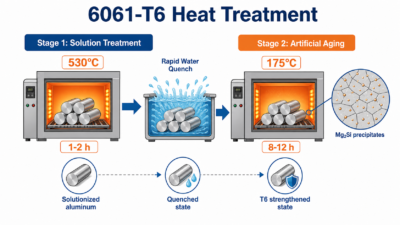
Le processus de traitement thermique T6
Traitement en solution: l'alliage est chauffé à environ 530 tu C, maintenu suffisamment longtemps pour dissoudre le magnésium et le silicium dans la matrice en aluminium, puis rapidement trempé pour conserver une solution solide sursaturée.
Vieillissement artificiel: le matériau est réchauffé à environ 175 deg C et maintenu pendant plusieurs heures. De fins précipités de Mg2Si se forment au cours de cette étape, augmenter la résistance et la dureté en limitant le mouvement de luxation.
T6 vs autres tempéraments
| Caractère | Traction (MPa) | Rendement (MPa) | Élongation (%) | HB | Application |
| Ô (Recuit) | 124 | 55 | 25 | 30 | Formage profond |
| T4 | 241 | 145 | 22 | 65 | Pliage + post-vieillissement |
| T6 | 310 | 276 | 8-12 | 95 | Usinage CNC, pièces structurelles |
| T651 | 310 | 276 | 8-12 | 95 | Plaque/barre épaisse, soulagé du stress |
| T5 | 262 | 207 | 12 | 75 | Profils extrudés |
Le T6 est largement utilisé dans l'usinage CNC car il combine une bonne résistance, usinabilité prévisible, propriétés stables, forte performance d'anodisation, et une large offre du marché.
Le T651 a les mêmes propriétés mécaniques nominales que le T6, mais il comprend une étape d'étirement pour réduire les contraintes résiduelles. Pour plaques épaisses et pièces longues, Le T651 est souvent le choix le plus sûr car il est moins susceptible de bouger pendant l'ébauche et la finition..
Comparaisons de matériaux
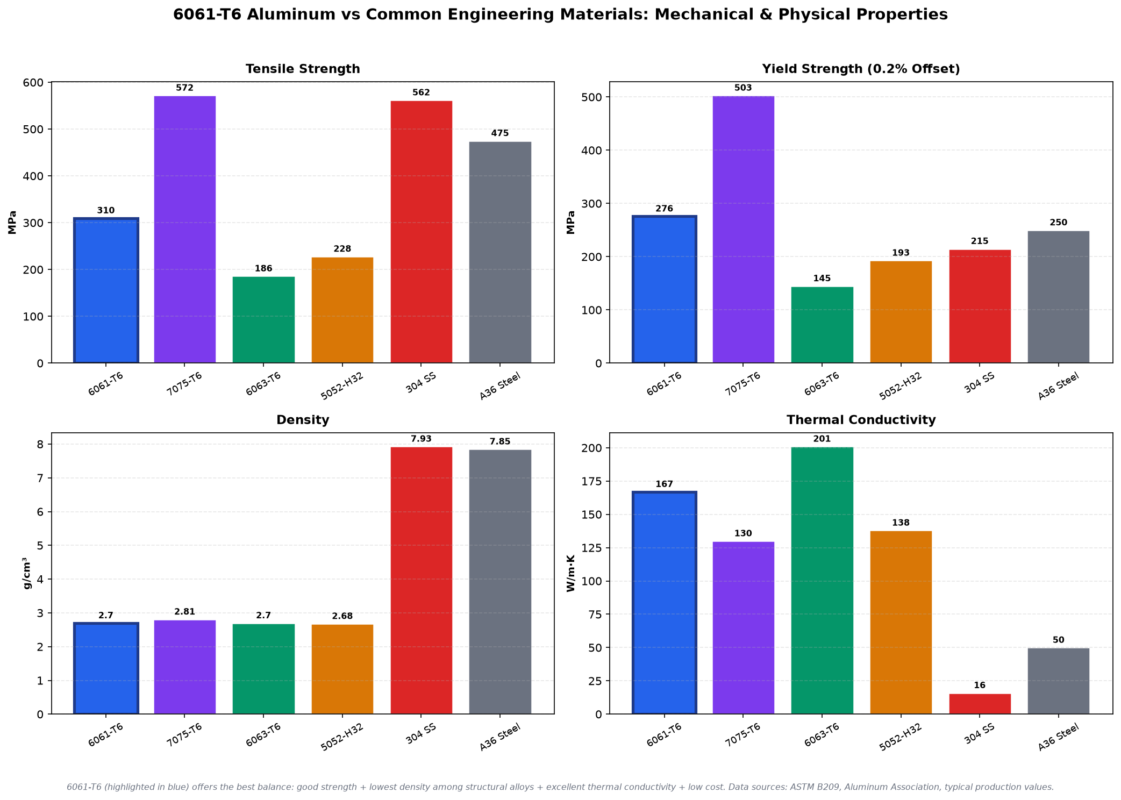
La sélection des matériaux est le point de départ de nombreux problèmes de coûts et de performances.. Le bon choix dépend de la charge, rigidité, exposition à la corrosion, exigences cosmétiques, volume de production, et si la pièce sera usinée à partir d'une plaque, bar, extrusion, ou casting.
6061-T6 contre 7075-T6
7075-Le T6 est beaucoup plus résistant que le 6061-T6 et est souvent sélectionné pour les applications aérospatiales et à charges élevées. Les compromis sont un coût matériel plus élevé, résistance à la corrosion inférieure, moins bonne soudabilité, et un contrôle d'usinage plus exigeant. Utiliser 7075 quand la force est le facteur limitant, pas simplement parce que ça sonne plus premium.
Article sur le cluster associé: 6061-T6 contre aluminium 7075-T6: Force, Coût, et usinabilité
6061-T6 contre 6063-T6
6063 est principalement un alliage d'extrusion. Il offre un aspect anodisé propre et un coût inférieur, mais il est nettement plus faible que 6061. Choisir 6063 pour profils extrudés, pièces décoratives, et quelques dissipateurs de chaleur; choisir 6061 pour composants structurels usinés CNC.
6061-T6 contre 5052-H32
5052 est un alliage Al-Mg non traitable thermiquement avec une excellente résistance à la corrosion et une excellente formabilité. C'est souvent un meilleur choix pour la tôle, pièces pliées, et milieux marins ou chimiques, tandis que le 6061-T6 est généralement meilleur pour les pièces structurelles fraisées.
6061-T6 contre 304 Acier inoxydable
304 l'acier inoxydable offre une plus grande résistance à la corrosion et de bien meilleures performances à haute température. C'est aussi beaucoup plus dense, plus cher en volume, et plus lent à usiner. Utiliser de l'acier inoxydable en cas de corrosion, température, ou les exigences d'hygiène justifient le surcoût et le temps d'usinage.
6061-T6 vs ADC12 en aluminium moulé sous pression
L'ADC12 est conçu pour le moulage sous pression de grands volumes. Cela peut réduire le coût unitaire une fois que le volume est suffisamment élevé pour justifier l'outillage., mais cela apporte une précision moindre, porosité possible, et de moins bonnes performances d'anodisation. Pour les prototypes, production en faible volume, tolérances serrées, et anodisation propre, Usiné CNC 6061 est généralement le chemin le plus flexible.
Article sur le cluster associé: 6061-T6 vs ADC12 en aluminium moulé sous pression: Usinage CNC vs moulage sous pression
Usinage CNC 6061-T6: Outils, Vitesses, et flux
6061-Le T6 est indulgent par rapport à de nombreux métaux techniques, mais il faut quand même des outils pointus, bonne évacuation des copeaux, fixation stable, et sensibilisation à la température. Les problèmes les plus courants sont les bords accumulés, mouvement à paroi mince, bavures, et dérive dimensionnelle sur les éléments de précision.
Sélection d'outils
| Matériau de l'outil | Application | Coût |
| Carbure non revêtu | Ebauche/finition générale | Moyen |
| Carbure diamanté (Contenu téléchargeable) | Finition à grande vitesse | Haut |
| PCD (Diamant polycristallin) | Grand volume, haute précision | Très élevé |
| HSS | Robinets, alésoirs, faible volume | Faible |
Pour le général Fraisage CNC, fraises en carbure non revêtues à deux ou trois cannelures, un angle d'hélice élevé, et les grandes goulottes à copeaux constituent un point de départ fiable. Les outils diamantés peuvent faciliter la finition à grande vitesse ou les longues séries de production.. Quel que soit le revêtement, le tranchant doit rester affûté; les outils émoussés maculent l'aluminium et augmentent les bords accumulés.
Paramètres de coupe pour les outils en carbure
| Opération | Vitesse de coupe (m/min) | Alimentation par dent (mm/z) | DOCUMENT (mm) |
| Ebauche (moulin latéral) | 300-500 | 0.05-0.15 | 0.5-1.0×D |
| Ebauche (moulin à visage) | 400-600 | 0.10-0.20 | 1-3 |
| Semi-finition | 500-800 | 0.03-0.08 | 0.3-0.5 |
| Finition | 600-1000+ | 0.02-0.05 | 0.1-0.3 |
| Forage (5-10mm) | 150-300 | 0.10-0.20mm/tour | — |
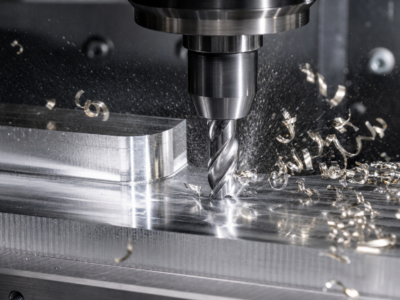
La règle pratique est simple: utiliser une vitesse de broche et une avance suffisantes pour maintenir les copeaux en mouvement. Lorsque le régime de la machine est limité, ne pas compenser en frottant à très faible avance. Une avance stable, charge de copeaux correcte, et une stratégie de refroidissement efficace compte généralement plus que la poursuite d'un nombre de vitesse théorique.
Fixation et Anti-Déformation
Parce que 6061 a un module inférieur à celui de l'acier, les parois minces peuvent fléchir sous l'effet des forces de serrage et de coupe. Utiliser une pression de serrage modérée, mâchoires molles, maintien sous vide, le cas échéant, et séparer l'ébauche de la finition. Pour pièces fines ou de grande valeur, laisser le stock pour un dernier passage de lumière après que la pièce se soit détendue.
Atteindre des tolérances strictes
6061-T6 peut contenir des tolérances de précision, mais le contrôle de la température est souvent le facteur décisif. Pour les dimensions critiques, permettre au stock et à la machine d'atteindre l'équilibre thermique, terminer dans un environnement contrôlé, et vérifiez les fonctionnalités avec les Services d'inspection CNC plutôt que de compter uniquement sur les décalages machine.
Article sur le cluster associé: 6061-Paramètres d'usinage CNC T6: Vitesses, Flux, Outillage, et tolérances
Finitions de surface pour les pièces 6061-T6
6061-T6 répond bien à beaucoup finition de surface processus. La bonne finition dépend de l'apparence, résistance à la corrosion, conductivité, porter, exigences de masquage, et surépaisseur dimensionnelle.
Anodisation
L'anodisation forme une couche d'oxyde d'aluminium contrôlée qui améliore la résistance à la corrosion et la dureté de la surface tout en permettant la teinture des couleurs.. L'anodisation sulfurique de type II est la finition standard pour de nombreux produits usinés. 6061 parties; L'anodisation dure de type III est utilisée lorsque la résistance à l'usure compte plus que la luminosité des couleurs..
| Taper | Film (µm) | Dureté (HT) | Couleur | Coût |
| Tapez I (Chromé) | 2-7 | 200-400 | Transparent/gris | Moyen |
| Type II (Sulfurique) | 5-25 | 300-500 | Teintable de toutes les couleurs | Faible |
| Type III (Dur) | 25-100 | 400-800 | Gris/noir | Haut |
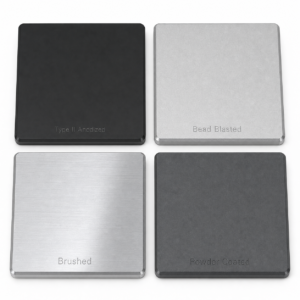
Une erreur de conception courante consiste à ignorer l'accumulation d'anodisation. En règle générale, environ la moitié de l'épaisseur du film s'étend vers l'extérieur. UN 10 Le film micrométrique peut ajouter environ 5 micromètres par surface, ce qui compte sur les alésages, machines à sous, fils de discussion, et assemblages ajustés.
Article sur le cluster associé: 6061-Anodisation T6: Espèces, Couleurs, Épaisseur, et guide de processus
Autres finitions de surface
| Finition | Apparence | Corrosion | Coût | Application |
| Microbillage | Mat uniforme | Équitable (base seulement) | Faible | Pré-anodisation, aspect mat |
| Brossage | Texture linéaire | Équitable | Moyen | Electronique grand public haut de gamme |
| Conversion des chromates | Incolore/jaune | Bien | Faible | Protection conductrice contre la corrosion, apprêt à peinture |
| Revêtement en poudre | Différentes couleurs/textures | Excellent | Moyen | Boîtiers, équipement extérieur |
| Peinture liquide | Divers effets | Bien | Faible-Moyen | Pièces d'apparence, décoratif |
JADE-CNC prend en charge la coordination de l'usinage à la finition, y compris l'anodisation, microbillage, brossage, et procédés de revêtement partenaires. Le point important n'est pas seulement de savoir si une finition est disponible, mais que ce soit le masquage, tolérance, cohérence des couleurs, et l'inspection sont planifiées avant le début de l'usinage.
Coût de l'usinage CNC 6061-T6
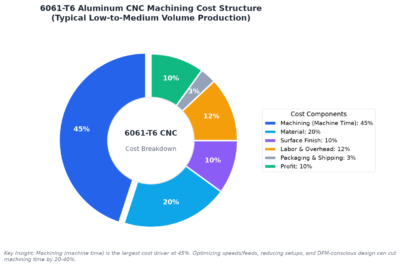
Le coût d'une pièce 6061-T6 dépend moins du nom de l'alliage que de la géométrie., temps de cycle, exigences de tolérance, nombre de configurations, état de surface, niveau d'inspection, et volume de production. Le prix des matériaux compte, mais le temps d'usinage est généralement le facteur de coût le plus important.
Structure des coûts
| Élément de coût | Pourcentage |
| Matériel | 10-30% |
| Usinage (temps machine) | 40-60% |
| Finition de surface | 5-20% |
| Main d'œuvre/frais généraux | 10-20% |
| Emballage/expédition | 2-5% |
| Profit | 10-20% |
Prix indicatif du matériel
Les chiffres ci-dessous sont des fourchettes indicatives du marché en août. 2026. Ils doivent être traités comme citant le contexte, prix d'achat non fixés. Le coût final dépend de la région, fournisseur, formulaire de stock, épaisseur, besoins de certification, et le volume des commandes.
| Formulaire | Spécification | Prix (USD/kg) |
| 6061-Plaque T6 | 1-10mm | 3.7-6.0 |
| 6061-Plaque T6 | 10-50mm | 3.3-5.2 |
| 6061-Plaque épaisse T651 | >25mm | 4.5-7.5 |
| 6061-Barre T6 | 10-150mm | 3.0-5.2 |
Tendance des prix de l’aluminium
| Année | Moyenne | Gamme | Année |
| 2024 | $2,970 | $2,806-3,164 | — |
| 2025 | $3,257 | $3,015-3,552 | +9.7% |
| 2026 (prévision) | $3,507-3,657 | $3,343-3,761 | +7.7-12.3% |
Coût par volume
| Volume | Prix unitaire | Délai de mise en œuvre |
| Prototype (1-5) | 3-5x ligne de base | 3-7 jours |
| Faible (10-50) | 1.5-2x ligne de base | 7-12 jours |
| Moyen (100-500) | 1.0-1.3x ligne de base | 12-20 jours |
| Haut (1000+) | 0.7-1.0x ligne de base | 20-40 jours |
La baisse de prix unitaire la plus importante se produit généralement entre un prototype unique et un petit lot.. Après environ 100 pièces, les économies continuent mais la courbe s'aplatit. Pour de très gros volumes, l'extrusion ou le moulage sous pression peuvent devenir plus économiques, mais ces processus nécessitent un outillage et apportent des contraintes de tolérance et de finition différentes.
Pour usinage CNC à faible volume, JADE-CNC se concentre sur la stabilité des processus, Commentaires sur le DFM, et un contrôle de cohérence d'un lot à l'autre plutôt que de simplement citer le prix le plus bas d'une pièce.
Directives DFM pour les pièces 6061-T6
Un bon DFM est le moyen le plus rapide de réduire les coûts et d’éviter les surprises d’usinage. Le but n’est pas de rendre toutes les fonctionnalités lâches; il s'agit de réserver des tolérances serrées et une géométrie difficile aux caractéristiques qui affectent réellement la fonction.
Épaisseur de paroi
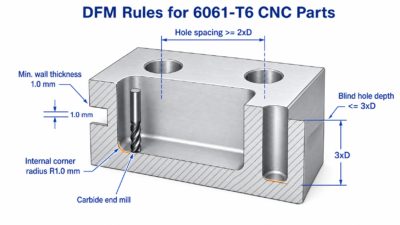
- Minimum: 0.5 mm pour murs courts avec fixations spéciales
- Recommandé: 1.0 mm ou plus épais pour la plupart des murs usinés
- De hauts murs au-dessus 20 mm: utiliser au moins 1.5 mm d'épaisseur ou ajouter des nervures
Trous et filetages
- Diamètre minimum du trou: 0.5 mm, avec 1.0 mm ou plus préféré
- Profondeur du trou borgne: garder un diamètre inférieur à 3x lorsque cela est possible
- Fil minimum: M1.6 possible, M3 ou plus préféré
- Profondeur de filetage effective: généralement pas plus de 2,5x le diamètre nominal
- Devis de taraudage: diamètre nominal moins 1,0825x pas
Coins et congés
- Rayon d'angle interne: 0.5 mm minimum, 1.0 mm préféré
- Les rayons intérieurs doivent correspondre aux tailles d'outils disponibles; évitez de spécifier des coins internes pointus
- Cassez les arêtes externes vives avec des chanfreins C0.2-C0.5 ou des congés R0.2-R0.5
Tolérances
- Tolérance générale: +/-0.1 mm pour les fonctionnalités non critiques
- Tolérance de précision: +/-0.02-0.05 mm là où la fonction l'exige
- Haute précision: +/-0.005-0.01 mm uniquement avec contrôle de processus spécial
- Appliquer des tolérances strictes uniquement à l'accouplement, scellage, alignement, ou dimensions fonctionnelles
Conception du traitement de surface
- Permet l'accumulation d'anodisation sur les surfaces de contact de précision
- Masquer les surfaces conductrices lorsqu'un contact électrique est requis
- Masquer ou chasser les trous filetés lorsque l'épaisseur du revêtement pourrait affecter l'assemblage
Article sur le cluster associé: 6061-Lignes directrices T6 DFM: Liste de contrôle et conseils de conception pour la fabrication
Exemples de projets
Les exemples ci-dessous montrent comment le comportement des matériaux, montage, finition, et l'inspection sont réunis dans de véritables projets 6061-T6.
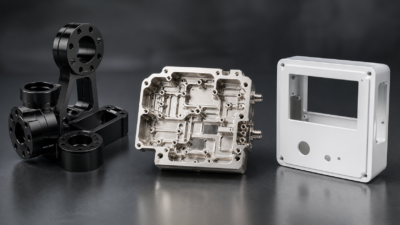
Exemples de projets
Cas 1: Ensemble de composants structurels robotiques
- Portée: haut du bras, avant bras, brides de joint, plaque effectrice terminale, et supports moteur
- Matériel: 6061-T6/T651
- Exigences critiques: +/-0.02 mm trous de joint et +/-0.01 mm face faux-rond
- Finition: microbillage et anodisation noire
- Stratégie de processus: 5-planification de la configuration des axes, séparation ébauche/finition, soulagement du stress, et anodisation par lots unifiée
- Résultat: 12-livraison le jour même avec tolérances respectées, consistance des couleurs contrôlée, et pré-assemblage réussi
Cas 2: Cavité de communication RF
- Partie: 5Cavité du filtre G, 120 x 80 x 30 mm
- Matériel: 6061-Crosse solide T6 pour éviter la porosité de coulée
- Exigences critiques: cavité +/-0.02 mm et planéité 0.01 mm
- Finition: nickel chimique à l'intérieur et anodisation naturelle à l'extérieur
- Défi: séquence de masquage et de traitement de surface pour les performances RF
- Résultat: platitude 0.008 mm, Ra interne 0.6, étanchéité aux gaz réussie, et performances RF respectées
Cas 3: Boîtier et support pour dispositif médical
- Portée: boîtier supérieur/inférieur, support interne, et cadre d'affichage
- Matériel: qualité médicale 6061-T6
- Finition: anodisation blanche sur les boîtiers et anodisation gris foncé sur la lunette
- Défi: parois minces, consistance cosmétique, et 0.1 écart de coque en mm
- Résultat: 10-livraison le jour, aucun défaut de finition visible, 0.1 +/-0.015 écart en mm, et inspection réussie
Conclusion
6061-Le T6 reste le choix d'aluminium par défaut pour de nombreuses pièces usinées avec précision car il est suffisamment solide pour de nombreuses applications., facile à trouver, efficace à usiner, et compatible avec les finitions courantes. Ce n'est pas toujours le meilleur matériau, cependant. Utiliser 7075 quand une force maximale est essentielle, 6063 pour profils extrudés, 5052 pour pièces en tôle formées résistantes à la corrosion, 304 acier inoxydable pour une corrosion ou une chaleur sévère, et ADC12 lorsque le volume de moulage sous pression justifie l'outillage.
Un projet 6061-T6 réussi dépend généralement d'un outillage pointu, charge de copeaux correcte, fixation stable, contrôle de la température, tolérances réalistes, et planification de l'état de surface. Quand ces décisions sont prises tôt, 6061-Le T6 peut offrir de solides performances à un coût raisonnable.
Capacités du JADE-CNC 6061-T6
- 6061-Plaques et barres T6/T651 disponibles pour la production de prototypes et de lots
- 3-axe, 4-axe, et centres d'usinage 5 axes plus tours CNC
- Anodisation, microbillage, brossage, et partenaires de revêtement coordonnés
- Contrôle MMT et ISO 9001:2015 gestion de la qualité
- Prototype, faible volume, et support à la production de moyens volumes
- Analyse DFM, recommandations de processus, et aide à la sélection des matériaux
Pour examiner un projet 6061-T6, envoyez votre modèle 3D et vos dessins 2D à JADE-CNC et demander un devis usinage CNC. Pour la plupart des projets, l'équipe peut examiner la fabricabilité, choix du matériau, état de surface, et exigences d'inspection avant le début de la production.
Foire aux questions
Le 6061-T6 est-il bon pour l'usinage CNC?
Oui. 6061-Machines T6 proprement avec des outils tranchants, prend en charge des vitesses de coupe élevées, et peut produire de bonnes finitions de surface avec une faible usure des outils.
Quelle est la différence entre 6061 et 6061-T6?
6061 est la qualité de l'alliage. T6 est le tempérament, ce qui signifie que le matériau a été traité thermiquement et vieilli artificiellement.. Pour pièces usinées, 6061 sans plus de détails, il s'agit généralement du stock 6061-T6 ou 6061-T651.
Le 6061-T6 peut-il être anodisé?
Oui. 6061-Le T6 est l'un des alliages d'aluminium les plus fiables pour l'anodisation de type II et peut également être anodisé dur lorsque la résistance à l'usure est importante..
Le 6061-T6 est-il plus résistant que le 7075-T6?
Non. 7075-T6 est beaucoup plus fort, mais il est aussi plus cher et moins résistant à la corrosion. 6061-Le T6 est souvent le meilleur choix lorsque les performances et le coût sont plus importants que la résistance maximale..
Quelles tolérances le 6061-T6 peut-il contenir?
Les tolérances générales d'usinage sont souvent proches +/-0.05 à +/-0.1 mm. Les fonctionnalités de précision peuvent atteindre +/-0.02 mm ou plus avec des machines adaptées, montage, contrôle de la température, et inspection.
Combien coûte le 6061-T6?
Le coût des matériaux évolue en fonction des conditions du marché, formulaire de stock, attestation, et le volume. Dans de nombreuses pièces usinées, le temps machine et la configuration sont des facteurs de coûts plus importants que les matières premières seules.
Dois-je choisir l'usinage CNC 6061-T6 ou le moulage sous pression ADC12?
Choisissez usiné CNC 6061 pour les prototypes, volume faible à moyen, tolérances serrées, anodisation, et l'intégrité des matériaux solides. Choisissez le moulage sous pression ADC12 pour les formes complexes à grand volume lorsque le coût de l'outillage est justifié.
Quelle épaisseur de paroi minimale est pratique pour les pièces 6061-T6?
UN 0.5 Un mur de mm peut être possible pour des éléments courts avec des fixations spéciales, mais 1.0 mm ou plus est un objectif de conception plus sûr pour la plupart des pièces usinées CNC.
Articles connexes sur le 6061-T6
- 6061-Guide complet d'usinage CNC en aluminium T6
- 6061-T6 contre aluminium 7075-T6: Force, Coût & Usinabilité
- 6061-Anodisation de l'aluminium T6: Espèces, Couleurs, Épaisseur & Règles de conception
- 6061-Paramètres d'usinage CNC T6: Vitesses, Flux, Outillage & Contrôle des processus
- 6061-T6 contre ADC12 Aluminium: Usinage CNC ou moulage sous pression?
- 6061-Directives DFM pour l'usinage CNC T6: Règles de conception & Liste de contrôle
- 6061-Propriétés de l'aluminium T6: Mécanique, Thermique & Données chimiques
Ce guide est basé sur des données matérielles publiées, informations sur le marché public, et expérience pratique en usinage. Les références de prix sont indicatives au mois d'août 2026 et doit être confirmé lors du devis du projet.

Léo Liang, Fondateur Meilleur partenaire avec R&D
LEO, fondateur de JADE-CNC, qui apporte plus de deux décennies d'expertise dans l'industrie, Leo a commencé sa carrière en tant qu'apprenti et met en pratique ses compétences en traitement de surface et en usinage CNC..