



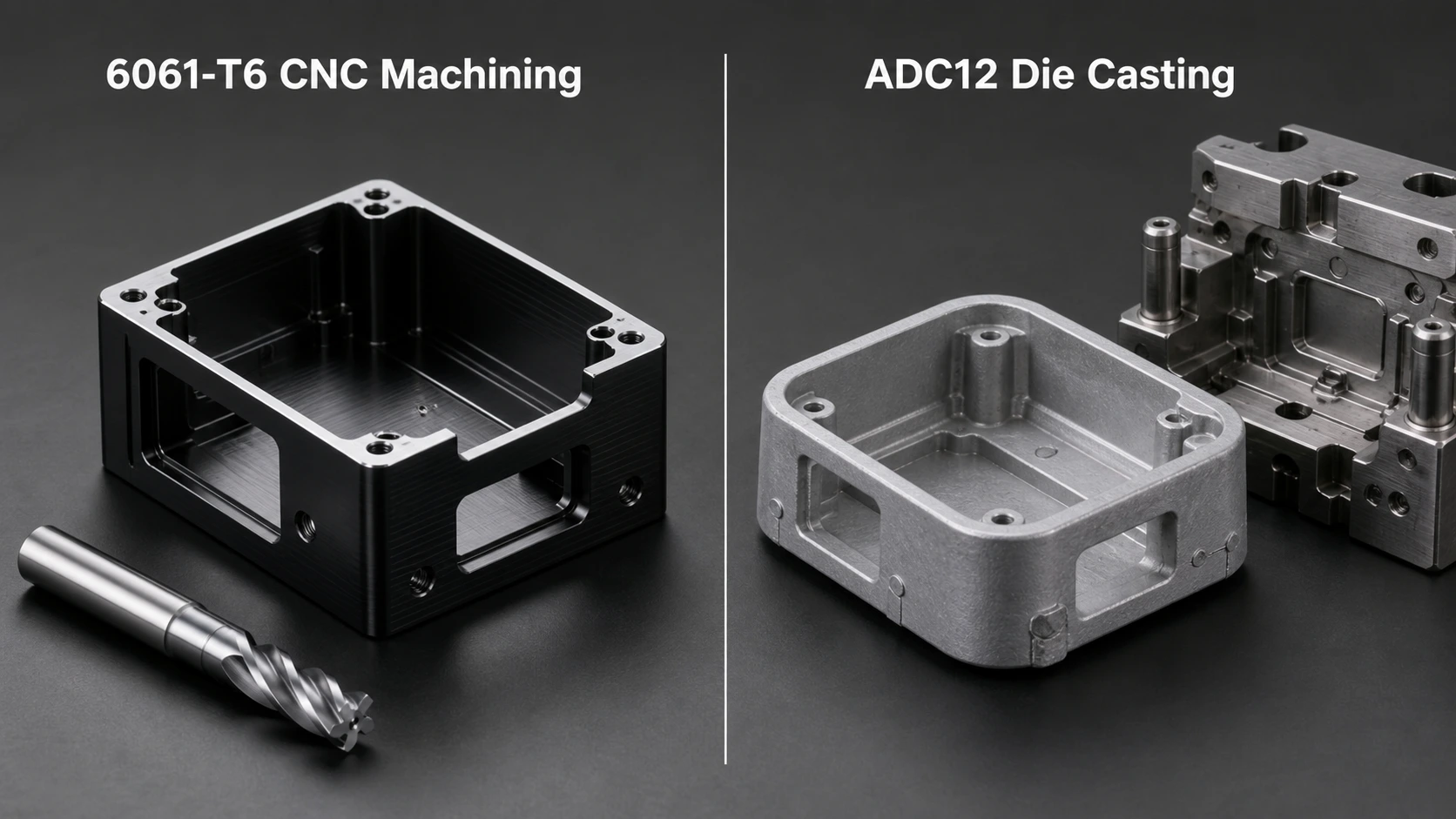
Une comparaison technique de l'usinage CNC 6061-T6 forgé et du moulage sous pression haute pression ADC12, propriétés couvrantes, outillage, économie de volume, tolérances, porosité, finition, et sélection des processus.
Introduction
Choisir entre l'usinage CNC 6061-T6 et le moulage sous pression ADC12 n'est pas simplement une décision matérielle. C'est un choix entre un alliage de corroyage et un alliage de fonderie., et entre un processus soustractif flexible et un processus de forme quasi nette nécessitant beaucoup d'outillage. Le meilleur itinéraire dépend de la géométrie, performance, volume de production, maturité de conception, finition, inspection, et le coût du changement de cap.
L'usinage CNC permet de fabriquer des pièces précises sans matrice de production et convient bien aux prototypes, révisions, et fonctionnalités de précision. Le moulage sous pression haute pression nécessite la conception et la qualification des outils, mais il peut intégrer des murs, côtes, les patrons, et d'autres fonctionnalités efficacement une fois que la demande est stable. Aucun des deux processus n’a de seuil de quantité universel auquel il devient automatiquement moins cher.
Pour une vision plus large du comportement des alliages, tolérances, finition, et conception, commencer par le 6061-Guide complet d'usinage CNC en aluminium T6. Cet article se concentre sur la décision entre l'usinage et le moulage.
6061-Usinage CNC T6 vs moulage sous pression ADC12 en un coup d'œil
Facteur de décision | 6061-Usinage CNC T6 | Moulage sous pression haute pression ADC12 |
Itinéraire de production | Le matériau est découpé dans une plaque forgée, bar, ou extrusion | L'alliage fondu est injecté dans une matrice en acier trempé |
Investissement initial | Programmation, installation, et accessoires; pas de filière de production | Conception de matrice, outillage, essais, et qualification des processus |
Économie de l'unité | Compétitif pour les prototypes, changer de conception, et de nombreuses pièces à faible volume | Peut être attractif à volume stable après amortissement de l'outillage |
Liberté de conception | Bon pour les fonctionnalités de précision et les révisions; limité par l'accès aux outils | Bon pour les côtes intégrées, les patrons, et lames minces; nécessite le casting de DFM |
Comportement du matériau | Forgé, traité thermiquement, ductile, et relativement conducteur | Alliage Al-Si-Cu coulable avec une ductilité inférieure et une porosité possible |
Stratégie de tolérance | Les fonctionnalités critiques peuvent souvent être terminées directement dans le processus CNC | Les fonctionnalités telles que diffusées suivent la capacité de diffusion; les zones critiques peuvent nécessiter un usinage |
Terminer la stratégie | Répond généralement bien à l'anodisation décorative et protectrice | Souvent mieux adapté au revêtement ou à la peinture; l'anodisation nécessite une validation d'échantillon |
Modifications de conception | Généralement géré via CAO, CAME, et mises à jour des appareils | Peut nécessiter une modification ou un remplacement de la matrice |
Une pièce usinée 6061-T6 est généralement plus facile à réviser et à qualifier, tandis qu'une pièce ADC12 moulée sous pression peut avoir un coût variable inférieur une fois l'outillage et le processus éprouvés.. La comparaison correcte est le coût total au débarquement au niveau de qualité requis, pas le prix de la billette par rapport au prix du casting.
Propriétés des matériaux: 6061-T6 contre ADC12
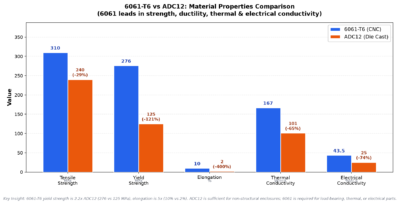
6061-Le T6 est un alliage forgé Al-Mg-Si traité thermiquement. L'ADC12 est un alliage Al-Si-Cu à haute teneur en silicium développé pour le moulage sous pression.. Le silicium améliore la fluidité et le remplissage des matrices, tandis que la structure forgée et traitée thermiquement du 6061-T6 offre généralement une meilleure ductilité, conductivité, et propriétés structurelles prévisibles.
Propriété | 6061-T6 en aluminium forgé | ADC12 en aluminium moulé sous pression | Implication en ingénierie |
Famille d'alliages | Al-Mg-Si, durci par les précipitations | Alliage de coulée Al-Si-Cu | Les deux matériaux ne sont pas des qualités interchangeables |
Densité | À propos 2.70 g/cm3 | À propos 2.7-2.8 g/cm3 | Le poids des pièces est généralement similaire à volume égal |
Résistance à la traction | Souvent à propos 290-320 MPa | Souvent à propos 220-310 MPa | Les valeurs ADC12 dépendent fortement de la section et du processus |
Limite d'élasticité | Souvent à propos 240-280 MPa | Processus- et dépendant du test; généralement inférieur à 6061-T6 | Utiliser des données de moulage certifiées ou testées pour la conception |
Élongation | Souvent à propos 8-12% | Généralement à propos 1-3% | 6061-T6 est généralement plus tolérant à la déformation |
Conductivité thermique | Souvent à propos 150-170 W/m-K | Souvent à propos 90-110 W/m-K | 6061-Le T6 convient généralement mieux aux pièces qui propagent la chaleur |
Conductivité électrique | Souvent à propos 40-47% SIGC | Généralement inférieur | 6061-T6 est généralement préférable pour les chemins conducteurs |
Intégrité interne | Le bois ouvré est normalement dense | Les gaz et la porosité de retrait sont des risques liés au procédé | Les pièces moulées étanches ou critiques en fatigue nécessitent un plan de qualité défini |
Les plages de référence typiques varient selon la forme du produit, épaisseur de section, processus de moulage sous pression, éprouvette, et fournisseur. Utiliser des certificats et des tests spécifiques au projet pour les valeurs de conception.
Le 6061-Guide des propriétés de l'aluminium T6 fournit un examen plus approfondi des produits chimiques, mécanique, et données thermiques. Si la conception nécessite plus de résistance que le 6061-T6, la publication 6061-Comparaison T6 et 7075-T6 couvre une autre option en aluminium forgé.
Résistance et ductilité
6061-Le T6 offre normalement une limite d'élasticité plus élevée et plus constante ainsi qu'un allongement nettement plus important.. Cette combinaison est utile pour les supports porteurs, assemblages bridés, et pièces exposées à des chocs ou à des déformations locales. L'ADC12 peut tout à fait convenir aux couvertures, logements, et structures modérément chargées, mais les propriétés de moulage doivent provenir de la source d'alliage approuvée et d'un processus de production représentatif.
Performances thermiques et électriques
6061-Le T6 conduit généralement mieux la chaleur et l’électricité que l’ADC12. Un boîtier moulé peut néanmoins offrir des performances thermiques adéquates car le moulage sous pression peut créer des parois minces., palmes, et géométrie intégrée. Valider le chemin thermique complet, résistance de contact, flux d'air, et traitement de surface au lieu de sélectionner uniquement la conductivité.
Porosité et étanchéité
Forgé 6061 le stock est normalement dense. Les pièces moulées sous pression peuvent contenir des gaz piégés, porosité de retrait, films d'oxyde, ou discontinuités locales, et l'usinage peut exposer les pores souterrains. Les pièces moulées sous pression ou scellées nécessitent donc un processus convenu, Stratégie de radiographie ou de tomodensitométrie si justifiée, surépaisseur d'usinage, test de fuite, critères d'acceptation, et toute étape d'imprégnation approuvée.
Règles de conception pour l'usinage CNC et le moulage sous pression
Caractéristique de conception | 6061-Approche CNC T6 | Approche de moulage sous pression ADC12 | Question de révision |
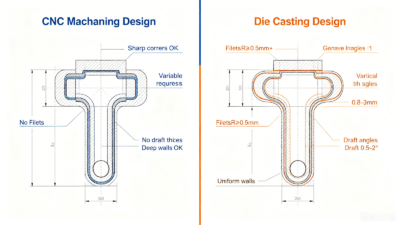
Brouillon | Pas normalement requis | Obligatoire sur les surfaces de dessin | La pièce peut-elle se détacher sans glisser ni endommager? |
Épaisseur de paroi | Peut varier, sujet à l'accès aux outils et à la déformation | Doit être aussi uniforme que possible | Les transitions d'épaisseur à fine entraîneront-elles des problèmes de remplissage ou de retrait? |
Coins intérieurs | Le rayon suit la taille et la portée de la fraise | Des filets généreux soutiennent le flux et la durée de vie de la matrice | Les rayons peuvent-ils être augmentés sans affecter la fonction? |
Côtes et patrons | Usinable lorsque les outils peuvent les atteindre | Efficace lorsqu’il est équilibré et connecté à des murs uniformes | Sont des côtes, les patrons, et murs proportionnés pour le processus? |
Contre-dépouilles | Possible avec des configurations supplémentaires ou des outils spécialisés | Exiger des diapositives, élévateurs, inserts, ou refonte | La fonctionnalité justifie-t-elle une complexité supplémentaire de l'outil? |
Trous | Foré, ennuyé, alésé, ou interpolé | Certains peuvent être évidés; les trous critiques sont souvent usinés | Quels trous ont besoin d'une taille finale, position, ou contrôle de fil? |
Sujets | Taraudé ou fileté | Généralement usiné ou produit avec des inserts | Quelle classe de thread, profondeur, et une force d'arrachement sont nécessaires? |
Séparation et éjecteurs | Sans objet | Ligne de séparation, portes, débordements, et les marques d'éjection doivent être placées | Quels visages sont cosmétiques ou fonctionnels? |
Un prototype CNC ne doit pas automatiquement devenir le modèle d'un outil de moulage sous pression. Brouillon, sens de séparation, portes, débordements, éjecteurs, diapositives, transitions de mur, et les références d'usinage doivent être conçues délibérément. Le 6061-Directives DFM pour l'usinage CNC T6 sont utiles pour la version usinée, mais le fournisseur de pièces moulées doit effectuer un examen distinct du remplissage et de l'outillage..
Planifiez la transition de production dès le début
- Identifier le volume annuel attendu, durée de vie du programme, et l'incertitude de la demande.
- Séparez les surfaces fonctionnelles des éléments qui peuvent rester tels quels.
- Définir la direction de séparation préférée et l'emplacement acceptable de la ligne de séparation.
- Ajoutez une dépouille et des congés pratiques avant que la disposition des matrices ne soit gelée.
- Gardez les murs aussi uniformes que la fonction le permet et examinez les jonctions épaisses pour détecter tout risque de retrait..
- Créez des références d'usinage et des surépaisseurs pour les caractéristiques post-coulées critiques..
- Réserver des emplacements pour les portes, débordements, marques d'éjection, et coupez les lignes de témoin.
Analyse des coûts et du seuil de rentabilité
Le coût de la CNC est dominé par le matériau, programmation, installation, temps de cycle, outils, inspection, finition, et ferraille. Le coût du moulage sous pression ajoute la conception de la matrice, fabrication de matrices, essais, échantillons, qualification, entretien, et remplacement éventuel, tandis que son coût récurrent inclut l'alliage, temps machine, garniture, ferraille, usinage secondaire, finition, et inspection.
Formule d'équilibre
Quantité seuil de rentabilité = (coût fixe de moulage sous pression – Coût fixe CNC) / (Coût variable CNC par pièce – coût variable de moulage sous pression par pièce)
Par exemple, assumer le coût fixe CNC de $500 et un coût variable de $18 par pièce, par rapport au coût fixe de coulée de $12,000 et un coût récurrent de $5.50 par pièce. Le seuil de rentabilité modélisé est d'environ 920 parties. Changez le dé en $35,000, ajouter $4 de post-usinage, ou réduisez le temps de cycle CNC et la réponse évolue brusquement. L'exemple illustre la méthode, pas un prix de marché ou une cotation.
Quantité | Illustration 6061 Total CNC | Total de casting illustratif ADC12 | Interprétation |
100 | $2,300 | $12,550 | La CNC évite l'investissement dans la matrice |
500 | $9,500 | $14,750 | Le CNC reste plus bas dans cet exemple |
1,000 | $18,500 | $17,500 | Les itinéraires modélisés sont proches |
2,500 | $45,500 | $25,750 | Le casting bénéficie de l’amortissement |
5,000 | $90,500 | $39,500 | Le casting a le total modélisé le plus bas |
Modèle illustratif: CNC = $500 + $18 x quantité; CAN12 = $12,000 + $5.50 x quantité. Exclut les taxes, fret, financement, inventaire, et les coûts de qualité spécifiques au projet.
Coûts fréquemment omis dans les premières estimations
- Entretien des matrices, inserts de rechange, réparation, et remplacement tout au long de la durée de vie du programme
- Essais de casting, études de capabilité, approbation du premier article, et tests destructifs
- Montages de post-usinage et contrôle des références pour les pièces moulées
- Débris créés par la porosité, combler les défauts, distorsion, ou rejet cosmétique
- Revêtement, masquage, ébavurage, imprégnation, test d'étanchéité, et emballage
- Coût des modifications techniques et inventaire obsolète si la conception change
- Capacité, quantité minimum de commande, délai de mise en œuvre, fret, et fonds de roulement
Tolérances et usinage CNC secondaire
L'usinage CNC et le moulage sous pression décrivent les processus, pas de niveaux de tolérance automatiques. Un petit alésage usiné, une grande couverture fine, un mur tel que moulé, et une face d'étanchéité post-usinée ont chacune des capacités différentes. Les dimensions doivent être attribuées aux états tels que moulés ou usinés., avec des références, méthodes d'inspection, et critères d'acceptation définis sur le plan.
Exigence | CNC à partir de 6061-T6 | Coulée ADC12 plus travaux secondaires |
Fermer l'alésage ou le siège du roulement | Terminer l'alésage ou l'alésage dans une configuration contrôlée | Allocation de fonte, puis usiner à partir de repères stables |
Trou fileté | Taraud ou fraise à fileter directement | Noyez ou lancez un pilote le cas échéant, puis appuyez sur ou installez un insert |
Face d'étanchéité plate | Surfacer la fraiseuse et inspecter | Usiner la donnée de coulée et gérer les besoins de porosité ou d'imprégnation |
DG&Modèle T-critique | Réduire les configurations et inspecter le dessin | Établir des références de moulage, puis usiner et inspecter les caractéristiques critiques |
Cavité étanche | Un bois ouvré dense simplifie le risque | Spécifier le processus de diffusion, test de fuite, acceptation de la porosité, et toute imprégnation |
Extérieur cosmétique | Contrôler le parcours d'outil et le prétraitement | Contrôler la texture du dé, marques d'écoulement, portes, garniture, et préparation du revêtement |
OIN 8062-3:2023 traite des tolérances dimensionnelles et géométriques générales et des surépaisseurs d'usinage pour les pièces moulées lorsqu'elles sont référencées de manière appropriée. Les capacités spécifiques au moulage sous pression doivent également être examinées par rapport aux preuves de processus du fournisseur et aux spécifications pertinentes. Normes techniques NADCA.
Pour les trous post-coulage critiques, visages, et des fils, la stratégie de coupe compte toujours. Le 6061-Guide des paramètres d'usinage CNC T6 explique les mêmes principes fondamentaux de l'accès aux outils, contrôle des copeaux, matériel de finition, température, et inspection qui s'appliquent lors de l'usinage secondaire de pièces moulées en aluminium.
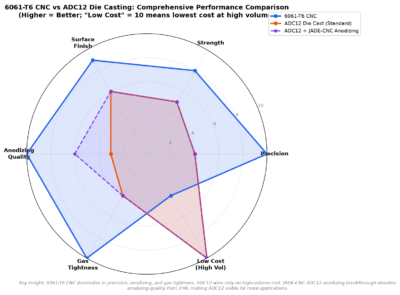
Finition de surface et anodisation
Finition | 6061-T6 | ADC12 | Note de planification |
Comme usiné / tel que moulé | Une texture de coupe uniforme peut être spécifiée | Séparation, grille, éjecteur, et des traces d'écoulement peuvent subsister | Définir les zones cosmétiques et les marques de processus acceptées |
Anodisation | Produit généralement un résultat décoratif plus uniforme | Une teneur élevée en silicium et en cuivre peut provoquer une apparence grise ou marbrée | Approuver les échantillons physiques avant de s’engager dans la production cosmétique |
Revêtement en poudre | Convient après un prétraitement approprié | Choix courant pour une couleur et une couverture uniformes | Prévoir de l'épaisseur sur les ajustements, fils de discussion, et zones de mise à la terre |
Peinture / revêtement électronique | Disponible là où une finition barrière est préférée | Souvent pratique pour les boîtiers et couvercles en fonte | Définir l'adhésion, corrosion, couleur, et exigences de masquage |
Revêtement de conversion | Utile pour la protection contre la corrosion et les interfaces électriques | Possible avec un contrôle de processus approprié à l'alliage | Nommer le processus de gouvernance et les performances requises |
6061-Le T6 est généralement le choix le plus sûr pour un, aspect anodisé décoratif constant. L'ADC12 contient beaucoup plus de silicium et de cuivre, donc l'anodisation conventionnelle peut paraître plus sombre, plus gris, ou marbré. Un prétraitement peut améliorer le résultat, mais il ne peut pas faire en sorte que le substrat se comporte exactement comme le 6061-T6 forgé.
JADE-CNC a développé une capacité de finition de surface mature pour l'aluminium moulé sous pression ADC12, obtenir une amélioration significative par rapport aux limites traditionnelles de l'anodisation ADC12. Grâce à un prétraitement optimisé, contrôle de processus, et paramètres d'anodisation, nous pouvons produire un produit plus uniforme, semi-lumineux, et finition visuellement stable sur les pièces ADC12, se rapprochant de la qualité d'apparence généralement associée à l'aluminium 6061-T6. Cette avancée n'est pas seulement un résultat de laboratoire: nous avons déjà appliqué le processus à des composants produits en série et fournissons des produits finis anodisés ADC12 aux clients finaux.
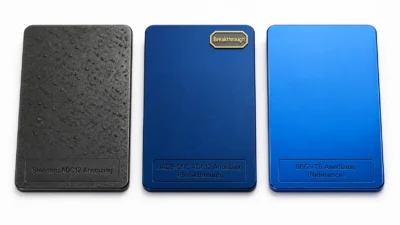
Le 6061-Guide d'anodisation en aluminium T6 explique l'épaisseur, couleur, masquage, et les exigences de dessin plus en détail.
Planification de la qualité pour les pièces moulées sous pression ADC12
Un plan qualité fonderie doit suivre les risques de défaillance de la pièce. Couvertures cosmétiques, enceintes scellées, supports structurels, et les corps sous pression n'ont pas besoin des mêmes contrôles. Le dessin et les spécifications d'achat doivent indiquer la désignation de l'alliage, processus de coulée, caractéristiques critiques, état d'usinage, exigences en matière de porosité ou de fuite, finition, plan d'échantillonnage, et les enregistrements requis.
- Chimie des matériaux et traçabilité pour l'ADC12 spécifié ou un équivalent approuvé
- État de la matrice, fenêtre de processus, surveillance des tirs, et première approbation
- Critères visuels pour les fermetures à froid, marques d'écoulement, ampoules, fissures, et les défauts de coupe
- Acceptation de la porosité liée à la fonction et à la profondeur d'usinage
- Test d'étanchéité avec un fluide spécifié, pression, temps de séjour, et fuite admissible
- radiographie, CT, sectionnement, ou essais mécaniques uniquement lorsque le risque le justifie
- Études de capacité dimensionnelle sur les caractéristiques critiques telles que coulées et usinées
- Adhésion du revêtement, épaisseur, couleur, corrosion, et masquage des contrôles si nécessaire
ASTMB85/B85M-25 couvre les moulages sous pression en alliage d'aluminium et peut être pertinent lorsqu'une désignation d'alliage ASTM est spécifiée. L'ADC12 est généralement spécifié via les systèmes japonais et fournisseurs., le dessin doit donc indiquer la désignation exacte, norme régissant, et si un alliage équivalent est acceptable.
Cadre décisionnel
État du projet | Favorise généralement la CNC 6061-T6 | Favorise généralement le moulage sous pression ADC12 |
Prototype ou demande incertaine | Oui | Non, sauf si un outillage souple ou un essai de moulage est justifié |
Révisions fréquentes de la conception | Oui | Non |
Volume annuel élevé et stable | Évaluer le temps de cycle et l’automatisation | Oui, après un examen complet des coûts et des capacités |
Haute ductilité ou marge structurelle | Généralement | Nécessite une validation spécifique à l'application |
Hautes performances thermiques ou électriques | Généralement | Peut être acceptable lorsque la marge de performance est suffisante |
Côtes intégrées, les patrons, et géométrie proche du net | Possible mais peut être lent | Souvent |
De nombreuses fonctionnalités à tolérance étroite | Généralement | Peut nécessiter un post-usinage approfondi |
Anodisation décorative haut de gamme | Généralement | Utiliser des échantillons; envisager une autre finition |
Pièce étanche ou sous pression | Risque généralement plus faible pour l’intégrité des matériaux | Nécessite un plan de coulée et de test d'étanchéité défini |
Choisissez l'usinage CNC 6061-T6 lorsque
- La demande est faible, incertain, ou susceptible de changer.
- La pièce a besoin de caractéristiques de tolérance étroite sur une grande partie de sa géométrie.
- Ductilité, conductivité, ou l'intégrité du stock ouvré est importante.
- L'apparence anodisée de qualité supérieure est une exigence primordiale.
- Le délai de livraison compte plus que le coût unitaire amorti des gros volumes.
- Le design est encore en évolution ou plusieurs variantes partagent une plate-forme.
Choisissez le moulage sous pression ADC12 quand
- La demande est suffisamment stable pour justifier l’outillage et la qualification.
- Côtes intégrées, les patrons, murs, et les fonctionnalités proches du net réduisent l'assemblage ou l'usinage.
- La conception peut s'adapter aux courants d'air, séparation, portes, éjecteurs, et rayons de coulée.
- Uniquement les références sélectionnées, alésages, visages, ou les filetages nécessitent un usinage secondaire.
- Le plan qualité peut gérer la porosité, distorsion, garniture, et finir les risques.
- Le coût du programme modélisé reste favorable après outillage, entretien, ferraille, et travaux secondaires.
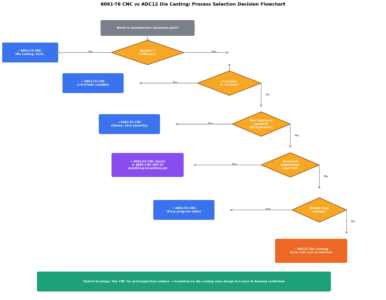
Utiliser une stratégie de développement hybride
Une voie courante consiste à usiner les premiers prototypes à partir du 6061-T6., valider la fonction et l'assemblage, repenser la géométrie mature pour le moulage sous pression, puis usinez uniquement les caractéristiques critiques sur les pièces moulées de production. Les différences entre les matériaux prototypes et les processus doivent être documentées: un prototype 6061-T6 ne prouve pas la solidité de l'ADC12, porosité, aspect de la surface, comportement thermique, ou durabilité à long terme.
Comment JADE-CNC prend en charge la sélection de processus
JADE-CNC peut examiner un itinéraire d'usinage 6061-T6 par rapport à un concept de fonderie plus usinage avant qu'un projet ne s'engage dans l'outillage. L'examen se concentre sur l'accès aux fonctionnalités, zones de tolérance, temps d'usinage, refonte du casting, opérations secondaires, finition, inspection, quantité, et stabilité de conception.
- Prototypes 6061-T6 usinés et pièces en faible volume pour la validation de la conception
- Examen DFM pour les murs, poches, fils de discussion, rayons internes, la date, et accès aux outils
- Identification des éléments pouvant rester sous forme de fonderie et des éléments nécessitant un usinage
- Planification des montages et des usinages pour les références de fonderie critiques, alésages, visages, et des fils
- Revue de finition et de masquage pour l'anodisation, revêtement de conversion, peinture, ou revêtement en poudre
- Planification de l'inspection basée sur le risque fonctionnel et les dossiers de projet convenus
- Comparaison des coûts à l'aide du modèle CAO réel, quantités, finitions, et la portée de la qualité
Envoyer le modèle CAO, 2Dessin D, volume annuel, durée de vie du programme, exigence d'alliage, finition, et la portée de l'inspection à demander une revue de fabrication JADE-CNC.
Foire aux questions
Questions courantes sur la sélection des processus
À quel volume le moulage sous pression ADC12 devient-il moins cher que l'usinage CNC?
Il n'y a pas de quantité universelle. Calculer le seuil de rentabilité à partir d'une matrice spécifique au projet, qualification, usinage unitaire, fonderie, opération secondaire, finition, ferraille, entretien, fret, et changer les coûts.
L'ADC12 est-il aussi puissant que le 6061-T6?
L'ADC12 peut fournir une force utile, mais le 6061-T6 offre généralement une limite d'élasticité plus élevée et plus constante et une ductilité beaucoup plus grande. Utiliser des données de moulage certifiées ou testées pour la section et le processus réels.
L'ADC12 peut-il être anodisé?
Oui, mais une teneur élevée en silicium et en cuivre donne un aspect brillant, résultat décoratif uniforme plus difficile que sur 6061-T6. Approuver les échantillons représentatifs de la production et envisager le revêtement en poudre, peinture, ou revêtement de conversion lorsque la cohérence de l'apparence est critique.
Une conception CNC peut-elle passer directement au moulage sous pression?
Généralement pas sans examen. Brouillon, sens de séparation, filets, uniformité du mur, portes, éjecteurs, débordements, diapositives, et les références d'usinage doivent être conçues pour le processus de coulée.
Les pièces moulées sous pression peuvent-elles respecter des tolérances au niveau de la CNC?
Les fonctionnalités sélectionnées peuvent être usinées après la coulée. Exiger des tolérances étroites sur la majeure partie de la pièce peut supprimer l'avantage économique du moulage sous pression., il faut donc distinguer les exigences telles que moulées et usinées.
Quel processus est le meilleur pour une enceinte scellée?
Le stock dense de 6061-T6 comporte généralement moins de risques de porosité. ADC12 peut être utilisé lorsque le processus de coulée, profondeur d'usinage, test de fuite, acceptation de la porosité, et toute imprégnation sont correctement spécifiées et validées.
Les prototypes devraient-ils utiliser le 6061-T6 avant la production de l'ADC12?
Souvent oui pour la validation de la géométrie et des assemblages. Le plan de test doit tenir compte des différentes forces, ductilité, conductivité, porosité, et le comportement de finition de la pièce coulée éventuelle.
Conclusion
Choisissez l'usinage CNC 6061-T6 lorsque vous êtes flexible, précision, ductilité, conductivité, souche dense, ou l'anodisation décorative porte la décision. Choisissez le moulage sous pression ADC12 lorsqu'une demande stable et une géométrie favorable au moulage justifient l'outillage et lorsque le plan qualité peut gérer la porosité., usinage secondaire, et finition.
La décision la plus forte provient de deux plans de processus complets construits à partir du même modèle CAO et des mêmes critères d'acceptation.. Comparer les outillages, coût récurrent, modifications de conception, ferraille, post-usinage, finition, inspection, logistique, et programmez la durée de vie avant de sélectionner l'itinéraire.
Articles connexes sur le 6061-T6
- 6061-Guide complet d'usinage CNC en aluminium T6
- 6061-T6 contre aluminium 7075-T6: Force, Coût & Usinabilité
- 6061-Anodisation de l'aluminium T6: Espèces, Couleurs, Épaisseur & Règles de conception
- 6061-Paramètres d'usinage CNC T6: Vitesses, Flux, Outillage & Contrôle des processus
- 6061-T6 contre ADC12 Aluminium: Usinage CNC ou moulage sous pression?
- 6061-Directives DFM pour l'usinage CNC T6: Règles de conception & Liste de contrôle
- 6061-Propriétés de l'aluminium T6: Mécanique, Thermique & Données chimiques

Léo Liang, Fondateur Meilleur partenaire avec R&D
LEO, fondateur de JADE-CNC, qui apporte plus de deux décennies d'expertise dans l'industrie, Leo a commencé sa carrière en tant qu'apprenti et met en pratique ses compétences en traitement de surface et en usinage CNC..