



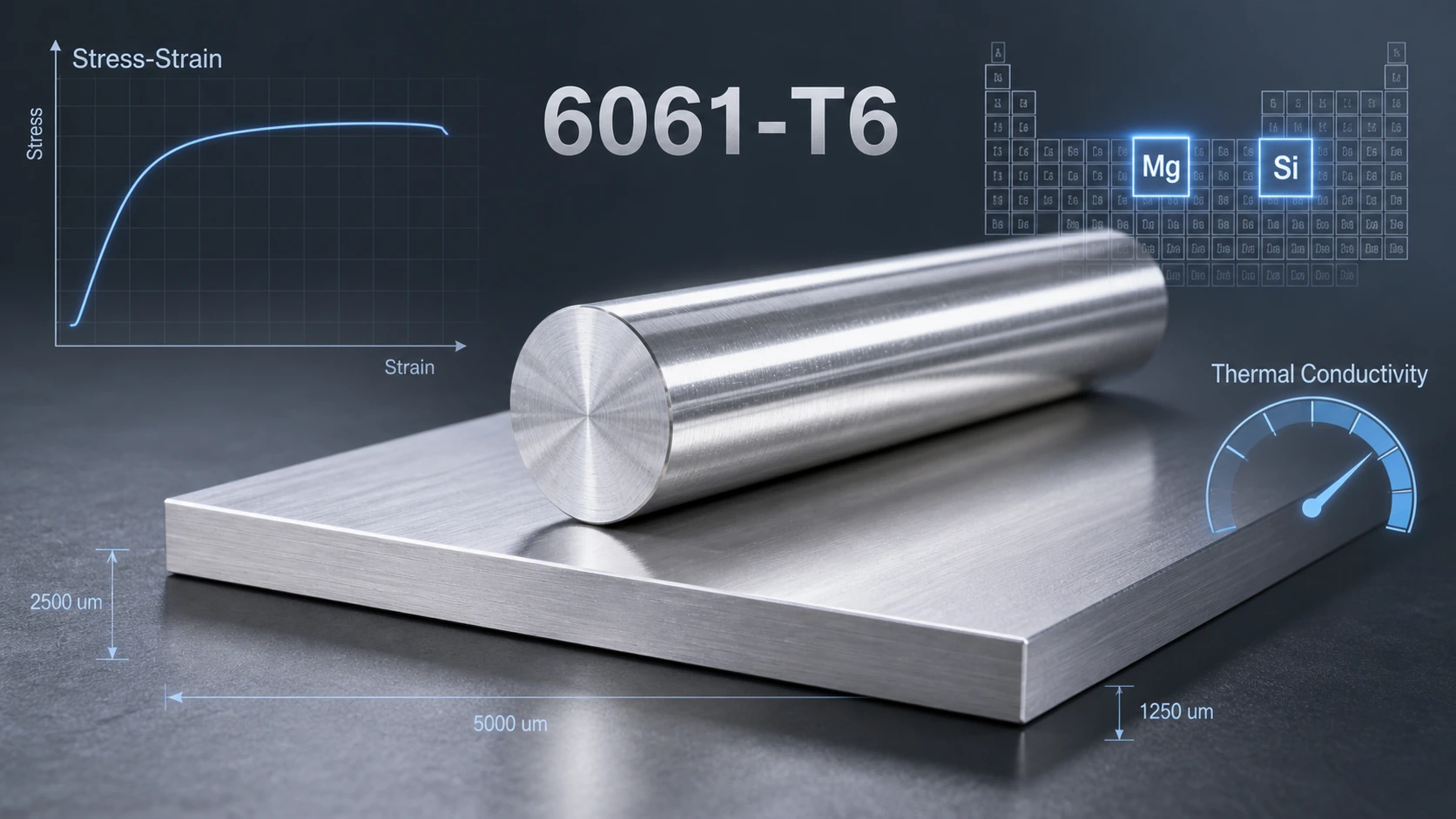
Eine technische Referenz für die Zusammensetzung 6061-T6, Zugeigenschaften, Steifheit, Dichte, Wärmeausdehnung, Leitfähigkeit, elektrisches Verhalten, Variation der Produktform, und Auswirkungen auf die CNC-Konstruktion.
Einführung
6061-T6 wird häufig für bearbeitete Aluminiumteile spezifiziert, da es ein nützliches Festigkeitsgleichgewicht bietet, Gewicht, Korrosionsbeständigkeit, Leitfähigkeit, Verfügbarkeit, abschließende Antwort, und Kosten. Diese Vorteile lassen sich leicht zusammenfassen, Die korrekte Verwendung der Legierung erfordert jedoch mehr als das Kopieren einer einzelnen Eigenschaftstabelle.
Die Eigenschaftswerte hängen von der Produktform ab, Dicke, Orientierung, Wärmebehandlung, Testmethode, und maßgebende Spezifikation. Zum Vergleich ist ein typischer Handbuchwert hilfreich, während für den Einkauf und die Abnahme ein Spezifikationsminimum verwendet wird. Ein zulässiger Entwurf kann nach der Temperatur wieder niedriger sein, Ermüdung, Umfeld, und Sicherheitsfaktoren werden berücksichtigt.
Für den vollständigen Zusammenhang zwischen Materialverhalten, Bearbeitung, Abschluss, kosten, und DFM, siehe die 6061-Vollständiger Leitfaden zur T6-Aluminium-CNC-Bearbeitung.
Was 6061-T6 bedeutet
Der 6061 Die Bezeichnung bezeichnet eine geknetete Aluminiumlegierung der 6xxx-Serie, deren Hauptverstärkungssystem auf Magnesium und Silizium basiert. Der T6-Temper bedeutet, dass das Produkt lösungsgeglüht und künstlich gealtert wurde. Dies bedeutet nicht, dass jedes 6061-T6-Produkt eine identische Festigkeit oder Beanspruchung aufweist.
Geben Sie immer sowohl Legierung als auch Härte an. Begriffe wie 6061-O, 6061-T4, 6061-T6, T651, und T6511 beschreiben wesentlich unterschiedliche Bedingungen. T651 und T6511 fügen dem wärmebehandelten Zustand Spannungsentlastungsvorgänge hinzu und werden oft gewählt, wenn es auf die Maßhaltigkeit während der Bearbeitung ankommt.
T6 vs. T651
T651 wird häufig mit Blechen in Verbindung gebracht, die nach der Lösungsglühbehandlung durch kontrolliertes Strecken entspannt wurden, dann künstlich gealtert. Es handelt sich per Definition nicht um eine stärkere Version des T6. Sein praktischer Vorteil ist die geringere Restspannungsbewegung bei Arbeiten, bei denen ein großer Teil des Materiales entfernt wird. Die genaue Bezeichnung und Anforderungen müssen sich an der jeweils gültigen Produktspezifikation orientieren.
6061 Chemische Zusammensetzung
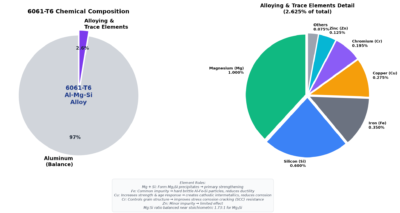
Die chemische Zusammensetzung ist an die Legierungsbezeichnung gebunden, nicht das T6-Temperament. Die unten aufgeführten Grenzwerte sind Zusammensetzungsbereiche und Höchstwerte, keine Zielrezepte. Eine Mühle kann konform produzieren 6061 an verschiedenen Punkten innerhalb dieser Grenzen.
Element | Zusammensetzung nach Gewicht | Metallurgische Rolle |
Silizium (Und) | 0.40-0.80% | Verbindet sich mit Magnesium im ausscheidungshärtenden System |
Eisen (Fe) | 0.70% maximal | Kontrollierte Verunreinigung; bildet intermetallische Partikel |
Kupfer (Cu) | 0.15-0.40% | Unterstützt Kraft und Alterungsreaktion; kann das Korrosionsverhalten beeinflussen |
Mangan (Mn) | 0.15% maximal | Kontrolle geringfügiger Zugaben und Verunreinigungen |
Magnesium (Mg) | 0.80-1.20% | Primärer Verstärkungszusatz mit Silizium |
Chrom (Cr) | 0.04-0.35% | Hilft bei der Kontrolle der Kornstruktur und Rekristallisation |
Zink (Zn) | 0.25% maximal | Begrenzte Restzugabe |
Titan (Von) | 0.15% maximal | Kann die Kornverfeinerung unterstützen |
Andere Elemente | 0.05% jede; 0.15% gesamt | Begrenzt nicht spezifizierte Restelemente |
Aluminium (Al) | Rest | Unedles Metall |
Zusammensetzungsgrenzen folgen den registrierten 6061 Bezeichnung. Bestätigen Sie die maßgebliche Revision und das Materialzertifikat für die Beschaffung.
Die Aluminium Association Internationale Legierungsbezeichnungen und Grenzwerte für die chemische Zusammensetzung sind die maßgebliche Referenz für registrierte Aluminium-Knetlegierungen. Produktspezifikationen können diese Grenzwerte reproduzieren und gleichzeitig mechanische Elemente hinzufügen, dimensional, Markierung, und Qualitätsanforderungen.
Wie Magnesium und Silizium stärken 6061
Durch die Lösungsglühbehandlung werden Verstärkungselemente in der Aluminiummatrix aufgelöst. Durch das Abschrecken bleibt der übersättigte Zustand erhalten, und durch künstliches Altern bilden sich feine Magnesiumsilizid-Ausscheidungen, die die Versetzungsbewegung behindern. Die Festigkeit hängt von der gesamten thermischen Vorgeschichte ab, Löschwirksamkeit, Abschnittsgröße, und Alterungszustand und nicht nur die Zusammensetzung allein.
Warum Zertifikate wichtig sind
Ein Zertifikat sollte die Legierung identifizieren, Temperament, Hitze oder viel, Produktform, geltenden Spezifikation, Chemie, und erforderliche mechanische Ergebnisse. Für kritische Projekte, Bestätigen Sie die Rückverfolgbarkeits- und Akzeptanzanforderungen, bevor der Bestand abgeschnitten wird. Die Identifizierung handgehaltener Legierungen kann die Eingangskontrolle unterstützen, Es dient jedoch nicht zur Prüfung der Härte und ersetzt nicht die erforderliche mechanische Prüfung.
Mechanische Eigenschaften von 6061-T6
Eigentum | Typischer Referenzbereich | Technischer Einsatz | Wichtige Qualifikation |
Ultimative Zugfestigkeit | Um 290-320 MPa | Maximale Belastung im Zugversuch | Die Mindestspezifikationen variieren je nach Produkt und Dicke |
0.2% Offset-Streckgrenze | Um 240-280 MPa | Beginn einer bleibenden Verformung | Nutzen Sie für die Abnahme die jeweils gültige Materialnorm |
Verlängerung | Oft etwa 8-17% | Duktilität und Verformungsfähigkeit | Hängt stark von der Messlänge ab, Orientierung, und Abschnitt |
Elastizitätsmodul | Um 68-70 GPa | Elastische Steifigkeit und Durchbiegung | Die Temperierung hat kaum Einfluss auf den Modul |
Schubmodul | Um 26 GPa | Torsion und Scherverformung | Verwendung mit den richtigen isotropen Materialannahmen |
Poissonzahl | Um 0.33 | Multiaxiale elastische Berechnungen | Typischer Wert statt einer Lot-Akzeptanzgrenze |
Brinellhärte | Oft etwa 90-100 HB | Ungefährer Härte- und Verschleißvergleich | Verfahren, laden, und Produktzustand beeinflussen das Ergebnis |
Dauerfestigkeit | Wird oft in der Nähe gemeldet 90-100 MPa bei einer angegebenen Zyklenzahl | Vorläufiges Screening der zyklischen Belastung | Aluminium hat keine echte Haltbarkeitsgrenze; Verwenden Sie eine Wöhlerkurve und Sicherheitsfaktoren |
Typische Raumtemperaturreferenzen. Produktspezifikationen und zertifizierte Testergebnisse steuern die Beschaffung; Entwurfszulässigkeiten steuern sicherheitskritische Berechnungen.
Stärke ist produktspezifisch
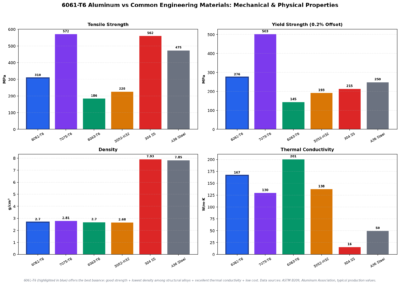
Die bekannten Werte von grob 310 MPa Höchstzugfestigkeit und 276 MPa-Streckgrenzen sind nützliche typische Referenzen, aber sie sind keine universellen Akzeptanzwerte. Platte, Blatt, extrudierte Stange, Rohr, Profil, und andere Produkte können hinsichtlich Dicke und Ausrichtung unterschiedliche Mindestwerte aufweisen. Verwenden Sie die Produktspezifikation und die aktuelle Version der Zeichnung, wenn die Festigkeit vertragsgemäß ist.
Steifigkeit unterscheidet sich von Festigkeit
Der Elastizitätsmodul steuert die Durchbiegung vor dem Nachgeben. Bei etwa 69 GPa, 6061-T6 ist etwa ein Drittel so steif wie herkömmliche Stähle. Durch den Wechsel von 6061-T6 zu 7075-T6 wird die Festigkeit erheblich erhöht, der Modul ändert sich jedoch nur geringfügig, Daher löst es selten ein Steifigkeitsproblem allein. Zunehmende Abschnittstiefe, Rippchen hinzufügen, Spannweiten verkürzen, oder die Wahl eines steiferen Materials ist normalerweise effektiver.
Für eine detaillierte Legierungsauswahl, sehen 6061-T6 vs. 7075-T6: Stärke, Kosten & Bearbeitbarkeit.
Ermüdung und Bruch
Aluminiumlegierungen weisen im Gegensatz zu manchen Stählen keine echte Haltbarkeitsgrenze auf. Eine angegebene Dauerfestigkeit ist nur mit ihrer Zyklenzahl aussagekräftig, Stressverhältnis, Probe, Oberflächenzustand, Umfeld, und statistische Grundlage. Bearbeitete Kanten, Threads, Korrosionsgruben, Eloxieren, Eigenspannung, und Stresskonzentration können alle die Ermüdungsleistung verändern. Verwenden Sie eine anwendungsspezifische Wöhlerkurve und eine geeignete Entwurfsmethode für zyklische Belastung.
Physikalische und thermische Eigenschaften
Eigentum | Typischer Referenzwert | Designimplikationen |
Dichte | Um 2.70 g/cm3 | Ungefähr ein Drittel der Dichte herkömmlicher Stähle |
Schmelzbereich | Um 582-652 du C | Eine Reihe, kein einziger Schmelzpunkt |
Spezifische Wärmekapazität | Um 0.90 J/g-K nahe Raumtemperatur | Beeinflusst die vorübergehende Erwärmung und Abkühlung |
Wärmeleitfähigkeit | Oft etwa 150-170 W/m-K | Nützlich für Gehäuse und wärmeableitende Strukturen |
Wärmeausdehnungskoeffizient | Um 23.6 um/m-K nahe Raumtemperatur | Dimensionsänderungen können aufgrund von Temperaturänderungen enge Toleranzen überschreiten |
Wärmeleitfähigkeit | Um 65-70 mm2/s | Beeinflusst, wie schnell sich Temperaturgradienten ausgleichen |
Wärmeleitfähigkeit
6061-T6 leitet Wärme im Vergleich zu Stählen und vielen technischen Kunststoffen gut. Dies unterstützt Gehäuse, Vorrichtungen, kalte Teller, und bearbeitete wärmeverteilende Komponenten. Die Systemleistung hängt immer noch von der Geometrie ab, feine Gegend, Luftstrom, Kontaktflachheit, Schnittstellenmaterialien, Oberflächenzustand, und Montagedruck. Die Leitfähigkeit allein bestimmt nicht die Leistung eines Kühlkörpers.
Wärmeausdehnung
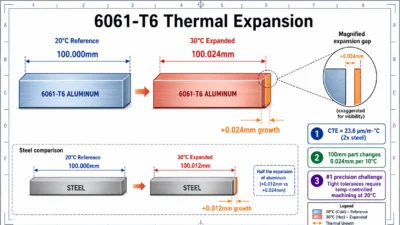
Unter Verwendung eines repräsentativen Koeffizienten von 23.6 a/m-K, A 100 Das mm-Maß ändert sich um ca 0.0236 mm für a 10 Grad C Temperaturänderung. Diese Bewegung ist bereits größer als viele enge Bearbeitungstoleranzen. In den Zeichnungen sollte gegebenenfalls die Referenztemperatur angegeben werden, und Teile und Messgeräte sollten sich vor der Endkontrolle stabilisieren.
Auch Baugruppen aus unähnlichen Materialien verdienen Beachtung. Aluminium dehnt sich etwa doppelt so stark aus wie viele Stähle, Daher können Temperaturänderungen die Vorspannung verändern, Lagerpassung, Dichtungskompression, Ausrichtung, und Grenzflächenstress. Analysieren Sie den gesamten Temperaturbereich, anstatt nur die Raumtemperaturmaße zu überprüfen.
Erhöhte und niedrige Temperaturen
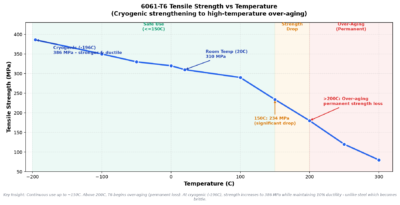
6061-Die T6-Stärke nimmt mit zunehmender Temperatur und Einwirkzeit ab, und längere Hitze kann die ausscheidungsgehärtete Struktur überbeanspruchen. Es gibt keine universelle Dauergebrauchstemperatur, die für jede Belastung und Lebensdauer geeignet ist. Verwenden Sie für die Auslegung bei erhöhten Temperaturen temperaturabhängige zulässige Werte von einer zugelassenen Quelle. Bei niedrigen Temperaturen, Viele Aluminiumlegierungen behalten ihre gute Zähigkeit, Für den kryogenen Betrieb gelten jedoch immer noch die geltenden Material- und Behälteranforderungen.
Elektrische Eigenschaften
Eigentum | Typischer Referenzbereich | Technische Implikationen |
Elektrische Leitfähigkeit | Um 40-47% IACS | Für viele Gehäuse ausreichend, Chassis, und Erdungsstrukturen |
Elektrischer Widerstand | Um 3.7-4.3 Mikro-Ohm-cm | Höherer Widerstand als Aluminium oder Kupfer in Elektroqualität |
Temperaturkoeffizient | Um 0.004 pro dich C | Der Widerstand steigt mit steigender Temperatur |
Eloxierte Oberfläche | Elektrisch isolierend | Maskieren oder entfernen Sie die Beschichtung dort, wo ein leitender Kontakt erforderlich ist |
6061-T6 ist für viele Chassis leitfähig genug, HF-Gehäuse, Erdungsstrukturen, und thermisch-elektrische Baugruppen, Es handelt sich jedoch nicht um eine elektrische Leiterlegierung. Der Kontaktwiderstand hängt vom Oxid ab, beenden, Druck, Sauberkeit, Befestigungsdesign, und Zeit im Dienst.
Anodisches Oxid ist elektrisch isolierend. Erdungspads, Verbindungssitze, Thread-Schnittstellen, und EMI-Kontaktzonen müssen möglicherweise abgedeckt oder anderweitig bearbeitet werden. Der 6061-Eloxierungsführung aus T6-Aluminium erklärt die Schichtdicke, Maskierung, und leitfähige Schnittstellenplanung.
Korrosion und Oberflächenverhalten
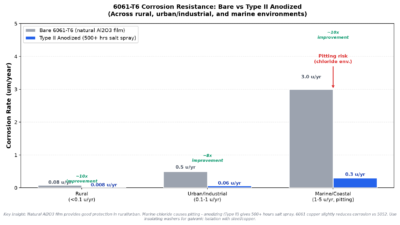
6061-T6 bildet einen dünnen natürlichen Oxidfilm und funktioniert im normalen atmosphärischen Betrieb im Allgemeinen gut. Chloride, Spalten, Feuchtigkeit zurückgehalten, alkalische Reinigungsmittel, unähnliche Metalle, und Kupfer- oder eisenreiche Partikel können das lokale Korrosionsrisiko erhöhen. Eine breite Bezeichnung wie „Marine“.’ reicht nicht aus, um die Lebensdauer vorherzusagen.
- Definieren Sie die tatsächliche chemische Belastung, Temperatur, Nass-Trocken-Zyklus, und Reinigungsmethode.
- Vermeiden Sie Wasserfallen und sorgen Sie nach Möglichkeit für Entwässerung und Belüftung.
- Aluminium elektrisch von Edelstahl isolieren, Kupfer, Messing, oder Kohlefaser im Nassbetrieb bei Bedarf.
- Wählen Sie Eloxieren, Konversionsbeschichtung, malen, Pulverbeschichtung, oder eine andere Ausführung je nach Umgebungs- und Schnittstellenanforderungen.
- Maskierung angeben, Zustand der Dichtung, Schichtdicke, Korrosionstest, und Akzeptanzkriterien anstelle eines Zielnamens allein.
Produktform und Spezifikation sind wichtig
Produktform | Häufiger Zustand | Betrachtung von Eigenschaften und Bearbeitung |
Platte | T6 oder entspanntes T651 | Die Dicke beeinflusst die garantierten Eigenschaften; T651 kann die Bewegung bei schwerer Bearbeitung reduzieren |
Blatt | T6, sofern verfügbar | Bei dünnen Abschnitten können unterschiedliche Biege- und Dehnungsanforderungen gelten |
Extrudiertes Profil | T6 oder T6511 | Die Eigenschaften hängen von der Profildicke ab, Extrusionsdesign, löschen, und dehnen |
Extrudierter Stab oder Rohr | T6 oder ähnliches stressfreies Temperament | Getreidefluss, Abmessungen, und Geradheit richten sich nach der Produktspezifikation |
Gewalzter oder kaltbearbeiteter Stab | Produktspezifisches Temperament | Gehen Sie nicht von denselben Anforderungen aus wie bei einer Extrusion oder Platte |
Schmieden | Wärmebehandelter Zustand | Eigenschaften und Kornfluss hängen vom Schmiedeweg und der Spezifikation ab |
ASTM B209/B209M-21a Deckt Bleche und Platten aus Aluminiumlegierung ab, während ASTM B221-21 deckt extrudierte Stäbe ab, Stangen, Draht, Profile, und Röhren. In der Bestellung ist die entsprechende Produktspezifikation anzugeben, Legierung, Temperament, Abmessungen, Inspektion, Zertifizierung, und etwaige ergänzende Anforderungen.
Ersetzen Sie die Platte nicht durch ein Profil, oder T6 für T651, basiert nur auf der Nennlegierung. Kornstruktur, Eigenspannung, Geradheit, Maßtoleranzen, garantierte mechanische Eigenschaften, und Oberflächenzustand können sich alle auf das fertige Teil auswirken.
6061-T6 im Vergleich zu anderen Materialien
Material | Hauptvorteil gegenüber 6061-T6 | Hauptkompromiss | Typischer Auswahlgrund |
7075-T6 | Viel höhere Festigkeit | Höhere Kosten und unterschiedliches Korrosions-/Veredelungsverhalten | Hochbelastete Leichtbaustrukturen |
6063-T6 | Oft bessere Extrusions- und Wärmeleistung | Geringere Stärke | Komplexe Profile und viele Kühlkörperprofile |
5052-H32 | Starke Blattbildungs- und Meereskorrosionsleistung | Nicht ausscheidungsgehärtet; geringere mechanische Festigkeit | Gebogene Blechgehäuse und Marineblecharbeiten |
ADC12 | Near-Net-Druckguss bei stabil hohem Volumen | Geringere Duktilität, mögliche Porosität, und weniger vorhersehbares Eloxieren | Integrierte Gussgehäuse und Abdeckungen |
304 Edelstahl | Höhere Steifigkeit und breite Korrosionsbeständigkeit | Viel schwerer, weniger leitfähig, und langsamer zu bearbeiten | Steif, dauerhaft, korrosionsbeständige Bauteile |
Kupfer | Wesentlich höhere thermische und elektrische Leitfähigkeit | Höhere Dichte, kosten, und Bearbeitungsaspekte | Hochleistungsfähige Wärme- und Strompfade |
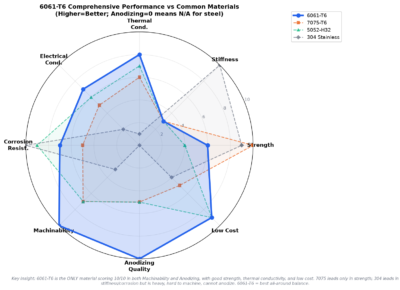
Die Materialauswahl sollte den Grenzanforderungen folgen. Höhere Stärke weist darauf hin 7075; eine aufwendige Extrusion kann begünstigen 6063; gebildete Meeresschicht kann begünstigen 5052; Eine stabile, hochvolumige Near-Net-Geometrie könnte ADC12 begünstigen; und Steifheit oder starke Korrosionseinwirkung können Stahl oder eine andere Legierung rechtfertigen. Der 6061-Vergleich zwischen T6 und ADC12 erläutert den Material- und Prozesskompromiss zwischen bearbeitetem Rohmaterial und Druckguss.
Was die Eigenschaften für die CNC-Bearbeitung bedeuten
Eigentum | Was es für das Teil bedeutet | Praktische Design- oder Fertigungsreaktion |
Geringe Dichte | Gutes Kraft-Gewicht-Potenzial | Nutzen Sie die Geometrie effizient, anstatt nur die Stärke zu vergleichen |
Elastizitätsmodul nahe 69 GPa | Größere Durchbiegung als Stahl bei gleicher Geometrie und Belastung | Abschnittstiefe erhöhen, Rippchen hinzufügen, Spannweiten verkürzen, oder Material wechseln |
Gute Bearbeitbarkeit | Hohe Abtragsraten sind möglich | Verwenden Sie scharfe Aluminiumwerkzeuge, ausreichende Spanlast, und zuverlässige Evakuierung |
Hohe Wärmeleitfähigkeit | Schneid- und Betriebswärme breiten sich schnell aus | Kontrollieren Sie die Massentemperatur, wenn die Abmessungen kritisch sind |
Hohe Wärmeausdehnung | Passungen und Abmessungen ändern sich mit der Temperatur | Definieren Sie die Referenztemperatur und bewerten Sie Baugruppen aus unterschiedlichen Materialien |
Gute Anodisierungsreaktion | Schützende und dekorative Oberflächen sind praktisch | Planen Sie das Beschichtungswachstum, Maskierung, Gestellspuren, und Endabmessungen |
Mäßige Härte | Der Werkzeugverschleiß ist in der Regel beherrschbar | Schützen Sie kosmetische Oberflächen vor Kratzern und Beschädigungen durch Handhabung |
Reststress | Ein großer Materialabtrag kann zu Verformungen führen | Betrachten Sie die T651-Platte, ausgewogenes Schruppen, Stabilisierung, und Fertigmaterial |
6061-T6 bearbeitet normalerweise sauber mit scharfen Werkzeugen und guter Spanabfuhr. Seine Wärmeleitfähigkeit hilft bei der Verteilung der Schneidwärme, während seine thermische Ausdehnung die Temperaturkontrolle für enge Abmessungen wichtig macht. Der relativ niedrige Modul macht dünne Wände außerdem anfällig für Werkzeugdruck und Spannverzug.
Benutzen Sie die 6061-Leitfaden zu T6-CNC-Bearbeitungsparametern für den Werkzeugbau, Geschwindigkeiten, füttert, Bohren, klopfen, Kühlung, und Validierung. Der 6061-T6-CNC-Bearbeitungs-DFM-Richtlinien Wandstärke der Abdeckung, Taschen, Radien, Löcher, Threads, Toleranzen, und Abschlusszulagen.
Wie JADE-CNC Materialdaten nutzt
JADE-CNC überprüft Materialdaten im Kontext der Zeichnung, anstatt eine Handbuchtabelle als vollständige Spezifikation zu behandeln. Die Überprüfung verbindet Legierung, Temperament, Lagerform, Bearbeitungsreihenfolge, Toleranz, beenden, Inspektion, Menge, und Servicebedingungen.
- Bestätigen Sie die gewünschte Legierung, Temperament, Produktform, und Zertifizierungsumfang
- Überprüfen Sie, ob T6, T651, oder eine andere Bedingung passt besser zur Geometrie und zum Zerspanungsplan
- Identifizieren Sie die Steifheit, Wärmeausdehnung, dünnwandig, und Eigenspannungsrisiken vor der Bearbeitung
- Koordinieren Sie die Eloxierung oder andere Veredelung mit den Abmessungen, Threads, Erdung, und kosmetische Gesichter
- Definieren Sie Prüfmethoden für kritische Abmessungen, Geometrie, Threads, und Oberflächenanforderungen
- Vergleichen Sie Materialalternativen hinsichtlich der Festigkeit, Leitfähigkeit, Korrosion, Volumen, oder die Kosten bestimmen die Entscheidung
Senden Sie das CAD-Modell, Zeichnung, Menge, Materialspezifikation, beenden, und Serviceanforderungen an Fordern Sie eine JADE-CNC-Material- und Bearbeitungsbewertung an.
Häufig gestellte Fragen
Häufige Fragen zu 6061-T6-Eigenschaften
Wie hoch ist die Zugfestigkeit von 6061-T6??
Eine typische Referenz ist ungefähr 290-320 MPa, Das garantierte Minimum hängt jedoch von der Produktform ab, Dicke, Orientierung, und Spezifikation. Verwenden Sie zur Abnahme das Materialzertifikat und die maßgebliche Norm.
Was ist die Streckgrenze von 6061-T6??
Typische Referenzen sind häufig vorhanden 240-280 MPa. Gehen Sie nicht für jede Platte von einem Wert aus, Blatt, Bar, Rohr, oder Extrusion; Verwenden Sie die entsprechende Produkttabelle und das zulässige Design.
Wie steif ist 6061-T6 im Vergleich zu Stahl??
Sein Elastizitätsmodul beträgt ca 69 GPa, etwa ein Drittel so viel wie herkömmliche Stähle. Bei gleicher Belastung und Geometrie, Ein Aluminiumteil biegt sich daher auch bei ausreichender Streckgrenze stärker durch.
Wie hoch ist die Wärmeleitfähigkeit von 6061-T6??
Ein üblicher Referenzbereich liegt bei ca 150-170 W/m-K nahe Raumtemperatur. Die tatsächlichen Werte variieren je nach Zustand und Temperatur, und die vollständige thermische Leistung hängt stark von der Geometrie und den Schnittstellen ab.
Wie stark dehnt sich 6061-T6 mit der Temperatur aus??
Mit ungefähr 23.6 a/m-K, A 100 Die mm-Abmessung ändert sich grob 0.0236 mm über 10 du C. Die Referenztemperatur ist wichtig für genaue Passungen und Inspektionen.
Leitet 6061-T6 Strom??
Ja, häufig in der Nähe 40-47% IACS. Natürliches Oxid und Eloxieren erhöhen den Kontaktwiderstand, Daher erfordern leitfähige Schnittstellen eine bewusste Verarbeitung und Kontaktgestaltung.
Ist 6061-T6 korrosionsbeständig?
Es funktioniert unter vielen atmosphärischen Bedingungen gut, kann jedoch in Chloridumgebungen Lochfraß bilden und bei Nässe galvanisch an edleren Materialien korrodieren. Umfeld, Detaillierung, Isolierung, und Finish bestimmen die Serviceleistung.
Was ist der Unterschied zwischen 6061-T6 und 6061-T651??
Beide sind lösungsgeglüht und künstlich gealtert. T651 beinhaltet auch Stressabbau durch Dehnung für entsprechende Produkte, Dies kann die Bewegung bei schwerer Bearbeitung reduzieren.
Abschluss
6061-T6 kombiniert mäßige Stärke, geringe Dichte, gute Bearbeitbarkeit, nützliche Leitfähigkeit, und ein allgemein günstiges Anodisierungsverhalten. Die größten Designeinschränkungen liegen in der geringeren Steifigkeit als bei Stahl, erhebliche thermische Ausdehnung, endliche Ermüdungslebensdauer, und Eigenschaftsunterschiede zwischen Produktformen und -spezifikationen.
Verwenden Sie typische Daten für einen frühen Vergleich, Spezifikationsgrenzen für die Beschaffung, Zertifizierte Ergebnisse zur Materialabnahme, und genehmigte zulässige Werte für kritisches Design. Diese Unterscheidung verhindert, dass eine praktische Handbuchnummer zu einem nicht unterstützten technischen Versprechen wird.
Verwandte 6061-T6-Artikel
- 6061-Vollständiger Leitfaden zur T6-Aluminium-CNC-Bearbeitung
- 6061-T6 vs. 7075-T6 Aluminium: Stärke, Kosten & Bearbeitbarkeit
- 6061-T6 Aluminium eloxiert: Typen, Farben, Dicke & Designregeln
- 6061-T6 CNC-Bearbeitungsparameter: Geschwindigkeiten, Feeds, Werkzeuge & Prozesskontrolle
- 6061-T6 vs. ADC12 Aluminium: CNC-Bearbeitung oder Druckguss?
- 6061-T6 CNC-Bearbeitungs-DFM-Richtlinien: Designregeln & Checkliste
- 6061-Eigenschaften von T6-Aluminium: Mechanisch, Thermal & Chemische Daten

Leo Liang, Gründer Bester Partner mit R&D
JADE-CNCs Gründer LEO, der über zwei Jahrzehnte Branchenexpertise mitbringt, Leo begann seine Karriere als Lehrling und erprobte seine Fähigkeiten in der Oberflächenbehandlung und CNC-Bearbeitung.