


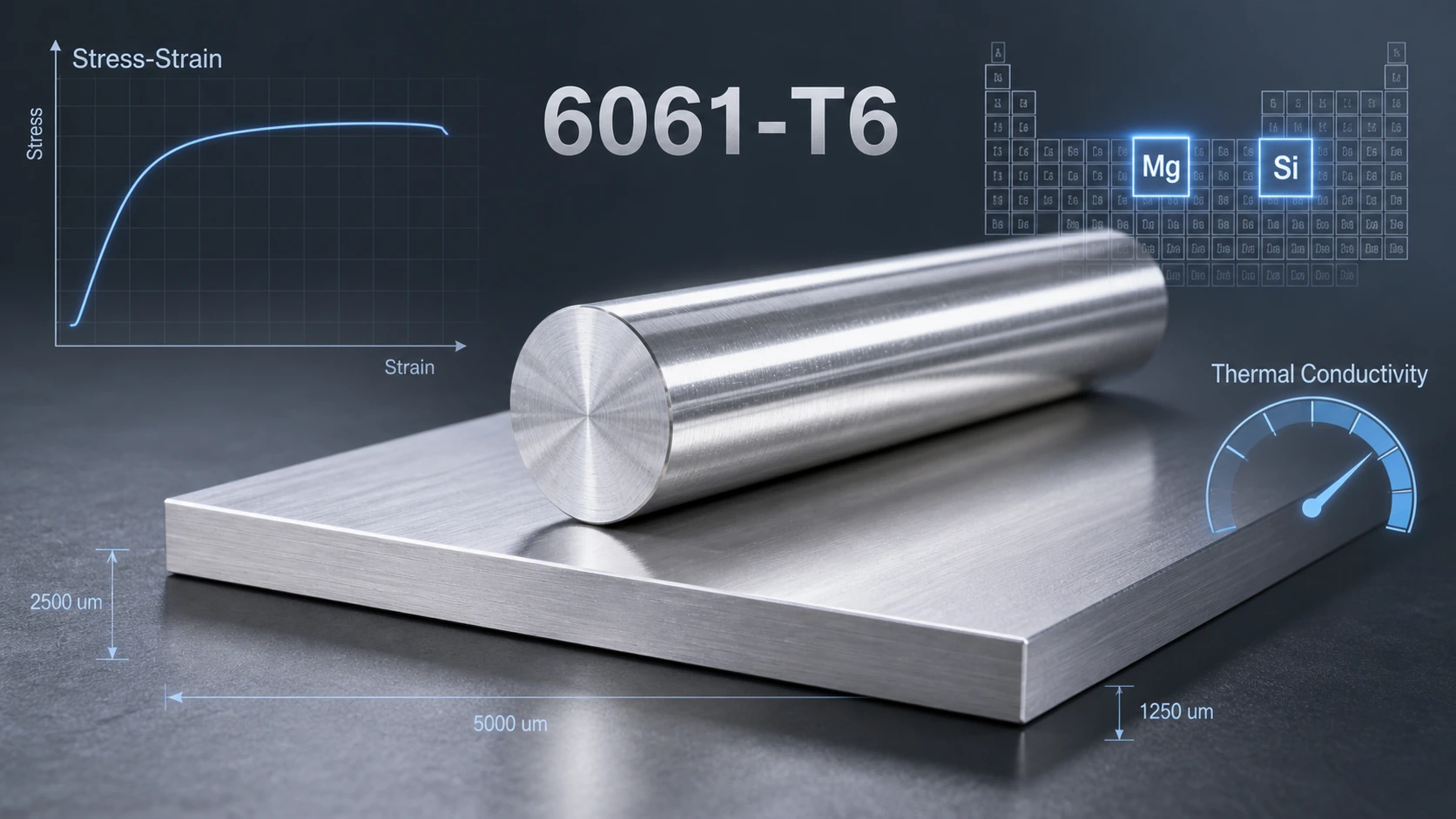
Una referencia de ingeniería para la composición del 6061-T6, propiedades de tracción, rigidez, densidad, expansión térmica, conductividad, comportamiento eléctrico, variación de la forma del producto, e implicaciones del diseño CNC.
Introducción
6061-T6 is widely specified for machined aluminum parts because it offers a useful balance of strength, peso, resistencia a la corrosión, conductividad, disponibilidad, finishing response, y costo. Those advantages are easy to summarize, but using the alloy correctly requires more than copying a single property table.
Property values depend on product form, espesor, orientation, tratamiento térmico, test method, and governing specification. A typical handbook value is useful for comparison, while a specification minimum is used for purchasing and acceptance. A design allowable may be lower again after temperature, fatigue, ambiente, and safety factors are considered.
For the complete connection between material behavior, mecanizado, refinamiento, costo, and DFM, see the 6061-Guía completa de mecanizado CNC de aluminio T6.
What 6061-T6 Means
El 6061 designation identifies a wrought 6xxx-series aluminum alloy whose main strengthening system is based on magnesium and silicon. The T6 temper means the product has been solution heat treated and artificially aged. It does not mean every 6061-T6 product has an identical strength or stress condition.
Always specify both alloy and temper. Terms such as 6061-O, 6061-T4, 6061-T6, T651, and T6511 describe materially different conditions. T651 and T6511 add stress-relief operations to the heat-treated condition and are often chosen when dimensional stability during machining matters.
T6 vs T651
T651 is commonly associated with plate that has been stress relieved by controlled stretching after solution heat treatment, then artificially aged. It is not a stronger version of T6 by definition. Its practical advantage is lower residual-stress movement during operations that remove a large fraction of the stock. The exact designation and requirements must follow the applicable product specification.
6061 Chemical Composition
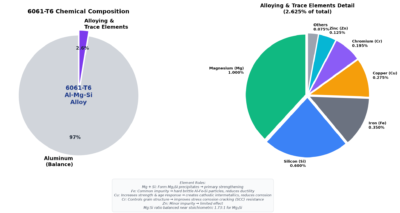
Chemical composition is tied to the alloy designation, not the T6 temper. The registered limits below are composition ranges and maximums, not target recipes. A mill may produce conforming 6061 at different points inside those limits.
Elemento | Composition by weight | Metallurgical role |
Silicio (Si) | 0.40-0.80% | Combines with magnesium in the precipitation-hardening system |
Hierro (Fe) | 0.70% maximum | Controlled impurity; forms intermetallic particles |
Cobre (Cu) | 0.15-0.40% | Supports strength and aging response; can influence corrosion behavior |
Manganese (Mn) | 0.15% maximum | Minor addition and impurity control |
Magnesio (Mg) | 0.80-1.20% | Primary strengthening addition with silicon |
Cromo (Cr) | 0.04-0.35% | Helps control grain structure and recrystallization |
Zinc (Zn) | 0.25% maximum | Limited residual addition |
Titanio (Ti) | 0.15% maximum | Can support grain refinement |
Other elements | 0.05% each; 0.15% total | Limits unspecified residual elements |
Aluminio (Alabama) | Remainder | Base metal |
Composition limits follow the registered 6061 designation. Confirm the governing revision and material certificate for procurement.
The Aluminum Association’s International Alloy Designations and Chemical Composition Limits are the controlling reference for registered wrought-aluminum compositions. Product specifications may reproduce these limits while adding mechanical, dimensional, marking, and quality requirements.
How Magnesium and Silicon Strengthen 6061
Solution heat treatment dissolves strengthening elements into the aluminum matrix. Quenching retains a supersaturated condition, and artificial aging forms fine magnesium-silicide precipitates that impede dislocation movement. Strength depends on the complete thermal history, quench effectiveness, section size, and aging condition rather than composition alone.
Why Certificates Matter
A certificate should identify the alloy, temperamento, heat or lot, forma del producto, applicable specification, chemistry, and required mechanical results. Para proyectos críticos, confirm traceability and acceptance requirements before stock is cut. Handheld alloy identification can support incoming control, but it does not verify temper or replace required mechanical testing.
Mechanical Properties of 6061-T6
Propiedad | Typical reference range | Engineering use | Important qualification |
Resistencia máxima a la tracción | Acerca de 290-320 MPa | Maximum stress in a tensile test | Specification minimums vary by product and thickness |
0.2% offset yield strength | Acerca de 240-280 MPa | Onset of permanent deformation | Use the applicable material standard for acceptance |
Elongation | Often about 8-17% | Ductility and deformation capacity | Depends strongly on gauge length, orientation, and section |
módulo elástico | Acerca de 68-70 GPa | Elastic stiffness and deflection | Temper has little effect on modulus |
Shear modulus | Acerca de 26 GPa | Torsion and shear deformation | Use with the correct isotropic-material assumptions |
Poisson’s ratio | Acerca de 0.33 | Multiaxial elastic calculations | Typical value rather than a lot acceptance limit |
Dureza Brinell | Often about 90-100 media pensión | Approximate hardness and wear comparison | Method, load, and product condition affect the result |
Fuerza de fatiga | Often reported near 90-100 MPa at a stated cycle count | Preliminary cyclic-load screening | Aluminum has no true endurance limit; use an S-N curve and safety factors |
Typical room-temperature references. Product specifications and certified test results control procurement; design allowables control safety-critical calculations.
Strength Is Product-Specific
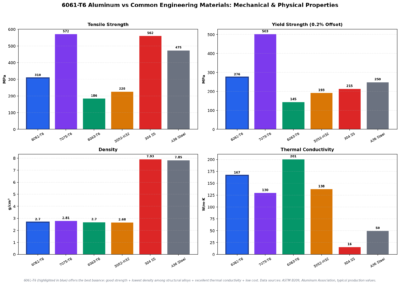
The familiar values of roughly 310 MPa ultimate tensile strength and 276 MPa yield strength are useful typical references, but they are not universal acceptance values. Plate, sheet, extruded bar, tube, profile, and other products can have different minimums by thickness and orientation. Use the drawing’s product specification and current revision when strength is contractual.
Stiffness Is Different from Strength
Elastic modulus controls deflection before yielding. At about 69 GPa, 6061-T6 is roughly one-third as stiff as common steels. Changing from 6061-T6 to 7075-T6 raises strength substantially but changes modulus only slightly, so it rarely solves a stiffness problem by itself. Profundidad de sección creciente, agregando costillas, shortening spans, or selecting a stiffer material is usually more effective.
For a detailed alloy choice, see 6061-T6 vs 7075-T6: Fortaleza, Costo & maquinabilidad.
Fatigue and Fracture
Aluminum alloys do not show a true endurance limit in the same way some steels do. A quoted fatigue strength is meaningful only with its cycle count, stress ratio, specimen, condición de la superficie, ambiente, and statistical basis. Machined edges, trapos, corrosion pits, anodizado, residual stress, and stress concentration can all change fatigue performance. Use an application-specific S-N curve and an appropriate design method for cyclic loading.
Physical and Thermal Properties
Propiedad | Typical reference value | Implicación del diseño |
Densidad | Acerca de 2.70 g/cm3 | Approximately one-third the density of common steels |
Melting range | Acerca de 582-652 deg C | A range, not a single melting point |
Specific heat capacity | Acerca de 0.90 J/g-K near room temperature | Affects transient heating and cooling |
Conductividad térmica | Often about 150-170 W/m-K | Useful for housings and heat-spreading structures |
Coefficient of thermal expansion | Acerca de 23.6 um/m-K near room temperature | Dimensional change can exceed close tolerances as temperature changes |
Thermal diffusivity | Acerca de 65-70 mm2/s | Influences how quickly temperature gradients equalize |
Conductividad térmica
6061-T6 conducts heat well compared with steels and many engineering plastics. This supports housings, accesorios, cold plates, and machined heat-spreading components. System performance still depends on geometry, fin area, flujo de aire, contact flatness, interface materials, condición de la superficie, and assembly pressure. Conductivity alone does not determine heat-sink performance.
Thermal Expansion
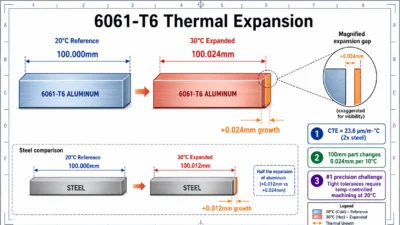
Using a representative coefficient of 23.6 um/m-K, a 100 mm dimension changes by about 0.0236 mm for a 10 deg C temperature change. That movement is already larger than many close machining tolerances. Drawings should define the reference temperature where necessary, and parts and gauges should stabilize before final inspection.
Dissimilar-material assemblies also deserve attention. Aluminum expands about twice as much as many steels, so temperature changes can alter preload, bearing fit, seal compression, alineación, and interface stress. Analyze the full temperature range instead of checking room-temperature dimensions only.
Elevated and Low Temperatures
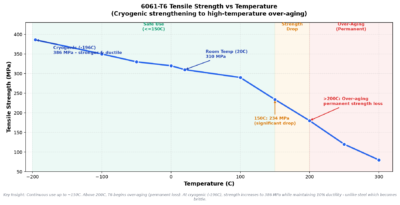
6061-T6 strength decreases as temperature and exposure time increase, and prolonged heat can overage the precipitation-hardened structure. There is no universal continuous-use temperature that suits every load and lifetime. Use temperature-dependent allowables from an approved source for elevated-temperature design. At low temperatures, many aluminum alloys retain useful toughness, but cryogenic service still requires the governing material and vessel requirements.
Electrical Properties
Propiedad | Typical reference range | Engineering implication |
Electrical conductivity | Acerca de 40-47% IACS | Adequate for many enclosures, chasis, and grounding structures |
Electrical resistivity | Acerca de 3.7-4.3 micro-ohm-cm | Higher resistance than electrical-grade aluminum or copper |
Temperature coefficient | Acerca de 0.004 per deg C | Resistance rises as temperature increases |
Anodized surface | Electrically insulating | Mask or remove coating where conductive contact is required |
6061-T6 is conductive enough for many chassis, RF housings, grounding structures, and thermal-electrical assemblies, but it is not an electrical-grade conductor alloy. Contact resistance depends on oxide, finalizar, presión, cleanliness, fastener design, and time in service.
Anodic oxide is electrically insulating. Grounding pads, connector seats, threaded interfaces, and EMI contact zones may need masking or another finish. El 6061-T6 aluminum anodizing guide explains coating thickness, enmascaramiento, and conductive-interface planning.
Corrosion and Surface Behavior
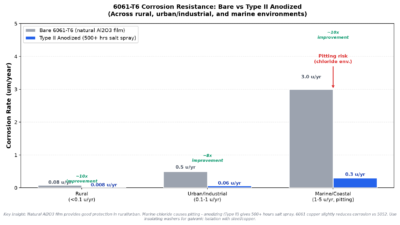
6061-T6 forms a thin natural oxide film and generally performs well in ordinary atmospheric service. Chlorides, crevices, retained moisture, alkaline cleaners, dissimilar metals, and copper- or iron-rich particles can increase localized corrosion risk. A broad label such as ‘marine’ is not enough to predict service life.
- Define the actual chemical exposure, temperatura, wet-dry cycle, and cleaning method.
- Avoid water traps and provide drainage and ventilation where possible.
- Electrically isolate aluminum from stainless steel, cobre, latón, or carbon fiber in wet service when needed.
- Select anodizing, conversion coating, paint, recubrimiento en polvo, or another finish from the environment and interface requirements.
- Specify masking, seal condition, espesor del recubrimiento, corrosion test, and acceptance criteria instead of a finish name alone.
Product Form and Specification Matter
Product form | Common condition | Property and machining consideration |
Plate | T6 or stress-relieved T651 | Thickness affects guaranteed properties; T651 can reduce movement during heavy machining |
Sheet | T6 where available | Thin sections may have different bend and elongation requirements |
Extruded profile | T6 or T6511 | Properties depend on profile thickness, extrusion design, quench, and stretch |
Extruded bar or tube | T6 or related stress-relieved temper | Grain flow, dimensions, and straightness follow the product specification |
Rolled or cold-finished bar | Product-specific temper | Do not assume the same requirements as an extrusion or plate |
Forging | Heat-treated condition | Properties and grain flow depend on forging route and specification |
ASTM B209/B209M-21a covers aluminum-alloy sheet and plate, while ASTM B221-21 covers extruded bars, rods, wire, profiles, and tubes. The purchase order should name the relevant product specification, alloy, temperamento, dimensions, inspección, proceso de dar un título, and any supplementary requirements.
Do not substitute an extrusion for plate, or T6 for T651, based only on nominal alloy. Grain structure, residual stress, straightness, dimensional tolerances, guaranteed mechanical properties, and surface condition can all affect the finished part.
6061-T6 Compared with Other Materials
Material | Main advantage over 6061-T6 | Main trade-off | Typical selection reason |
7075-T6 | Much higher strength | Higher cost and different corrosion/finishing behavior | Highly loaded lightweight structures |
6063-T6 | Often better extrusion and thermal performance | Lower strength | Complex profiles and many heat-sink extrusions |
5052-H32 | Strong sheet-forming and marine-corrosion performance | Not precipitation hardened; lower machined structural strength | Bent sheet enclosures and marine sheet work |
ADC12 | Near-net die casting at stable high volume | Lower ductility, possible porosity, and less predictable anodizing | Integrated cast housings and covers |
304 acero inoxidable | Higher stiffness and broad corrosion resistance | Much heavier, less conductive, and slower to machine | Stiff, durable, corrosion-resistant components |
Cobre | Much higher thermal and electrical conductivity | Higher density, costo, and machining considerations | High-performance heat and current paths |
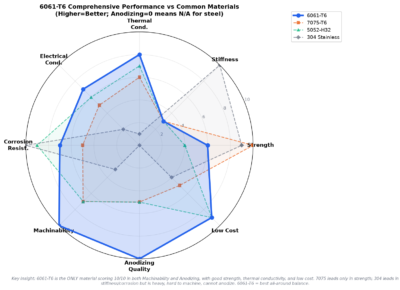
Material choice should follow the limiting requirement. Higher strength points toward 7075; a complex extrusion may favor 6063; formed marine sheet may favor 5052; stable high-volume near-net geometry may favor ADC12; and stiffness or harsh corrosion exposure may justify steel or another alloy. El 6061-T6 vs ADC12 comparison explains the material and process trade-off between wrought machining stock and die casting.
What the Properties Mean for CNC Machining
Propiedad | What it means for the part | Practical design or manufacturing response |
Low density | Good strength-to-weight potential | Use geometry efficiently instead of comparing strength alone |
Elastic modulus near 69 GPa | More deflection than steel at equal geometry and load | Increase section depth, add ribs, shorten spans, or change material |
Good machinability | High removal rates are possible | Use sharp aluminum tools, adequate chip load, and reliable evacuation |
High thermal conductivity | Cutting and service heat spread quickly | Control bulk temperature when dimensions are critical |
High thermal expansion | Fits and dimensions move with temperature | Define reference temperature and evaluate dissimilar-material assemblies |
Good anodizing response | Protective and decorative finishes are practical | Plan coating growth, enmascaramiento, rack marks, and final dimensions |
Moderate hardness | Tool wear is usually manageable | Protect cosmetic surfaces from scratches and handling damage |
Residual stress | Large stock removal can release distortion | Consider T651 plate, balanced roughing, stabilization, and finish stock |
6061-T6 usually machines cleanly with sharp tools and good chip evacuation. Its thermal conductivity helps distribute cutting heat, while its thermal expansion makes temperature control important for close dimensions. The relatively low modulus also makes thin walls susceptible to tool pressure and clamping distortion.
Use the 6061-T6 CNC machining parameters guide for tooling, speeds, feeds, perforación, tocando, cooling, and validation. El 6061-T6 CNC machining DFM guidelines cover wall thickness, bolsillos, radii, agujeros, trapos, tolerancias, and finishing allowances.
How JADE-CNC Uses Material Data
JADE-CNC reviews material data in the context of the drawing rather than treating a handbook table as a complete specification. The review connects alloy, temperamento, formulario de acciones, secuencia de mecanizado, tolerancia, finalizar, inspección, cantidad, and service conditions.
- Confirm the requested alloy, temperamento, forma del producto, and certification scope
- Review whether T6, T651, or another condition better fits the geometry and stock-removal plan
- Identify stiffness, expansión térmica, thin-wall, and residual-stress risks before machining
- Coordinate anodizing or other finishing with dimensions, trapos, toma de tierra, y caras cosméticas
- Define inspection methods for critical dimensions, geometría, trapos, and surface requirements
- Compare material alternatives when strength, conductividad, corrosión, volume, or cost drives the decision
Send the CAD model, drawing, cantidad, especificación de materiales, finalizar, and service requirements to request a JADE-CNC material and machining review.
Preguntas frecuentes
Common 6061-T6 Property Questions
What is the tensile strength of 6061-T6?
A typical reference is roughly 290-320 MPa, but the guaranteed minimum depends on product form, espesor, orientation, and specification. Use the material certificate and governing standard for acceptance.
What is the yield strength of 6061-T6?
Typical references are often around 240-280 MPa. Do not assume one value for every plate, sheet, bar, tube, or extrusion; use the applicable product table and design allowable.
How stiff is 6061-T6 compared with steel?
Its elastic modulus is about 69 GPa, roughly one-third that of common steels. At the same load and geometry, an aluminum part therefore deflects more even when its yield strength is adequate.
What is the thermal conductivity of 6061-T6?
A common reference range is about 150-170 W/m-K near room temperature. Actual values vary with condition and temperature, and complete thermal performance depends heavily on geometry and interfaces.
How much does 6061-T6 expand with temperature?
Using about 23.6 um/m-K, a 100 mm dimension changes roughly 0.0236 mm over 10 deg C. The reference temperature matters for close fits and inspection.
Does 6061-T6 conduct electricity?
Sí, commonly around 40-47% IACS. Natural oxide and anodizing increase contact resistance, so conductive interfaces need deliberate finish and contact design.
Is 6061-T6 corrosion resistant?
It performs well in many atmospheric conditions but can pit in chloride environments and corrode galvanically against more noble materials when wet. Ambiente, detailing, isolation, and finish determine service performance.
What is the difference between 6061-T6 and 6061-T651?
Both are solution heat treated and artificially aged. T651 also includes stress relief by stretching for applicable products, which can reduce movement during heavy machining.
Conclusión
6061-T6 combines moderate strength, low density, good machinability, useful conductivity, and a generally favorable anodizing response. Its main design limitations are lower stiffness than steel, substantial thermal expansion, finite fatigue life, and property variation across product forms and specifications.
Use typical data for early comparison, specification limits for procurement, certified results for material acceptance, and approved allowables for critical design. That distinction prevents a convenient handbook number from becoming an unsupported engineering promise.
Artículos relacionados con 6061-T6
- 6061-Guía completa de mecanizado CNC de aluminio T6
- 6061-Aluminio T6 frente a 7075-T6: Fortaleza, Costo & maquinabilidad
- 6061-Anodizado de aluminio T6: Tipos, Bandera, Espesor & Reglas de diseño
- 6061-Parámetros de mecanizado CNC T6: Velocidades, Feeds, Estampación & Process Control
- 6061-Aluminio T6 frente a ADC12: Mecanizado CNC o fundición a presión?
- 6061-Directrices DFM de mecanizado CNC T6: Reglas de diseño & Lista de verificación

Leo Liang, Founder Best Partner with R&D
LEO, fundador de JADE-CNC, que aporta más de dos décadas de experiencia en la industria, Leo comenzó su carrera como aprendiz y practica sus habilidades en tratamiento de superficies y mecanizado CNC..