


Some buyers have experienced a confusing problem: the precision parts they received looked perfect, but they could not be assembled.
The surface was clean. The edges looked sharp. The machining marks seemed normal. But when the parts reached the assembly line, holes did not align, mating faces did not fit, or the final product could not be installed correctly.
At that point, the factory may say, “There is no problem with the machining.” In some cases, that may be partly true. The issue may not come from the cutting tool or CNC program itself. The real problem may come from workholding and positioning.
In CNC machining, how the material is clamped, supported, and located can directly affect dimensional accuracy. A small clamping error may not be obvious from the outside, but it can cause serious assembly problems later.
Today, we will explain three common CNC workholding methods used in precision machining: machine vise, vacuum workholding, and custom fixture.
Workholding Is Not Just “Holding the Part”
Many people think workholding simply means fixing the raw material on the CNC machine. In reality, workholding is part of the machining strategy.
A good workholding method must do three things at the same time:
- Hold the workpiece firmly during cutting
- Position the part accurately according to the machining datum
- Avoid deformation, vibration, or clamp marks
If one of these conditions is not controlled, the final part may look acceptable but fail in function.
For example, if a part shifts slightly during machining, hole positions may change. If the workpiece is clamped too tightly, it may deform during cutting and spring back after release. If the second setup is not aligned with the first setup, features from different sides may not match.
This is why workholding is closely connected to assembly quality.
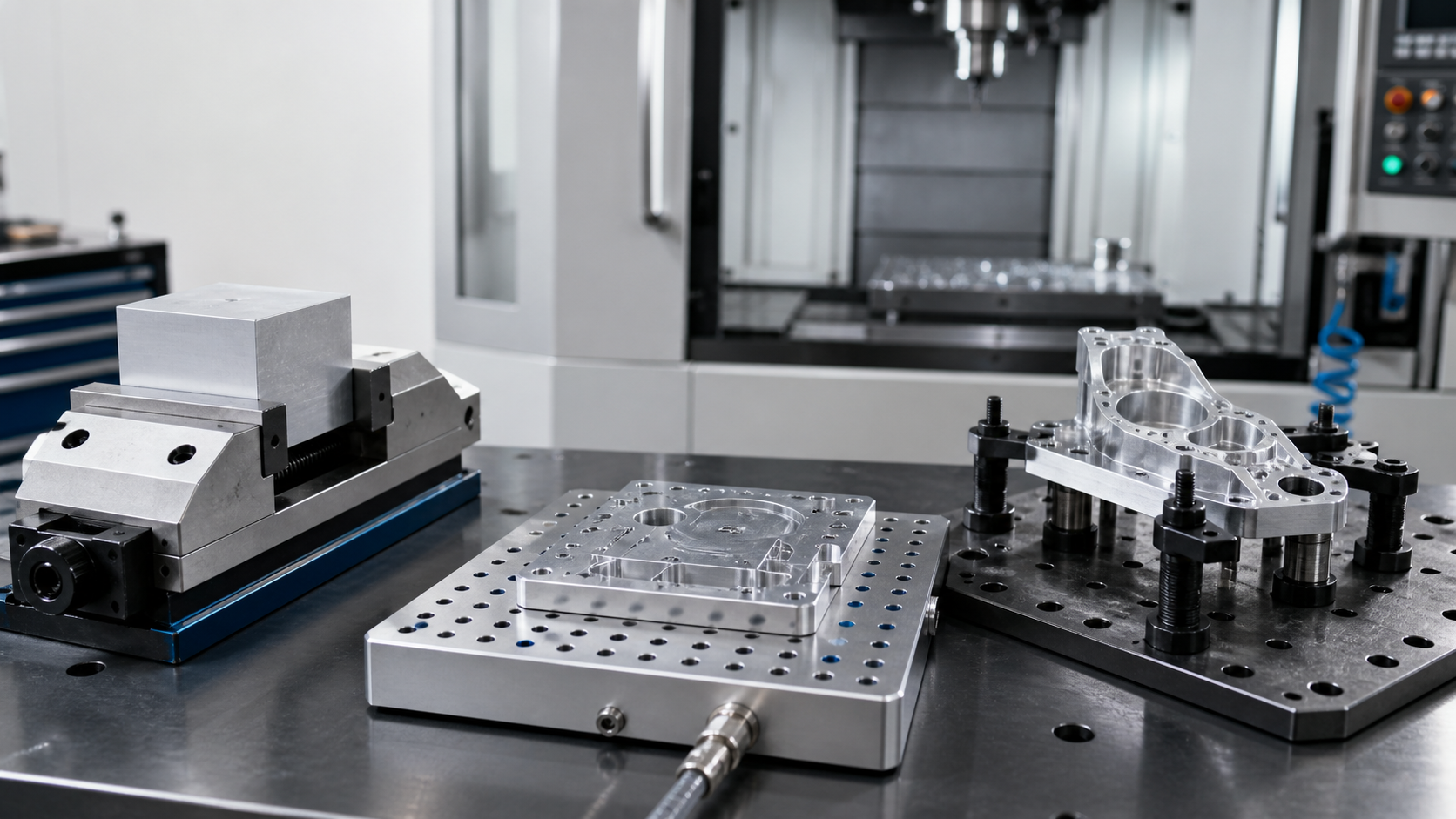
Machine Vise: The Most Common CNC Clamping Method
A CNC machine vise is one of the most widely used workholding methods in milling.
It is simple, stable, and efficient. For regular-shaped parts such as blocks, plates, brackets, and housings, a vise can provide reliable clamping force and fast setup.
In prototype machining and small-batch production, the machine vise is often the first choice because it is flexible. The machinist can quickly adjust the position, clamp different materials, and complete multiple machining operations without designing a special fixture.
However, a vise is not automatically safe for every part. The clamping surface, jaw pressure, part shape, and machining direction must all be considered.
If the part is thin, soft, long, or has weak structures, improper vise clamping may create hidden deformation.
Excessive Clamping Force Can Cause Deformation
One common mistake in CNC machining is believing that stronger clamping always means better stability.
In fact, excessive clamping force can deform the workpiece.
This problem is especially common with:
- Thin aluminum plates
- Plastic parts
- Long and narrow components
- Thin-wall housings
- Precision parts with tight flatness requirements
During machining, the part may be forced into a slightly deformed shape by the vise. The CNC machine then cuts the part while it is under stress. After machining is complete and the vise is released, the material may spring back.
The result is a part that looked correct during machining but changed shape after removal.
This can affect flatness, parallelism, hole position, and assembly fit. From the buyer’s perspective, the part may look beautifully machined, but it cannot be installed correctly.
Good CNC machining requires enough clamping force to prevent movement, but not so much force that the part is distorted.
Vacuum Workholding: A Better Option for Flat and Thin Parts
When you see a fixture plate with many holes, grooves, or a grid pattern, it is often a vacuum workholding system.
Vacuum workholding uses negative pressure to hold the workpiece against the fixture surface. Instead of applying strong mechanical force at several clamp points, vacuum pressure spreads the holding force across a larger surface area.
This method is commonly used for flat and thin workpieces.
For example:
- Thin aluminum plates
- Plastic sheets
- Flat panels
- Electronic covers
- Composite boards
- Precision flat components
The main advantage of vacuum workholding is that it reduces local clamping pressure. This helps prevent dents, bending, and clamp marks.
For parts where flatness and surface appearance are important, vacuum workholding can provide more uniform support than traditional clamps.
Vacuum Workholding Has Limits Too
Vacuum workholding is useful, but it is not suitable for every part.
It works best when the workpiece has enough contact area with the fixture. If the part is very small, very narrow, porous, uneven, or has many through-holes, the vacuum force may not be strong enough.
Another limitation is cutting force. Heavy rough machining may create side forces that exceed the holding power of the vacuum system. In that case, additional positioning blocks, side stops, or auxiliary clamps may be needed.
So vacuum workholding is not simply a “better” method than a vise. It is better for certain types of parts.
The correct choice depends on part geometry, material, cutting load, tolerance, and surface requirements.
Custom Fixtures Are Used for Special Workpieces
For special workpieces, standard clamping methods may not be enough.
Some parts have irregular shapes, curved surfaces, multiple angles, thin walls, or complex machining requirements. These parts may need a custom fixture designed specifically for their geometry.
A custom fixture can help:
- Match the shape of the workpiece
- Support weak or thin areas
- Locate the part accurately
- Reduce repeated setup errors
- Protect cosmetic surfaces
- Improve consistency in batch production
In JADE-CNC, custom fixtures are often used when the part requires stable positioning across multiple machining operations.
For example, if a part must be machined on several sides, the fixture can help the operator locate the part in the same position every time. This improves repeatability and reduces the risk of assembly mismatch.
Positioning Is Just as Important as Clamping
Clamping keeps the part from moving. Positioning tells the machine where the part is.
Both are important.
A workpiece may be clamped tightly but positioned incorrectly. In that case, the machining process may still run smoothly, but the final dimensions may be wrong.
In CNC machining, positioning is usually controlled by datums, locating pins, fixture edges, soft jaws, stop blocks, or machined reference surfaces.
For parts that require multiple setups, positioning becomes even more critical. If the second setup does not accurately match the first setup, hole locations, pockets, threads, or mating surfaces may shift.
This is one of the main reasons parts fail assembly even when each individual feature looks well-machined.
Precision machining is not only about making each surface clean. It is about controlling the relationship between all important features.
Machining Allowance Helps Create Accurate Final Edges
In the video, JADE-CNC mentions leaving enough machining allowance on the raw material. This is a very practical detail.
Machining allowance means extra material is reserved before final machining. This gives the machinist enough space to remove rough edges, correct raw material variation, and create accurate final dimensions.
If the raw material is cut too close to the final size, there may not be enough room to clean up the edges. Saw-cut errors, material deformation, or uneven stock surfaces may affect the finished part.
Proper allowance helps improve:
- Edge accuracy
- Surface consistency
- Dimensional control
- Final appearance
- Batch repeatability
For precision parts, machining allowance is not waste. It is part of quality control.
The Right Workholding Method Depends on the Part
There is no single best workholding method for all CNC parts.
A machine vise may be best for regular blocks and small batches. Vacuum workholding may be better for thin flat plates. A custom fixture may be necessary for complex or repeat-production parts.
The decision should be based on:
- Part shape
- Material type
- Wall thickness
- Required tolerance
- Cutting force
- Cosmetic surface requirements
- Number of machining setups
- Production quantity
- Assembly function
For buyers, this means the supplier should not only look at the drawing and quote the price. A reliable CNC machining supplier should also evaluate how the part will be held, located, machined, inspected, and assembled.
Good Workholding Reduces Assembly Risk
Many assembly problems begin before the part reaches the assembly line.
If the workholding method is wrong, the machining process may create hidden errors. These errors may not be obvious in photos or basic visual inspection, but they can appear during installation.
Good workholding improves:
- Dimensional accuracy
- Hole alignment
- Flatness
- Repeatability
- Surface protection
- Batch consistency
- Final assembly reliability
This is especially important for precision components used in robotics, communication devices, automation equipment, medical devices, electronic housings, and industrial machinery.
A part that looks good is not enough. It must fit, function, and repeat consistently.
Practical Advice for CNC Part Buyers
Before placing a CNC machining order, buyers should provide more than just a 3D file.
To help the supplier choose the right workholding method, it is useful to share:
- 2D drawings with tolerances
- Critical assembly dimensions
- Datum requirements
- Cosmetic surfaces
- Material grade
- Quantity
- Surface treatment requirements
- Application environment
- Which surfaces are allowed to have clamp marks
- Which features must align with other parts
The more the supplier understands the function of the part, the easier it is to choose the correct clamping and positioning strategy.
Conclusion
CNC workholding is one of the hidden factors behind precision machining quality.
A part may look perfect but fail assembly if it was clamped incorrectly, positioned poorly, or deformed during machining. This is why machine vises, vacuum workholding, and custom fixtures must be selected carefully according to the part’s geometry and function.
At JADE-CNC, we do not treat workholding as a small setup detail. We see it as an important part of the manufacturing process.
By choosing the right clamping method, controlling positioning accuracy, and leaving enough machining allowance, we help customers receive CNC machined parts that are not only clean in appearance, but also accurate, stable, and ready for assembly.
Need custom CNC machined parts?
Send us your drawings, material, quantity, and application requirements. JADE-CNC can help review your part design and choose a practical machining and workholding solution.
Table of Contents

Leo Liang, Founder Best Partner with R&D
JADE-CNC’s Founder LEO, who brings over two decades of industry expertise, Leo started his career as an apprentice and practice his skills in surface treatment and CNC machining.