



Algunos compradores han experimentado un problema confuso.: las piezas de precisión que recibieron parecían perfectas, pero no se pudieron montar.
La superficie estaba limpia. Los bordes se veían nítidos. Las marcas de mecanizado parecían normales.. Pero cuando las piezas llegaron a la línea de montaje, los agujeros no estaban alineados, las caras de apareamiento no encajaban, o el producto final no se pudo instalar correctamente.
en ese momento, la fábrica puede decir, "No hay ningún problema con el mecanizado". En algunos casos, eso puede ser en parte cierto. Es posible que el problema no provenga de la herramienta de corte o del programa CNC en sí.. El verdadero problema puede venir de sujeción y posicionamiento del trabajo.
En mecanizado CNC, cómo se sujeta el material, apoyado, y ubicado puede afectar directamente la precisión dimensional. Un pequeño error de sujeción puede no ser evidente desde el exterior., pero puede causar serios problemas de montaje más adelante.
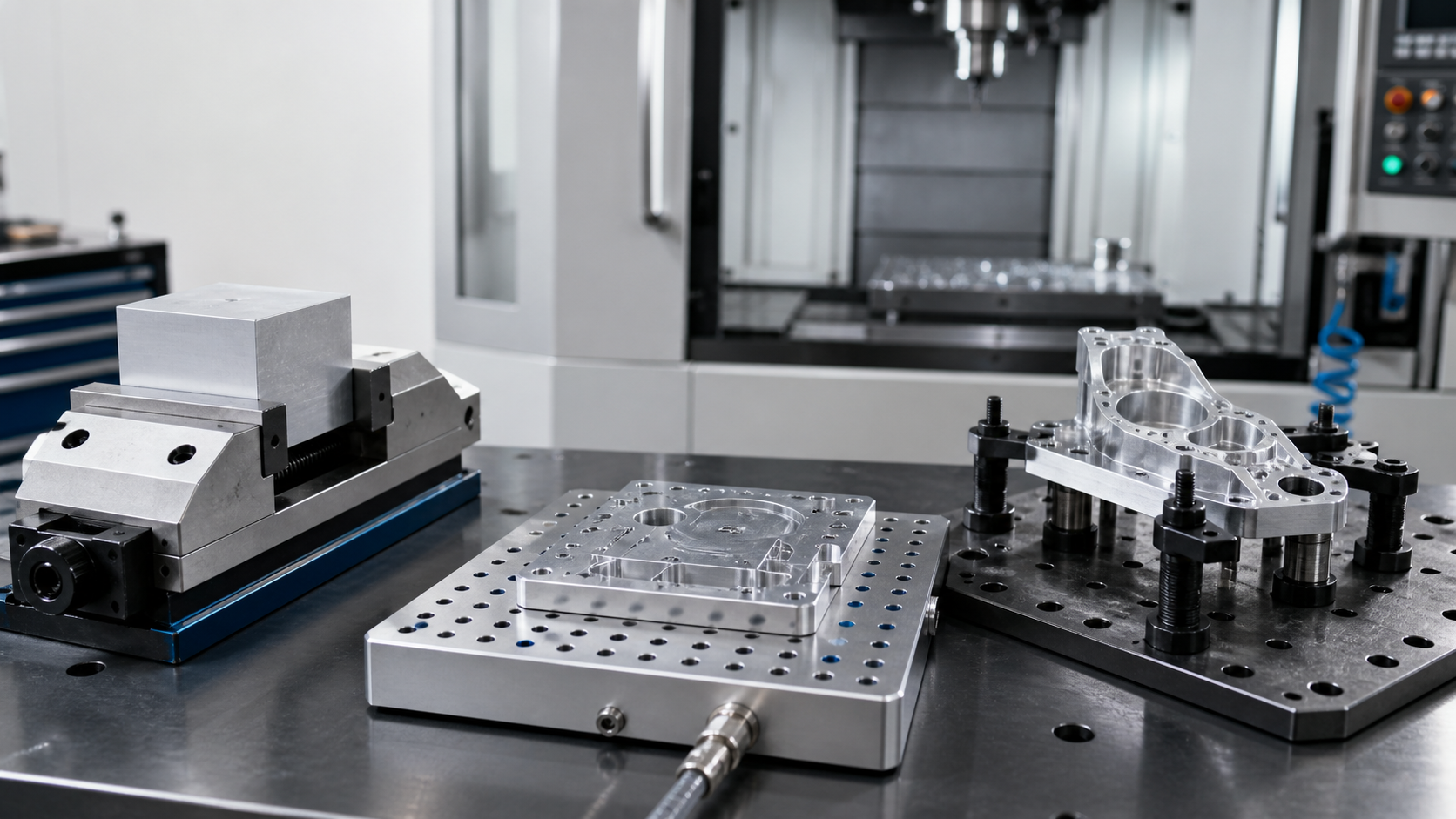
Hoy, Explicaremos tres métodos comunes de sujeción de piezas CNC utilizados en el mecanizado de precisión.: tornillo de banco, sujeción al vacío, y accesorio personalizado.
Sujetar piezas no es sólo “sujetar la pieza”
Mucha gente piensa que sujetar piezas significa simplemente fijar la materia prima en la máquina CNC.. En realidad, La sujeción de piezas es parte de la estrategia de mecanizado..
Un buen método de sujeción debe hacer tres cosas al mismo tiempo.:
- Sujete la pieza de trabajo firmemente durante el corte.
- Posicionar la pieza con precisión según el dato de mecanizado.
- Evitar la deformación, vibración, o marcas de abrazadera
Si una de estas condiciones no está controlada, La parte final puede parecer aceptable pero no funciona..
Por ejemplo, si una pieza se desplaza ligeramente durante el mecanizado, Las posiciones de los agujeros pueden cambiar.. Si la pieza de trabajo está demasiado apretada, Puede deformarse durante el corte y recuperarse después de soltarlo.. Si la segunda configuración no está alineada con la primera configuración, Es posible que las características de diferentes lados no coincidan..
Por eso el amarre está estrechamente relacionado con la calidad del montaje..
Tornillo de máquina: El método de sujeción CNC más común
Una prensa de máquina CNC es uno de los métodos de sujeción de piezas más utilizados en el fresado..
es sencillo, estable, y eficiente. Para piezas de forma regular como bloques, platos, paréntesis, y viviendas, un tornillo de banco puede proporcionar una fuerza de sujeción confiable y una configuración rápida.
En mecanizado de prototipos y producción de lotes pequeños, El tornillo de banco suele ser la primera opción porque es flexible.. El maquinista puede ajustar rápidamente la posición., sujetar diferentes materiales, y completar múltiples operaciones de mecanizado sin diseñar un accesorio especial.
Sin embargo, un tornillo de banco no es automáticamente seguro para todas las piezas. La superficie de sujeción, presión de la mandíbula, forma de parte, y la dirección de mecanizado deben tenerse en cuenta.
Si la pieza es delgada, suave, largo, o tiene estructuras débiles, una sujeción inadecuada del tornillo de banco puede crear deformaciones ocultas.
Una fuerza de sujeción excesiva puede causar deformación
Un error común en el mecanizado CNC es creer que una sujeción más fuerte siempre significa una mejor estabilidad..
De hecho, Una fuerza de sujeción excesiva puede deformar la pieza de trabajo..
Este problema es especialmente común con:
- Placas finas de aluminio
- Piezas de plastico
- Componentes largos y estrechos
- Carcasas de pared delgada
- Piezas de precisión con estrictos requisitos de planitud
Durante el mecanizado, La pieza puede verse forzada a adoptar una forma ligeramente deformada por el tornillo de banco.. Luego, la máquina CNC corta la pieza mientras está bajo tensión.. Después de completar el mecanizado y soltar el tornillo de banco, el material puede retroceder.
El resultado es una pieza que parecía correcta durante el mecanizado pero cambió de forma después de retirarla..
Esto puede afectar la planitud, paralelismo, posición del agujero, y ajuste de montaje. Desde la perspectiva del comprador, la pieza puede verse bellamente mecanizada, pero no se puede instalar correctamente.
Un buen mecanizado CNC requiere suficiente fuerza de sujeción para evitar el movimiento, pero no tanta fuerza como para que la pieza se deforme.
Sujeción al vacío: Una mejor opción para piezas planas y delgadas
Cuando ves una placa de fijación con muchos agujeros., surcos, o un patrón de cuadrícula, A menudo se trata de un sistema de sujeción de piezas por vacío..
La sujeción por vacío utiliza presión negativa para sujetar la pieza de trabajo contra la superficie del accesorio.. En lugar de aplicar una fuerte fuerza mecánica en varios puntos de sujeción, La presión de vacío distribuye la fuerza de sujeción a través de una superficie más grande..
Este método se utiliza comúnmente para piezas de trabajo planas y delgadas..
Por ejemplo:
- Placas finas de aluminio
- láminas de plástico
- Paneles planos
- Fundas electrónicas
- tableros compuestos
- Componentes planos de precisión
La principal ventaja del sistema de sujeción por vacío es que reduce la presión de sujeción local.. Esto ayuda a prevenir abolladuras., doblando, y marcas de abrazadera.
Para piezas donde la planitud y la apariencia de la superficie son importantes, La sujeción de piezas por vacío puede proporcionar un soporte más uniforme que las abrazaderas tradicionales..
La sujeción de piezas al vacío también tiene límites
La sujeción de piezas al vacío es útil, pero no es adecuado para todas las partes.
Funciona mejor cuando la pieza de trabajo tiene suficiente área de contacto con el accesorio.. Si la pieza es muy pequeña, muy estrecho, poroso, desigual, o tiene muchos agujeros pasantes, Es posible que la fuerza del vacío no sea lo suficientemente fuerte..
Otra limitación es la fuerza de corte.. El mecanizado de desbaste pesado puede crear fuerzas laterales que exceden el poder de retención del sistema de vacío.. en ese caso, bloques de posicionamiento adicionales, paradas laterales, o pueden ser necesarias abrazaderas auxiliares.
Por lo tanto, la sujeción de piezas por vacío no es simplemente un método “mejor” que un tornillo de banco.. Es mejor para ciertos tipos de piezas..
La elección correcta depende de la geometría de la pieza., material, carga de corte, tolerancia, y requisitos de superficie.
Se utilizan accesorios personalizados para piezas de trabajo especiales
Para piezas especiales, Los métodos de sujeción estándar pueden no ser suficientes..
Algunas partes tienen formas irregulares., superficies curvas, múltiples ángulos, paredes delgadas, o requisitos de mecanizado complejos. Es posible que estas piezas necesiten un accesorio personalizado diseñado específicamente para su geometría..
Un accesorio personalizado puede ayudar:
- Haga coincidir la forma de la pieza de trabajo
- Soporta zonas débiles o delgadas.
- Localice la pieza con precisión
- Reducir los errores de configuración repetidos
- Proteger las superficies cosméticas
- Mejorar la consistencia en la producción por lotes
En JADE-CNC, Los accesorios personalizados se utilizan a menudo cuando la pieza requiere un posicionamiento estable en múltiples operaciones de mecanizado..
Por ejemplo, si una pieza debe mecanizarse en varios lados, El accesorio puede ayudar al operador a localizar la pieza en la misma posición cada vez.. Esto mejora la repetibilidad y reduce el riesgo de que el ensamblaje no coincida..
El posicionamiento es tan importante como la sujeción
La sujeción evita que la pieza se mueva. El posicionamiento le dice a la máquina dónde está la pieza..
Ambos son importantes.
Es posible que una pieza de trabajo esté sujeta firmemente pero colocada incorrectamente.. en ese caso, el proceso de mecanizado aún puede realizarse sin problemas, pero las dimensiones finales pueden estar equivocadas.
En mecanizado CNC, El posicionamiento suele estar controlado por datos., pasadores de localización, bordes del accesorio, mandíbulas suaves, detener bloques, o superficies de referencia mecanizadas.
Para piezas que requieren múltiples configuraciones, El posicionamiento se vuelve aún más crítico.. Si la segunda configuración no coincide exactamente con la primera configuración, ubicaciones de los agujeros, bolsillos, trapos, o las superficies de contacto pueden moverse.
Esta es una de las principales razones por las que las piezas fallan en el ensamblaje, incluso cuando cada característica individual parece bien mecanizada..
El mecanizado de precisión no se trata sólo de dejar limpia cada superficie. Se trata de controlar la relación entre todas las características importantes..
La tolerancia de mecanizado ayuda a crear bordes finales precisos
en el vídeo, JADE-CNC menciona dejar suficiente margen de mecanizado en la materia prima. Este es un detalle muy práctico..
El margen de mecanizado significa que se reserva material adicional antes del mecanizado final.. Esto le da al maquinista suficiente espacio para eliminar los bordes ásperos., variación correcta de la materia prima, y crear dimensiones finales precisas.
Si la materia prima se corta demasiado cerca del tamaño final, Puede que no haya suficiente espacio para limpiar los bordes.. Errores de corte de sierra, deformación del material, o superficies irregulares pueden afectar la pieza terminada.
La asignación adecuada ayuda a mejorar:
- Precisión de borde
- Consistencia de la superficie
- control dimensional
- Apariencia final
- Repetibilidad de lotes
Para piezas de precisión, El margen de mecanizado no es un desperdicio.. Es parte del control de calidad..
El método correcto de sujeción depende de la pieza
No existe un único método de sujeción óptimo para todas las piezas CNC.
Un tornillo de banco puede ser mejor para bloques regulares y lotes pequeños.. La sujeción de piezas al vacío puede ser mejor para placas planas delgadas. Puede ser necesario un accesorio personalizado para piezas complejas o de producción repetida..
La decisión debe basarse en:
- Forma de la pieza
- tipo de material
- Grosor de la pared
- Tolerancia requerida
- Fuerza de corte
- Requisitos de superficie cosmética
- Número de configuraciones de mecanizado
- Cantidad de producción
- Función de montaje
Para compradores, Esto significa que el proveedor no sólo debe mirar el dibujo y cotizar el precio.. Un proveedor confiable de mecanizado CNC también debe evaluar cómo se sujetará la pieza., situado, mecanizado, inspeccionado, y ensamblado.
Una buena sujeción reduce el riesgo de montaje
Muchos problemas de ensamblaje comienzan antes de que la pieza llegue a la línea de ensamblaje..
Si el método de sujeción es incorrecto, El proceso de mecanizado puede crear errores ocultos.. Es posible que estos errores no sean obvios en las fotografías o en la inspección visual básica., pero pueden aparecer durante la instalación.
Una buena sujeción mejora:
- Precisión dimensional
- Alineación de agujeros
- Llanura
- Repetibilidad
- Protección de superficies
- Consistencia del lote
- Fiabilidad del montaje final
Esto es especialmente importante para los componentes de precisión utilizados en robótica., dispositivos de comunicación, equipo de automatización, dispositivos médicos, carcasas electrónicas, y maquinaria industrial.
Una parte que se ve bien no es suficiente.. debe encajar, función, y repetir constantemente.
Consejos prácticos para compradores de piezas CNC
Antes de realizar un pedido de mecanizado CNC, Los compradores deben proporcionar algo más que un archivo 3D..
Ayudar al proveedor a elegir el método de sujeción correcto, es útil compartir:
- 2Dibujos D con tolerancias.
- Dimensiones críticas de montaje
- Requisitos de referencia
- Superficies cosméticas
- Grado de material
- Cantidad
- Requisitos de tratamiento de superficie
- Entorno de aplicación
- ¿Qué superficies pueden tener marcas de abrazadera?
- Qué características deben alinearse con otras partes
Cuanto más comprenda el proveedor la función de la pieza, más fácil será elegir la estrategia correcta de sujeción y posicionamiento.
Conclusión
La sujeción de piezas CNC es uno de los factores ocultos detrás de la calidad del mecanizado de precisión.
Una pieza puede parecer perfecta pero fallar en el ensamblaje si se sujetó incorrectamente, mal posicionado, o deformado durante el mecanizado. Esta es la razón por la que las prensas mecánicas, sujeción al vacío, y los accesorios personalizados deben seleccionarse cuidadosamente de acuerdo con la geometría y función de la pieza..
En JADE-CNC, No tratamos la sujeción de piezas como un pequeño detalle de configuración.. Lo vemos como una parte importante del proceso de fabricación..
Eligiendo el método de sujeción correcto, controlar la precisión del posicionamiento, y dejando suficiente margen de mecanizado, Ayudamos a los clientes a recibir piezas mecanizadas por CNC que no solo tienen una apariencia limpia., pero también preciso, estable, y listo para el montaje.
Necesita piezas mecanizadas CNC personalizadas?
Envíanos tus dibujos, material, cantidad, y requisitos de aplicación. JADE-CNC puede ayudarle a revisar el diseño de su pieza y elegir una solución práctica de mecanizado y sujeción de piezas..
Tabla de contenido
Leo Liang, Fundador Mejor Socio de R&D
LEO, fundador de JADE-CNC, que aporta más de dos décadas de experiencia en la industria, Leo comenzó su carrera como aprendiz y practica sus habilidades en tratamiento de superficies y mecanizado CNC..