


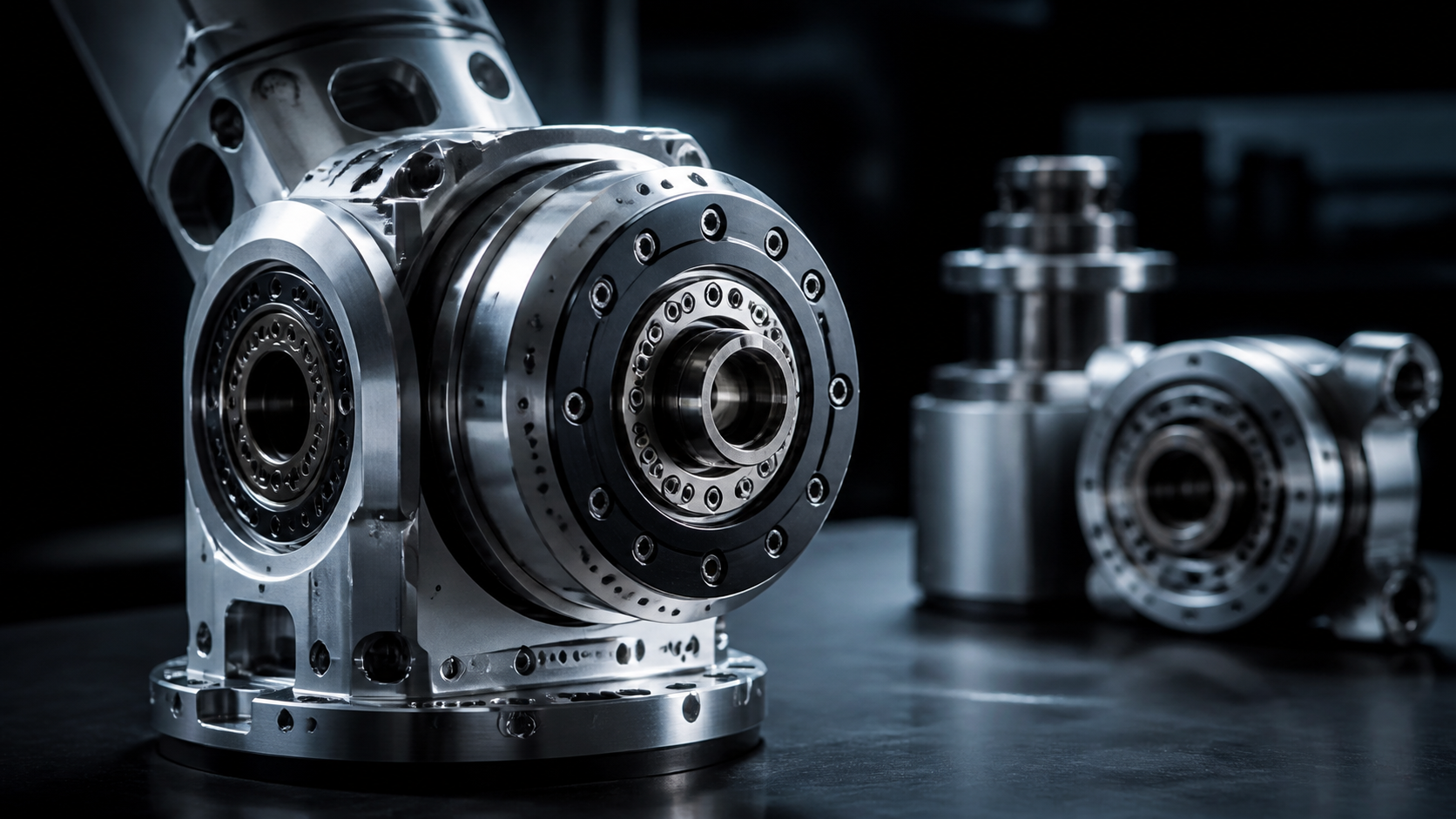
Nei sistemi robotici, la precisione del movimento inizia dall'articolazione.
A robot may look advanced from the outside, but its motion stability depends heavily on the precision of its mechanical components. Among them, the robot joint housing is one of the most critical parts. It supports bearings, gear systems, motori, and structural connections between axes.
In robot joint parts CNC machining, details such as bearing seats, mounting faces, riferimenti di dati, concentricità, and machining tolerance must be controlled carefully. Even small deviations in a joint housing can lead to misalignment, vibrazione, noise, uneven load distribution, e problemi di prestazioni a lungo termine.
Robot joint housings are not just structural parts. They directly affect motion precision, load transfer, e affidabilità del sistema.
What Is a Robot Joint Housing?
A robot joint housing is a precision mechanical component used to support and align the key motion elements inside a robotic joint.
Depending on the robot design, it may support:
- Bearings
- Harmonic drives or gear systems
- Motors
- Alberi
- Mounting faces
- Structural connection points
Its main function is to ensure accurate rotation and stable load transfer between robot axes.
If the housing is not machined accurately, the bearing may not sit correctly, the motor and gearbox may not align, or the joint may generate vibration during movement. For robotics applications, this can affect repeatability, precisione di posizionamento, service life, and overall system performance.
Bearing Seat Precision Is Critical
Bearing seats are among the most important features in robot joint housings.
A bearing seat must hold the bearing securely while maintaining proper fit, rotondità, and alignment. If the bore is too tight, assembly becomes difficult and bearing stress may increase. If it is too loose, the bearing may shift under load and reduce motion accuracy.
For many precision robot joint parts, bearing seat tolerance may need to be controlled within tight ranges such as ±0.01 mm, depending on the drawing and application.
Bearing seat quality affects:
- Rotation smoothness
- Montaggio in forma
- Load transfer
- Noise and vibration
- Bearing life
- Motion repeatability
This is why precision boring, careful tool selection, and strict inspection are essential during CNC machining.
Alignment Between Motor, Gearbox, and Bearing Must Be Controlled
A robot joint housing often connects several motion components together. The motor, cambio, harmonic drive, cuscinetto, shaft, and mounting surfaces must work as one system.
If these features are not aligned, the joint may experience uneven load, vibrazione, friction, or premature wear.
Important alignment requirements may include:
- Concentricità
- Parallelismo
- Perpendicularity
- Datum relationship
- Hole position accuracy
- Mounting face flatness
Nella lavorazione CNC, these requirements are controlled through datum planning, fixture design, multi-axis machining strategy, e ispezione. For complex robot joint housings, the relationship between features is often more important than any single dimension.
A part may look correct visually, but if the motor bore and bearing seat are not concentric, the final robotic joint may not perform correctly.
Thin Wall Structures Create Deformation Risk
Robotics parts often need to be lightweight. This is why many robot joint housings use thin wall structures, tasche, costolette, and optimized cavities.
Lightweight design helps reduce inertia and improve robot motion performance. Tuttavia, thin wall machining creates manufacturing challenges.
Durante la lavorazione CNC, thin walls may deform due to:
- Forza di taglio
- Clamping pressure
- Internal material stress
- Heat generation
- Uneven material removal
- Tool vibration
If deformation is not controlled, the final housing may lose flatness, rotondità, or dimensional stability.
JADE-CNC manages thin wall machining through optimized toolpaths, tenuta del lavoro stabile, controlled cutting parameters, proper machining allowance, and step-by-step inspection.
Heat and Vibration Affect Long-Term Performance
Robot joints operate under dynamic load. Motors generate heat, gears transmit torque, and bearings carry repeated movement. A joint housing must remain stable under these operating conditions.
Poorly machined surfaces, inaccurate bearing seats, or misaligned mounting faces can increase vibration and heat during operation. Over time, this may reduce service life or cause unstable motion.
For robotic systems, precision machining is not only about passing dimensional inspection. It is about supporting long-term reliability under real working conditions.
That is why robot joint housing manufacturing must consider both machining accuracy and application performance.
How CNC Machining Solves Robot Joint Housing Challenges
CNC machining is well suited for robot joint housings because it can produce complex cavities, accurate bores, mounting faces, fori filettati, and multi-angle features from metal or engineering plastic materials.
Presso JADE-CNC, robotic CNC machining services include more than cutting the part. Before production, we review drawings, File CAD, materiali, tolleranze, accesso allo strumento, surface finish requirements, riferimenti di dati, and inspection scope.
For robot joint housings and related motion parts, we typically apply:
- High-speed CNC milling for complex cavities
- Precision boring for bearing seats
- 5-lavorazione degli assi per caratteristiche multi-angolo
- Controlled machining strategies for thin wall structures
- Surface finish control for bearing and mounting interfaces
- Pianificazione dell'ispezione per dimensioni critiche
This process helps improve dimensional accuracy, affidabilità dell'assemblaggio, and part-to-part consistency.
Key CNC Machining Capabilities for Robotics Components
Robot joint parts often require a combination of milling, noioso, perforazione, toccando, girando, and surface finishing.
JADE-CNC supports precision components such as:
- Robot joint housings
- Brackets
- Alberi
- Pins
- Sleeves
- Bearing-related parts
- Motion system components
- Milled housings
- Turned features
Key machining capabilities include:
- Tight tolerance up to ±0.01 mm, depending on part geometry and drawing requirements
- Smooth surface finish for bearing interfaces
- Controlled deformation for thin wall parts
- 5-axis CNC machining for complex structures
- Rapid prototyping and small batch production
- Surface finishing such as anodizing, lucidatura, and coating
The final machining route depends on the part design, materiale, tolleranza, quantità, e requisiti di ispezione.
Selezione dei materiali per gli alloggiamenti dei giunti dei robot
Material selection affects strength, peso, stabilità della lavorazione, trattamento superficiale, e costo.
Common materials for robot joint housings include:
Alluminio 7075
7075 aluminum is lightweight and strong. It is often used when higher mechanical strength is required while keeping weight low.
Alluminio 6061
6061 aluminum is cost-effective, lavorabile, and widely used for robot housings, parentesi, and structural components.
Acciaio inossidabile
Stainless steel provides higher strength and corrosion resistance, but it is heavier and more difficult to machine than aluminum.
Titanio
Titanium is used for high-end applications requiring strength, peso ridotto, e resistenza alla corrosione. It requires careful machining control due to its material behavior.
Ingegneria delle materie plastiche
Materials such as POM, Nylon, and PEEK may be used for lightweight, a basso attrito, isolamento elettrico, or special application requirements.
A reliable machining supplier should help evaluate material selection based on the part’s function, tolleranza, quantità di produzione, and working environment.
Dal prototipo alla produzione in piccoli lotti
Robotics development often involves repeated design iteration.
A robot joint housing may be prototyped in small quantities, tested, modified, and then produced again. This makes fast response and flexible manufacturing important.
JADE-CNC supports:
- Rapid CNC prototyping
- Small batch production
- Drawing review before machining
- Design-for-manufacturing feedback
- Material and process suggestions
- Surface finishing coordination
- Inspection for critical features
For robotics teams, this helps shorten development cycles while maintaining precision requirements.
A good prototype is not only used to check appearance. It must also verify assembly, movement, allineamento, and long-term performance risk.
Why Inspection Matters for Robot Joint Parts
Robot joint housings usually contain several critical features that must work together. Inspection should therefore focus on functional dimensions, not only overall size.
Possono includere importanti punti di ispezione:
- Bearing seat diameter
- Bore roundness
- Concentricità
- Mounting face flatness
- Posizione del foro
- Qualità del filo
- Spessore della parete
- Dimensioni relative ai Datum
- Surface finish of contact areas
For high-precision parts, inspection reports may be required before shipment. This helps customers confirm whether the part meets the drawing and assembly requirements.
Conclusione
La precisione nel movimento robotico inizia con componenti meccanici accurati.
A well-machined robot joint housing helps ensure stable rotation, accurate alignment, smooth load transfer, e affidabilità a lungo termine. Bearing seats, mounting faces, riferimenti di dati, thin wall structures, and machining tolerances must all be controlled carefully.
JADE-CNC provides CNC machining services for robot joint housings and related motion components, supporting CAD-to-CNC manufacturing, selezione del materiale, precision milling, noioso, 5-lavorazione degli assi, finitura superficiale, and inspection planning from prototype to small batch production.
CTA
Looking for a robotics component manufacturer for robot joint housings or related motion parts?
JADE-CNC can review RFQ machining requirements for aluminum components, machined titanium parts, alloggiamenti fresati, turned shafts, perni, sleeves, and bearing-related features before confirming the most practical production route.
For projects often compared with a CNC turning parts factory, CNC turning aluminum parts factory, CNC turning parts manufacturer, O CNC turning parts manufacturers, JADE-CNC can also evaluate whether turning, fresatura, 5-lavorazione degli assi, or a combined process is the best solution.
The final process depends on the drawing, materiale, tolleranza, finitura superficiale, quantità, and inspection scope.
Sentiti libero di condividere i tuoi file CAD con noi.
Sommario

Leone Liang, Founder Best Partner with R&D
Il fondatore di JADE-CNC LEO, che vanta oltre due decenni di esperienza nel settore, Leo ha iniziato la sua carriera come apprendista e ha messo in pratica le sue competenze nel trattamento superficiale e nella lavorazione CNC.