



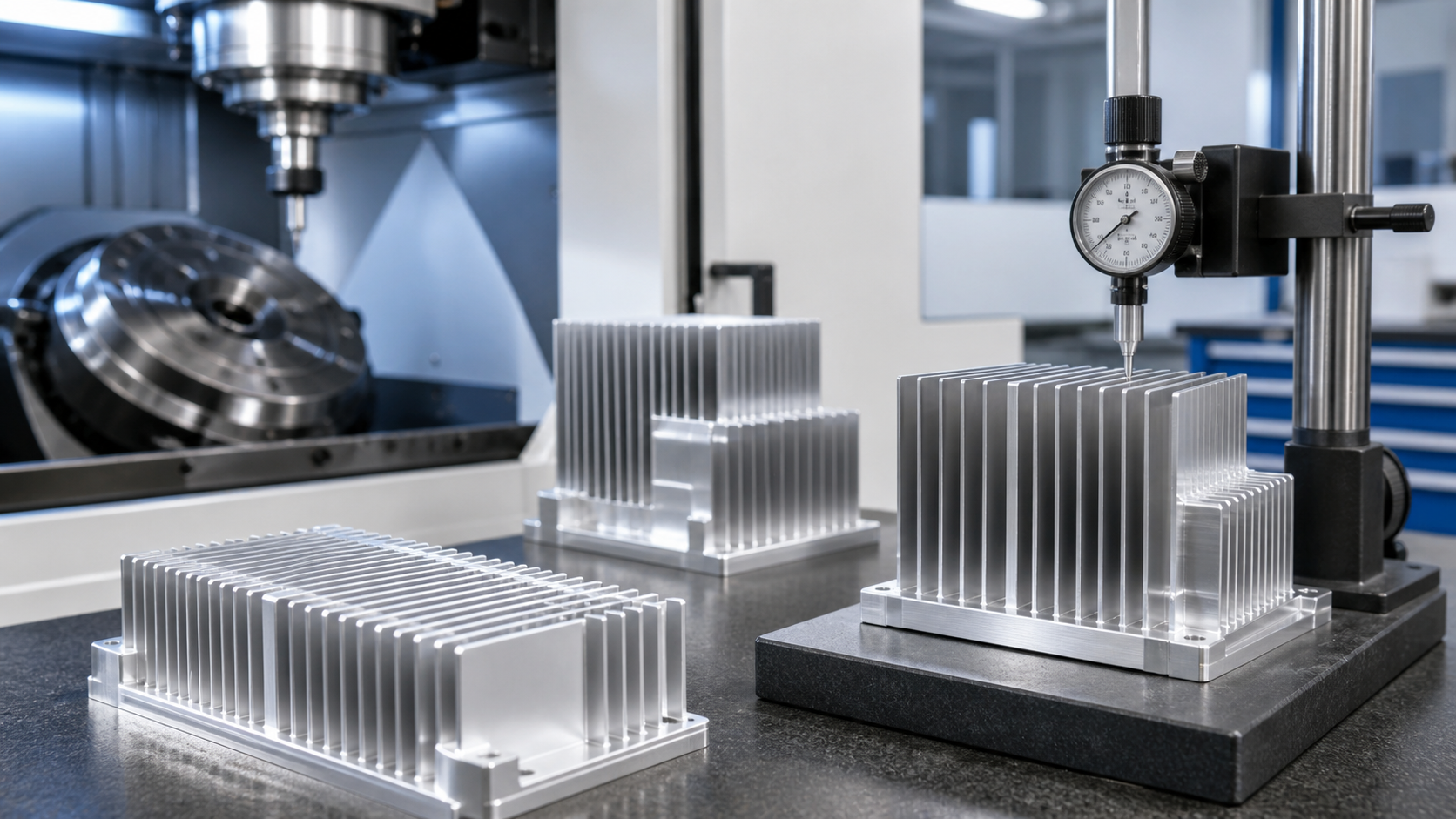
Aluminum heat sinks look simple from the outside, but they are often difficult to manufacture well.
The challenge comes from their structure. Many heat sinks include thin walls, deep grooves, delicate fins, large flat surfaces, and tight assembly requirements. During CNC machining, these features can easily deform, vibrate, or lose dimensional accuracy if the process is not controlled correctly.
For engineering teams, this creates a practical problem: the heat sink must provide reliable thermal performance, but it must also remain accurate enough for assembly. A part with bent fins, poor flatness, or unstable dimensions may affect contact with electronic components, reduce heat transfer efficiency, or create installation problems.
At JADE-CNC, we provide systematic solutions for aluminum heat sink CNC machining, from design optimization to final production.
Aluminum Heat Sinks Require More Than Simple CNC Milling
An aluminum heat sink is not just a block of aluminum with slots cut into it.
Its function depends on geometry, surface area, material behavior, contact flatness, and assembly accuracy. The fins must increase heat dissipation area, but they also create machining difficulty. The base must remain flat enough to contact the heat source properly. Mounting holes, threaded holes, and positioning features must stay accurate after machining.
This means heat sink machining requires both manufacturing experience and engineering control.
If the cutting process is too aggressive, thin fins may vibrate or bend. If the machining sequence is not planned correctly, internal stress may cause the part to deform after material removal. If inspection only checks external appearance, hidden flatness or dimensional problems may be missed.
For precision aluminum heat sinks, process planning is just as important as machine capability.
Thin Walls and Delicate Fins Are Easy to Deform
Thin fins are the most recognizable feature of many aluminum heat sinks, but they are also one of the biggest manufacturing risks.
During machining, cutting forces act on narrow structures. If the fins are too thin or too tall, they may vibrate, chatter, bend, or even break. Even if they remain intact, small deformation can affect the final appearance and dimensional consistency.
Thin walls create similar problems. As material is removed, the remaining structure becomes less rigid. The workpiece may release internal stress, shift slightly, or become sensitive to clamping force.
Common issues include:
- Bent fins
- Uneven fin spacing
- Chatter marks
- Poor surface consistency
- Base deformation
- Flatness problems
- Assembly mismatch
These are not only cosmetic issues. They can affect heat dissipation, mounting accuracy, and product reliability.
Deformation Risk Must Be Considered During Design
Some heat sink problems begin before machining starts.
If the design has extremely thin fins, sharp internal corners, very deep grooves, or insufficient support, the part may be difficult to machine consistently. A design may look good in CAD but become unstable during real production.
That is why design optimization is important.
JADE-CNC can review heat sink designs and provide manufacturability feedback. In some cases, small design adjustments can greatly improve production stability without affecting the part’s function.
For example, engineers may consider:
- Adjusting fin thickness
- Increasing root radius
- Optimizing fin height-to-thickness ratio
- Improving base thickness
- Adding support features
- Modifying groove width for tool access
- Clarifying flatness and tolerance requirements
Good design optimization helps reduce cost, improve quality, and shorten delivery time.
Machining Sequence Affects Dimensional Stability
For aluminum heat sinks, the machining sequence can directly affect final accuracy.
If too much material is removed from one side too quickly, the part may warp. If thin fins are machined before the base is stabilized, the structure may become weak too early. If finishing passes are not arranged properly, residual stress may affect the final dimension.
A controlled process usually includes rough machining, stress relief consideration, semi-finishing, finishing, and inspection. The exact route depends on the part’s size, geometry, tolerance, and quantity.
The goal is to remove material in a controlled way so the part remains stable throughout the process.
This is especially important for heat sinks with large flat bases, dense fins, and tight mounting requirements.
Stress Control Helps Prevent Warping
Aluminum is widely used for heat sinks because it offers good thermal conductivity, low weight, and machinability. However, aluminum stock may contain internal stress from extrusion, rolling, casting, or previous processing.
When CNC machining removes material, this internal stress may be released. The result can be warping, twisting, or dimensional change.
Stress control is therefore an important part of aluminum heat sink machining.
Depending on the project, JADE-CNC may control stress through material selection, machining allowance, balanced material removal, optimized cutting parameters, and process inspection. For some parts, stress-relieved material or staged machining may be recommended.
The goal is not only to machine the part accurately once, but to keep it stable after it leaves the machine.
Workholding Must Protect Accuracy and Surface Quality
Heat sinks often have large surfaces and delicate features, so workholding must be carefully planned.
If clamping force is too strong, the base may deform. If support is insufficient, the part may vibrate during fin machining. If the fixture contacts a functional surface incorrectly, it may leave marks or affect flatness.
A good workholding strategy should hold the part securely while protecting critical surfaces and supporting weak areas.
For prototype heat sinks, flexible workholding may be enough. For production quantities, custom fixtures may improve repeatability and reduce part-to-part variation.
Workholding is one of the hidden factors behind stable heat sink quality.
5-Axis CNC Machining Supports Complex Heat Sink Structures
Some aluminum heat sinks have complex shapes, angled features, multi-side machining requirements, or integrated mounting structures. In these cases, 5-axis CNC machining can help improve efficiency and accuracy.
5-axis machining allows the cutting tool to approach the workpiece from different angles with fewer setups. This can reduce repositioning errors and improve access to complex features.
For heat sinks, 5-axis capability may be useful for:
- Multi-sided features
- Angled fins or channels
- Complex mounting interfaces
- Integrated housings
- Precision aerospace or electronics components
- Parts requiring fewer clamping changes
By reducing repeated setups, 5-axis machining can improve consistency and shorten production time for suitable parts.
Quality Inspection Is Essential for Heat Sink Performance
A heat sink should not be judged only by appearance.
Important inspection points may include:
- Base flatness
- Overall dimensions
- Fin thickness
- Fin spacing
- Hole positions
- Thread quality
- Surface roughness
- Burr control
- Assembly fit
- Cosmetic condition
For heat sinks used in electronic devices, communication equipment, automation systems, or high-performance assemblies, inspection helps ensure the part can perform reliably.
JADE-CNC operates under ISO 9001 certified quality management, supporting consistent inspection and process control from prototype to mass production.
Production Capacity Matters for Both Speed and Consistency
Engineering teams often need heat sinks quickly, especially during prototype testing or product development. But speed alone is not enough. The supplier must also maintain stable quality across the order.
JADE-CNC is equipped with 50+ high-precision CNC machines and advanced 5-axis machining technology. This supports fast response, flexible production scheduling, and reliable machining for both prototypes and mass production.
For customers, this means a project can move from sample verification to batch production with better continuity. The machining process, inspection standards, and quality expectations can remain consistent as the order scales.
From Prototype to Mass Production, Process Control Is the Key
Aluminum heat sink machining requires a complete manufacturing mindset.
A successful project may include design review, material evaluation, workholding planning, stress control, machining sequence optimization, surface finish control, and final inspection.
For prototypes, the goal may be fast validation. For mass production, the goal becomes repeatability, cost control, delivery stability, and consistent quality.
JADE-CNC supports both stages by combining engineering feedback, CNC machining capability, 5-axis technology, and ISO 9001 quality management.
Practical Advice for Heat Sink Buyers
When requesting a quote for aluminum heat sinks, provide clear technical information, including:
- 2D drawings with tolerances
- 3D CAD files
- Aluminum grade
- Fin thickness and height
- Base flatness requirement
- Critical assembly surfaces
- Hole and thread requirements
- Surface treatment requirements
- Quantity
- Application environment
- Thermal or assembly constraints
If the heat sink connects directly to electronic components, make sure to specify the required contact surface quality and flatness.
Clear requirements help the supplier recommend a more reliable machining process.
Conclusion
Aluminum heat sinks are challenging because thin walls, delicate fins, and deformation risks must all be controlled during CNC machining. A good-looking heat sink is not enough. It must maintain stable dimensions, accurate mounting features, clean fins, and reliable thermal contact surfaces.
At JADE-CNC, we provide systematic solutions from design optimization to final production. Through optimized machining processes, stress control, advanced 5-axis CNC machining, 50+ high-precision CNC machines, and ISO 9001 certified quality management, we help customers receive reliable precision components from prototype to mass production.
Need custom aluminum heat sinks or precision CNC machined components?
Send your drawings, material, quantity, and application requirements. JADE-CNC can help evaluate your design and provide a practical manufacturing solution.
Table of Contents
Leo Liang, Founder Best Partner with R&D
JADE-CNC’s Founder LEO, who brings over two decades of industry expertise, Leo started his career as an apprentice and practice his skills in surface treatment and CNC machining.