



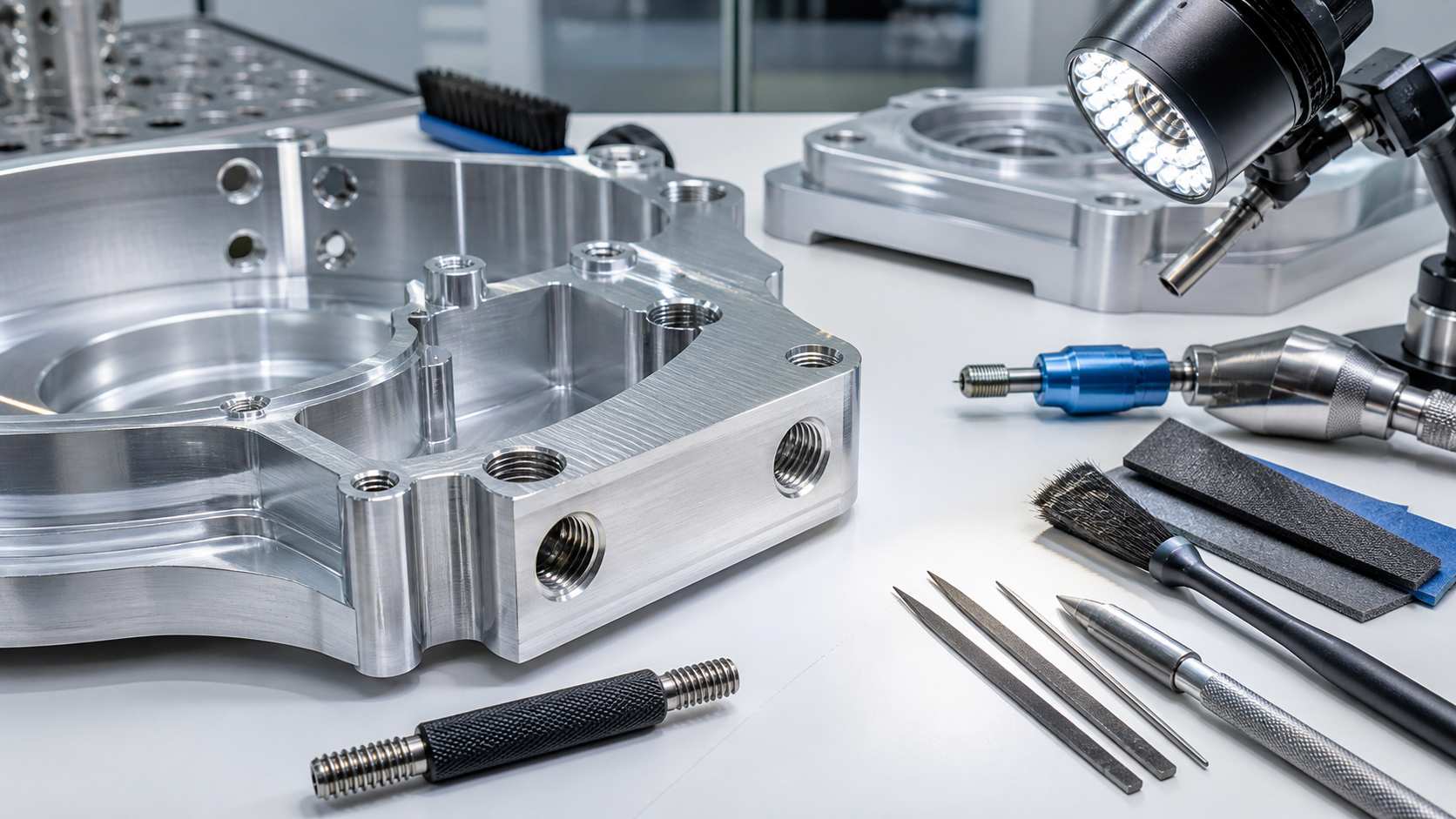
Les pièces CNC ne sont généralement pas parfaites immédiatement après l'usinage.
Même lorsque les dimensions sont précises et que le parcours d'outil est correct, de petites bavures peuvent rester sur les bords, trous, machines à sous, fils de discussion, et coins intérieurs. Ces bavures peuvent paraître mineures, mais ils peuvent affecter l'assemblage, traitement de surface, sécurité, et la qualité du produit final.
Avant qu’une pièce usinée CNC n’atteigne le client, il passe souvent par plusieurs étapes manuelles et d'inspection. Chez JADE-CNC, l'usinage de précision ne s'arrête pas lorsque la machine termine la coupe. Cela continue par l'ébavurage, lissage des surfaces, nettoyage interne, vérification des trous filetés, et inspection de l'éclairage.
Dans cet article, nous expliquerons les étapes clés du processus de nettoyage et d'ébavurage des pièces CNC de JADE-CNC.
L'usinage CNC n'est que la première étape
De nombreux acheteurs se concentrent principalement sur la machine CNC elle-même. Marque de la machine, nombre d'axes, capacité de tolérance, et la vitesse de coupe sont tous importants. Mais l'étape d'usinage ne représente qu'une partie du processus de fabrication complet..
Après qu'une pièce se détache de la machine CNC, il peut encore y avoir de petites bavures, arêtes vives, fluide de coupe, puces, poussière, ou des marques d'outils qui doivent être contrôlées.
Si ces détails sont ignorés, la pièce peut créer des problèmes plus tard.
Par exemple, une bavure près d'un trou fileté peut empêcher une vis d'entrer en douceur. Un bord tranchant peut rayer un autre composant lors de l'assemblage. Les copeaux laissés à l'intérieur d'une poche peuvent contaminer le produit final. Un bord rugueux peut affecter l'anodisation, peinture, ou qualité du placage.
C'est pourquoi le nettoyage après usinage est un élément essentiel de la fabrication de précision..
De petites bavures peuvent causer de gros problèmes d'assemblage
Une bavure est un petit morceau de matériau indésirable laissé après la coupe, forage, fraisage, tapotement, ou encastrement.
Les bavures sont courantes dans l'usinage CNC, surtout autour:
- Bords des trous
- Trous filetés
- Machines à sous
- Poches
- Parois minces
- Intersections entre surfaces
- Coins intérieurs
- Bords extérieurs tranchants
Même si les bavures peuvent être minuscules, ils peuvent causer de vrais problèmes. Ils peuvent bloquer l'assemblage, endommager les pièces d'accouplement, affecter les surfaces d’étanchéité, créer des erreurs de mesure, ou devenir une contamination lâche à l'intérieur d'un système mécanique.
Pour les composants de précision, le contrôle des bavures ne consiste pas seulement à améliorer l'apparence de la pièce. Il s'agit de s'assurer que la pièce peut fonctionner correctement.
Ébavurage initial avec des fichiers
Chez JADE-CNC, le processus de nettoyage commence souvent par un premier ébavurage à l'aide de limes.
Les fichiers sont des outils simples, mais ils sont très efficaces lorsqu'ils sont utilisés par des techniciens expérimentés. Ils aident à éliminer les plus grosses bavures des bords usinés et à préparer la pièce pour des étapes de finition plus fines..
La clé est le contrôle. Trop de limage peut endommager les dimensions, arrondir les bords importants, ou modifier l'apparence des surfaces cosmétiques. Trop peu de limage laisse des bavures qui peuvent affecter l'assemblage.
Cette étape nécessite que les travailleurs comprennent quels bords doivent être adoucis et quelles caractéristiques de précision doivent être protégées..
Un bon processus d’ébavurage n’enlève pas aveuglément de la matière. Il supprime uniquement ce qui ne devrait pas être là.
Le papier de verre fin aide à lisser la surface
Après un premier ébavurage, JADE-CNC utilise du papier de verre fin pour lisser les surfaces sélectionnées.
Un ponçage fin peut réduire la netteté, améliorer la sensation de la main, enlever les petites traces de bavures, et créer une surface plus propre avant le prochain processus. Ceci est particulièrement utile pour les pièces qui seront anodisées ultérieurement., peinture, placage, ou autre traitement de surface.
Cependant, le ponçage doit également être soigneusement contrôlé. Certaines surfaces peuvent être cosmétiques, tandis que d'autres peuvent être fonctionnels. Une surface d'étanchéité, siège de roulement, trou de précision, ou le bord à tolérance serrée ne doit pas être poncé avec désinvolture.
Pour cette raison, JADE-CNC considère le ponçage comme une étape de finition contrôlée, pas seulement une simple opération manuelle.
Les zones internes complexes nécessitent des outils spécialisés
Certaines bavures et éclats ne sont pas visibles de l'extérieur.
Les pièces CNC complexes peuvent inclure des poches internes, trous profonds, trous croisés, rainures, fentes étroites, et coins cachés. Ces zones peuvent piéger les copeaux, poussière, ou petites bavures après usinage.
Le nettoyage de ces zones nécessite des outils spécialisés. En fonction de la structure de la pièce, les techniciens peuvent utiliser des pinceaux, grattoirs, nettoyage de l'air, petits fichiers, ou d'autres outils de nettoyage de précision pour atteindre les caractéristiques internes.
Cette étape est importante car la contamination interne peut créer des risques cachés. Une pièce peut paraître propre à l’extérieur, mais les copeaux laissés à l'intérieur peuvent affecter l'assemblage ou le fonctionnement ultérieur.
Pour les pièces de précision utilisées en électronique, automation, robotique, appareils de communication, ou ensembles mécaniques, la propreté intérieure peut être tout aussi importante que l’apparence extérieure.
Les trous filetés doivent être propres pour un assemblage parfait
Les trous filetés sont l'un des domaines les plus importants à vérifier après l'usinage CNC.
Même une petite bavure, ébrécher, ou des résidus à l'intérieur d'un trou fileté peuvent causer des problèmes d'assemblage. Les vis peuvent sembler serrées, fil croisé, s'arrêter à mi-chemin, ou endommager le filetage lors de l'installation.
Chez JADE-CNC, les trous filetés sont nettoyés et vérifiés soigneusement pour garantir un assemblage fluide.
Cela peut inclure la suppression des puces, vérifier l'entrée du fil de discussion, nettoyer le fond des trous borgnes, et confirmer que la vis ou la jauge peut s'enclencher correctement.
Pour les acheteurs, ce détail est important car les problèmes de filetage n'apparaissent souvent que lors de l'assemblage final. D'ici là, les retouches peuvent retarder l'ensemble du projet.
Des trous filetés propres aident à réduire les risques d'assemblage et à améliorer l'expérience client.
L’inspection de l’éclairage aide à révéler les petits défauts
Après ébavurage et nettoyage, JADE-CNC effectue une inspection sous éclairage.
Un bon éclairage aide les techniciens à voir les petites bavures, arêtes vives, rayures, résidu, trous bouchés, et défauts de surface qui peuvent être manqués dans des conditions normales.
Les bords et les trous sont soigneusement vérifiés car ce sont des zones communes où subsistent des bavures.. Pour pièces complexes, plusieurs angles de vision peuvent être nécessaires pour confirmer que les zones cachées sont propres.
L’inspection de l’éclairage est une étape de contrôle qualité simple mais importante. Cela permet de garantir que chaque détail visible est confirmé avant que la pièce ne passe au processus suivant..
Chaque détail est confirmé avant le prochain processus
Après nettoyage et inspection, la pièce peut être anodisée, peinture, placage, polissage, assemblée, conditionnement, ou livraison directe.
Si des bavures ou une contamination subsistent avant le traitement de surface, la finition finale peut présenter des défauts. Si les trous filetés ne sont pas propres avant l'assemblage, les vis peuvent ne pas s'ajuster correctement. Si les bords ne sont pas vérifiés avant la livraison, le client peut recevoir des pièces qui semblent inachevées.
C'est pourquoi JADE-CNC confirme les détails avant le début du prochain processus..
Cette approche étape par étape permet d'éviter que les problèmes ne progressent en production.. Cela réduit également les retouches, améliore la cohérence, et prend en charge une livraison fiable.
L'ébavurage protège à la fois la fonction et l'apparence
L’ébavurage est souvent considéré comme une étape esthétique, mais il a une valeur à la fois fonctionnelle et visuelle.
Fonctionnellement, cela aide les pièces à s'assembler en douceur, réduit les interférences, protège les composants correspondants, et enlève les matériaux lâches. Visuellement, cela améliore la qualité des bords, propreté des surfaces, et l'impression générale de la pièce.
Pour des pièces CNC de haute qualité, l'acheteur ne doit pas voir de aspérités, trous bouchés, ou des bavures évidentes. La pièce doit être prête à être assemblée ou finie.
C'est pourquoi l'attention portée aux petits détails fait partie de l'usinage de précision..
10. L'usinage de précision commence par une attention aux détails
Le message de JADE-CNC est simple: l'usinage de précision commence par une attention portée à chaque détail.
Une machine CNC peut couper la géométrie, mais les personnes et le contrôle des processus complètent le rôle. Ébavurage, ponçage, nettoyage interne, vérification des fils, et l'inspection de l'éclairage font tous partie de la qualité finale.
Pour les clients, ces étapes signifient moins de problèmes d'assemblage, surfaces plus propres, meilleurs résultats de finition, et des pièces plus fiables.
Conseils pratiques pour les acheteurs de pièces CNC
Lors de la commande de pièces usinées CNC, cela permet de définir clairement les attentes en matière d'ébavurage et de nettoyage.
Les acheteurs doivent préciser:
- Si les arêtes vives doivent être brisées
- Quels bords doivent rester tranchants
- Exigences du fil
- Exigences de propreté
- Surfaces cosmétiques
- Traitement de surface après usinage
- Trous ou fentes critiques pour l'assemblage
- Si les puces internes sont inacceptables
- Normes d’inspection si nécessaire
Une simple note de dessin telle que « ébavurer tous les bords » est utile, mais pour les composants de précision, des notes plus détaillées peuvent éviter les malentendus.
Conclusion
Les pièces CNC ne sont pas toujours parfaites immédiatement après l'usinage. Petites bavures, puces, arêtes vives, et des résidus internes peuvent rester, surtout autour des trous, fils de discussion, machines à sous, et des fonctionnalités complexes.
Chez JADE-CNC, nous suivons un processus complet de nettoyage et d'ébavurage. Nous utilisons des limes pour l'élimination initiale des bavures, papier de verre fin pour lisser la surface, outils spécialisés pour les domaines internes complexes, nettoyage soigneux des trous filetés, et inspection de l'éclairage pour chaque bord et chaque trou avant le processus suivant.
Cette attention aux détails permet de garantir que les pièces usinées CNC sont propres, précis, prêt pour le montage, et adapté à une finition ultérieure.
Besoin de pièces usinées CNC propres et fiables?
Envoyez vos dessins, matériel, quantité, et exigences d'assemblage. JADE-CNC peut aider à fabriquer des composants de précision avec un contrôle minutieux des processus, de l'usinage à l'inspection finale..
Table des matières

Léo Liang, Fondateur Meilleur partenaire avec R&D
LEO, fondateur de JADE-CNC, qui apporte plus de deux décennies d'expertise dans l'industrie, Leo a commencé sa carrière en tant qu'apprenti et met en pratique ses compétences en traitement de surface et en usinage CNC..